

Has the Hockey Specialization Pendulum Swung Too Far?: An HSC Meta-analysis-
Has the Hockey Specialization Pendulum Swung Too Far?: An HSC “Meta-analysis”
From athletic development to higher education, I'm as big a proponent of a general, well-rounded approach as anybody.
So when I read David Epstein's book Range: Why Generalists Triumph in a Specialized World, all I was exposed to was a big hunk of confirmation bias with examples to back up what I already believe: that being well-rounded and not specializing leads to better long-term outcomes.
Regardless, I enjoyed reading along despite my acknowledged agreement. It was like porn, except for my educational philosophy, not useful for anything but stroking my ego.
“Yeah! Screw Tiger Woods!” I found myself thinking throughout the first chapter comparing the Tiger's specialized, predetermined upbringing to tennis star Roger Federer, the case study for a varied upbringing with multiple sports and activities.
My hypothesis—as Anthony Donskov would call it—seemed to grow stronger and stronger.
Yet, at that moment I realized I needed to step back.
Has the pendulum swung too far in the other direction?
Are we all going to start taking a generalized approach with our athletes, and never preparing them for their main sport? Of course, there is no definitive answer, and every situation varies.
But as the maxim goes, attributed to Mark Twain, “Whenever you find yourself on the side of the majority it is time to pause and reflect.”
Let's not forget that a few years ago, many preached the Tiger Woods model of development.
To aid us in our reflection, I've dug into the archives to find discussions for both sides, a podcast from Joey Garland, the owner of Elite Training Systems in Windsor, ON and former strength coach of the Windsor Spitfires (OHL), and an article from Darryl Nelson, the former head strength coach for the U.S. National Team Development Program (NTDP).
—————————————————————————————————————————————-
Enter Darryl: This article was originally published on 5/10/2017
There seems to be an ongoing debate about sports specialization for kids. Some people seem to advocate playing one sport starting at a very young age while others advocate playing many sports throughout high school. One school of thought views early specialization as the best bet for success. The other views generalization as the optimum route. My viewpoint, which I have attempted to form based on our models of Long Term Athlete Development falls in between.
I feel that specialization can be good if it's done correctly.
For little kids 12 years old and under it is absolutely essential that a wide array of sports are played. These sports should be as varied as possible and include vastly different environments. For example, young kids should be doing stuff in the water, on fields and courts, on snow and ice, and even some air-born sport. Learning in these environments for kids under 6 years old builds a foundation on which they can learn more complex skills later on. Up to age 10, kids should master gross motor skills and their hockey specific training should be limited to 60 days per year.
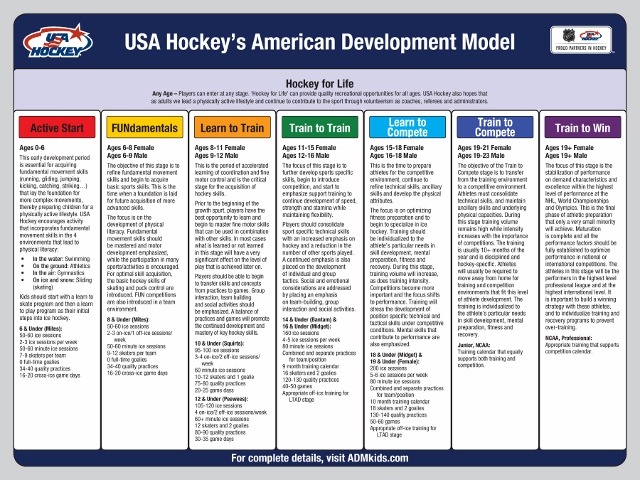
Starting at age 10 kids can begin learning fine motor skills or sport-specific skills. This time is critical for developing things like stickhandling and shooting and age 10-12 is viewed as a 'golden' age for skill development. At this age hockey, specific training can be increased to a range of 100 to 120 days per year with one-hour-long sessions. However, it is also important to note that other sports should still be played.
Over the age of 12 is where kids can begin to specialize in ice hockey a bit. At 13 to 15 years old I would recommend participation in only 2 sports. Hockey specific training can increase from one hour to 1.5 hour-long sessions in the range of 120 to 130 days per year. Also, at this point, the number of games can be increased as competition has a more important role to play in development.
Now starting around 15 or 16 years old is when I think kids should specialize in hockey. By this age, foundational movement skills, as well as fine motor sport-specific skills, have been mastered and their window for train-ability is passed. Now is the optimal age for developing fitness traits and competitiveness. At this stage, players will need around 200 days of on-ice hockey specific training and 50 to 60 of those days should be games.
Critics of this model always use the argument that early specialization will be a detriment. However, what they fail to understand is this is not early-specialization. It is late-specialization. By age 16 to 18 years old, physical growth and maturity are 3/4 complete and the players are nearly a finished product. At this age, it is too late to build movement literacy and greatly increase fine motor skills. At this point, the emphasis of training changes to tactics and strategy, position-specific requirements, competitiveness, and fitness, strength, and power training. Therefore, when I advocate specialization I am actually recommending late specialization and not early specialization.
—————————————————————————————————————————————-
To me, Darryl brings up a whole new discussion. Perhaps it's not about generalization and specialization— but when to do one or the other.
Elite level hockey players can't spend four months of the year playing another sport—refining their skillset requires consistent practice. But, even for the specialized, developed player, their broadened activities—whether off-ice training or a walk in the park for mental recuperation and pondering—are necessary.
Can specialization and generalization co-exist? They can, and they should.
Yet, we can't forget about the dangers of early specialization. Here, I've transcribed a section of a conversation between our own Brian Sipotz and Joey from 2018.
—————————————————————————————————————————————
For context, Joey is talking about the current research he's involved with.
Joey: In this study, most of the kids started specializing at age 12. Hockey was all they did twelve months a year.
Brian: And so, of course, you'll start to see overuse injuries and burnout. And there are psychological and physical issues with that.
Joey: For sure. At that stage, they were training, competing, and practicing around forty hours a week. The players and families viewed that age as the age they needed to make a decision. And of course, the relative age effect comes into play so these kids don't really know what they're going to be good at yet.
Brian: And if you ask most twelve-year-olds they'd say “Yeah, I wanna be in the NHL,” but they have really no idea what that's like or what trip that takes.
Joey: Part of the reason I started to get into research was due to my work with the [Canadian] national junior team. This team is the elite of the elite in Hockey Canada, the best 19-year-olds in the world. And one of the kids could not throw a ball. One day we were warming up—and I tried to have fun with the warm-up because I was there in a blended role as strength and conditioning coach and athletic trainer—and we had a lot of open space so we threw a basketball around, a baseball, a football. And the football fell to this kid's feet and he could not pick it up to throw it.
At first, I thought he was left-handed just messing around trying to throw with his right hand to goof around. We all laughed, and he didn't understand why we were laughing. He could not throw. He had literally never thrown a football in his life. Less than a year later this player had double hip surgery and two serious shoulder injuries. He's never cracked an NHL roster even though he was a high 1st round pick and on the national junior team. The lack of athleticism eventually caught up to him.
Brian: Yeah, and I think you could pull up a dozen stories like that.
Listen to the full conversation:
—————————————————————————————————————————————
Although this is just an anecdote, and anecdotes should not be confused for research, it's a powerful one. I'm excited to hear the findings of Joey's reserach.
A close reading of both of these reveals there's nothing contradictory about Darryl's thoughts and Joey's. As Darryl asserts, “At 13 to 15 years old I would recommend participation in only 2 sports.” So, it's not about whether specialization is good or bad, but when.
Another question this brings up for me is, what is the benefit of doing “generalized” activities for “specialized” athletes?
Do NHL players benefit physically from playing Spikeball or pick-up volleyball? Or should all of their physical resources be dedicated to on-ice work and training?
I have no idea, I'm just posing the question.
Lastly, this doesn't at all touch on the mental parameters. As Justin went deep on in our recent podcast, there's more to an athlete than just who they are as a player, and that's essential for every player, but even more so for kids, who haven't formed who they are as a person and are malleable to a myriad of influences.
Which is all to say, hockey specialization is not as simple as “at X age a player should specialize,” as every player and situation is unique. But we can still develop general guidelines and then adjust to the individual from there.
