

How Michelle Boland Fixed My Hips in 25 Minutes
I'm not particularly good at anything. Except for one thing: Volunteering at conferences.
I'm an all-pro hand raiser as soon as a speaker asks for a volunteer.
One day it might come back to bite.
But at the 2018 NSCA Vermont State Clinic, it turned out to be a great decision.
Dr. Michelle Boland was presenting on her movement principles in her presentation titled Position Defined: Paradigm Shift in Sports Performance, some of which she outlined in our latest podcast.
But of course, she needed a guinea pig for the hands-on portion. That's where I come in.
Upon walking over to the weight area at the University of Vermont's gym, where Michelle was presenting from, I stepped into a hex bar with 25 lb plates on each side—light work. I could 100 of those.
As I stood with my feet planted in, Michelle asked me to extend my arms out and give a deep exhale. Then, I slowly descended to grab the bar, trying to maintain the position she helped me set up in. I grabbed the handles like they were delicate glass and raised the hex bar to the top position, struggling to keep my “ribs down.” Within a handful of reps, I could barely lift 95 lbs. We moved on to push-ups (yes, bodyweight only) and the slideboard. By the end, I felt like my hips had gone through a blender and then realigned themselves in the perfect position, with each bone and muscle resting in the position it was meant to.
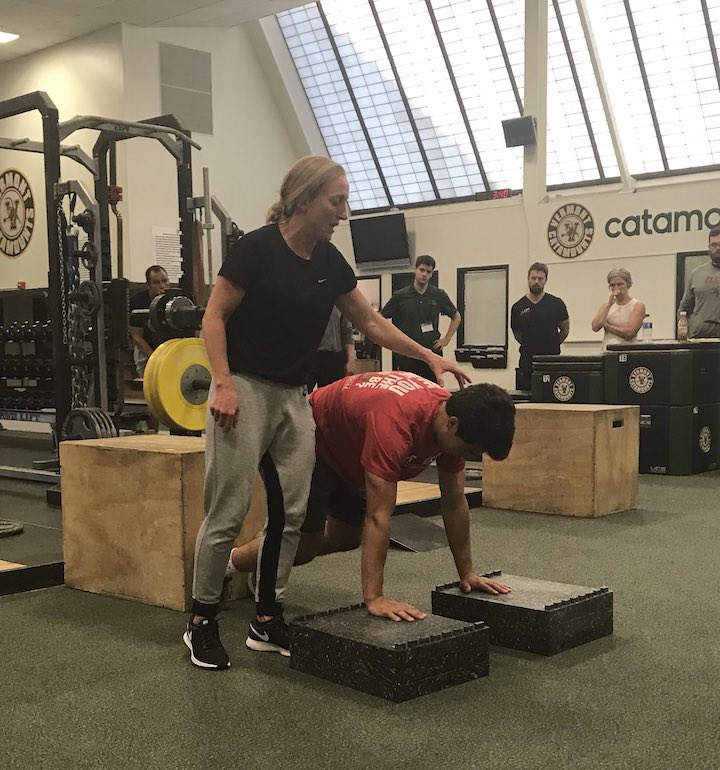
It's all a blur. At the time I had no clue how she did it. But my chronic lowkey hip pain disappeared.
Then, of course, some guy, let's call him Chad, asked Michelle, “Well, this is great, but do you have data on injury reduction in the Northeastern Women's hockey team with this data,” or some shit like that. Before she could answer, I did.
“My hips have never felt better.”
I'm not sure if I should've butt in, but then I saw Justin Smith behind the whole crowd giving me the thumbs up, and that's when I knew I did the right thing.
Chad if you're reading this, I'm sorry I had to villainize you for the purpose of this story. And of course, being data-driven is hugely important. But sometimes anecdotal evidence repeated over and over is the data, even if it won't ever get published in a journal.
The day after the conference I bought her exercise database, and it changed the way I coach so many exercises, from hex bar deadlifts to split squats to push-ups. And, because I train like that now, my hips don't hurt. As a coach, it's a resource I still use two years later to refine how I coach certain exercises. In fact, I attribute this presentation and resource as a large part of how I nearly eliminated hip and groin injury in an entire Junior Program.
This is all to stay, Michelle is the real deal.
And next Monday, May 18th Michelle is opening up her Strategy Course Group Mentorship, a twelve-week program for coaches to develop their own training principles and systems. If you're looking to fill a void in your continuing education right now, I'd highly recommend checking it out.
And of course, if you haven't, check it Michelle's article on Change of Directions Skills on the site.
Oh, and next time you're at a conference, raise your hand. You might learn an extra thing or two.
