

Mindful Cueing In Training
Mindfulness training has appeared with greater frequency in sports since George Mumford and Kabat-Zin's partnership in basketball; Kris Beech's work in hockey; and the publication of efficacious team-tested models, like the Mindfulness Acceptance Commitment and Mindful Sport Performance Enhancement program. Over several years, a colleague and I intertwined mindfulness into warm-up protocols with positive results. This article delivers knowledge empowering you to fine-tune language in your preexisting programming and provide athletes with mindfulness skills to acknowledge distractions, let them go, then refocus, or, mindful cueing.
Cueing is Sharing a Vocabulary Where Specific Phrases Gain Special Meaning
When you coach a movement, single words or phrases are often loaded with instruction. ‘Be mindful while you do this' isn't any different – it's a simple phrase laden with meaning. Let's share a vocabulary to ensure we understand one another and, when you deliver mindfulness skills to your athletes, you and your players stay on the same page.
Mindfulness Is Paying Attention In a Particular Way.
You pay effortful attention to the present, the task you're engaged in, and do so non-judgmentally, without attachment (Gardner & Moore, 2004; Kaufman, Glass, Pineau, 2018; Giges, 2011). Mindful attention focuses on something while distractions are ignored. You might tune in to your environment, opponent, thoughts, emotions, or the physical sensations you're experiencing (Garnder & Moore, 2007; Kaufman, Glass, Pineau, 2018; Giges, 2016).
‘Non-judgmentally' means you don't assign personal meaning to what you're doing or have done (e.g. calling something good, bad, helpful, unhelpful, success, failure; Giges, 2011). You're an objective observer. The phrase ‘without attachment' indicates you're not dwelling on a distracting feeling, thought, or event. You either choose to engage the distraction or shift focus to what's happening at the moment. Being mindful during sport and training doesn't mean changing what you do, just the way you pay attention while you do it.
To ignore distractions, players will exercise a skill alongside mindfulness called ‘acceptance.' It's the ability to notice and let a distraction ‘just be.' Ideally, players will become capable of paying attention to what's important, noticing when they're distracted, then refocusing without pursing the distraction further.
What's the Benefit to My Athletes?
Flow
Mindfulness is closely linked to flow. Athletes won't have flowing, personal best experiences every game or practice. Developing mindfulness skills helps them train and play in a way similar to when they flow. When an athlete is mindful, they're fully focused on what they're doing, immersed in the process, and little else gets their attention. If something pulls attention away momentarily, they're easily able to shift focus back to the task at hand (Gardner & Moore, 2005). This makes mindfulness a powerful tool for performance enhancement.
Focus
Regular mindfulness practice also benefits a player's ability to focus attention on a single task, engage in attentional switching from one focal point to another as a situation demands. If it becomes a consistent focal point of practice, mindfulness skills enhance emotional regulation (behaving in the way you'd like to in the presence of emotions).
Awareness and Tolerance
Benefits for your athletes, like better awareness of their bodies and physical sensations in their environments as well as a greater tolerance to discomfort may facilitate the training process. There are benefits to:
- Interoceptive awareness
- Getting them to learn movements and what to feel
- Tactile awareness of your environment
- Getting them aware of their body's contact with the environment
- Pain tolerance
- Perception or experience of pain
These benefits stem from mindfulness's impact on the way related brain areas communicate and the physical structure of those areas with links to sport performance (Davidson et al., 2003; Tang et al., 2015). The link to performance isn't ‘winning-at-sports' - there's no single drill for that. There's a link to sport performance in terms of the tasks athletes need to perform with efficiency to function in sport. We'll quickly dive into a neuro lesson for the folks who, similarly, like facts over ‘Yeah, bro. Just, like, do it or whatever. It's science or something, I bet.'
A Quick Dive into the Neuroscience of Mindfulness
Parts of Your Brain Important to Attention and Attentional Switching
There are brain areas with significant involvement in focus and the fluid shifting of focus. These are the:
- Anterior cingulate cortex (ACC). It plays a large role in the ability to focus attention while ignoring distractions (van Veen & Carter, 2002).
- Fronto-insular cortex (FIC) [composed of ventrolateral prefrontal cortex and part of the insular cortex (IC)], which is also involved in attention (Fan et al., 2005; Posner & Rothbart, 2007)
- The ACC's communication with FIC and the dorsolateral prefrontal cortex (DLPFC) is important in attentional switching (Kondo et al., 2004; Sridharan et al., 2008).
ACC, FIC, DLPFC all play a role in attention and attentional switching, which is important in athletics. These brain areas' structure or ability to communicate are positively impacted by mindfulness practice.
Areas with Importance to Emotional Regulation
Like focus of attention, emotional regulation is a brain-based phenomenon. Structures like the:
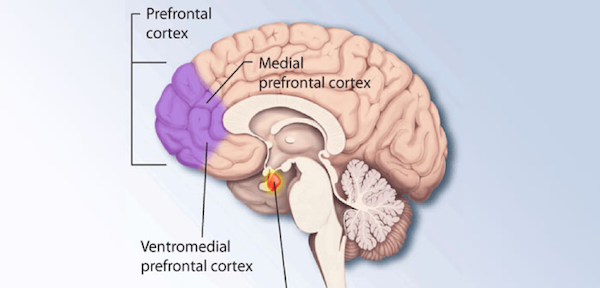
- ACC, IC, and areas of the prefrontal cortex are involved in emotional regulation, too (Banks et al., 2007; Diekhof et al., 2011).
- The Amygdala has a role in the experience of negative emotion (Zald, 2003). DLPFC and dorsal medial prefrontal cortex (DMPFC) have a similar relationship to the amygdala and emotion regulation (Banks et al., 2007).
- The ventromedial prefrontal cortex [VMPFC] (Diekhof et al., 2011) is involved, because of its connections with the amygdala (Zald, 2003).
- Activation of the VMPFC is inversely correlated with activation in the amygdala when people try to regulate or function in the presence of negative emotion (Urry et al., 2006).
The ACC, OFC, DMPFC, and amygdala are all part of an emotion regulation circuit. Think of the aggressiveness in gators example from ‘Water Boy.' The ability to perform in the presence of potentially unpleasant or distracting emotions is all-important to sport performance.
Do You Need to Devote Years of Practice and Be Expert?
Fortunately, your athletes don't need years or months of rigorous, long-form practice to benefit from mindfulness training. However, being advanced at mindfulness training and mindful meditation as a general practice doesn't hurt.
- Advanced meditators (which is mindfulness practice) have greater activation in the DMPFC and rostral ACC and increased gray matter in areas associated with attention and emotion regulation (IC, ACC, VMPFC) when compared to nonmeditators as well as reduced activation of the amygdala (Fox et al., 2014; Wheeler et al., 2016).
- That's fine for advanced folks, but we see the same changes beginning in novice mindfulness practitioners in the areas related to emotional regulation and intentional attention (Wheeler et al., 2016).
Benefits for S&C's Incorporating Aspects of Mindfulness--and mindful cueing--into Their Work
Outside of the mental game benefits to sport performance, there's spillover to what you do in the weight room.
- The IC has a role in interoceptive awareness (Fox et al., 2014).
- Enhanced somatosensory cortex function means a greater ability to process tactile information (Fox et al., 2014).
- Structural and functional changes in these areas for meditators were associated with greater pain tolerance (Grant, Courtemanche, Duerden, Duncan, & Rainville, 2010; Zeidan et al., 2011).
Knowing what you know now, you're hopefully asking, ‘does mindfulness training fit into my program?' Probably, yes. Circling back, mindfulness training is wrapped into your warm-up or cooldown by adapting your cues to include prompts and instructions on being mindful.
Where Does Mindfulness Fit?
Apply interoceptive awareness cues to exercises that aren't explosiveness- or power-focused. Things like iso holds, breathing and bracing, resets, CARs, warm-up or cooldown mobility or flexibility exercises, ‘gain conscious control of XYZ' movements all lend themselves to mindfulness cueing. Timed exercises lend themselves well to mindfulness practice. If you're doing something with a rep count, you'll find a comfortable rhythm with practice.
You will teach and coach movements the way you normally do and interject new cues to encourage a mindful focus on something specific or the letting go of distractions. When you're cueing for internal awareness:
- What are you feeling?
- Where are you feeling it?
- This is what you should be feeling when it's correct.
- Recreate that feeling.
- If you become distracted, gently shift your focus back to what you are doing.
You're able to apply a mindful perspective in speed and agility or power-focused work. When your player is doing an exercise, you can help them learn to disengage from distracting thoughts or emotions with the non-judgmental component of mindful attention. This means:
- Pay attention to what you're doing
- See an error or difficulty, take it for what it is, and respond to it.
- Notice I quit/this is too hard/I don't want to thoughts and feelings as ‘just thoughts' that don't need to be bought into and gently shift focus back to the task.
Mindful cueing is simple when you learn the terminology and how to fit it into what you already teach. Build reminders of ‘what's expected' into the exercise (e.g. what to pay attention to, what to feel, what to do if you lose focus), the same way you would when describing a complex drill or lift. In my experience, it's helpful to pepper reminders during longer exercises or use longer drills to more fully flesh the mindfulness components of a drill out as players go.
Troubleshooting and Answering Questions
With any drill or exercise, you will receive questions and identify players who encounter difficulties. Many of the questions I get are to do with challenges in becoming distracted, the acceptance component, what to refocus on after letting a distraction go. Some are to do with being ‘perfect' at mindfulness, too.
Remind your athletes it's normal and okay to get distracted - everyone does. When you initially try to reel in your focus or be mindful, it's not unusual for your thinking to go in a million different directions. Being distracted, bored, thinking about other things isn't bad or problematic either – they're just not what you need to focus on at the time. It's literally impossible not to get distracted; the real skill is in getting distracted and reeling yourself in quickly and fluidly to refocus without beating yourself up for it. There's a component of acceptance to that process that they may or may not have down pat.
Acceptance is easily explained with examples. For instance, watching game film. Do you get mad, yell at yourself on screen, throw chairs when you get beat, or do you notice what happened and identify ways to address it despite thoughts or feelings in the background? When you notice a distracting thought or emotion, it can ‘just be' something you're experiencing right now. You choose to give thoughts or emotions meaning, so you can just as easily choose to momentarily acknowledge either and ‘let them be.'
When it's time to refocus, many people overthink it and don't know where to put their attention. Return your attention to what you were doing at the time. Or, to what will benefit your performance in the moment. Losing focus, then refocusing is reps - it's skill practice. As many times as you do isn't good or bad it's just what it is that day or in that moment - accepting what is right then is an athletic skill (show examples). Distractions are especially easy to manage when you demonstrate acceptance.
Some of your athletes will want to be perfect at the mental game. Let them know that being perfectly focused all the time isn't possible – things will drift in and drift out. What is trainable, masterable skill is the ability to notice and let distractions be, then refocus. Inform them that, just like physical training, some days will be better than others. Your power output might be great on Monday in your Olympic movements or weighted jumps, then dip midweek depending on diet, slept, stress recovery, how intentional and motivated you are that day. With practice, though, that curve moves. Let them know you appreciate their interest.
Conclusion
Mindful cueing sounds a lot like how you cue exercises. You instruct what the ideal is, acknowledge common errors, then encourage effort and gradual successes. Just like you would for a great set, be sure to congratulate what goes well (e.g. moments of full focus, self-reported clear-headedness, times players were able to refocus well). Mindfulness is a multifaceted perspective that requires practice and regular, conscious choices to integrate into your way of seeing and responding. No doubt you're asking, “where can I read more, Mike? I love this and I've never been made so happy or felt so engaged by the written word.” There's another article on mindful cueing here - internal versus external and benefits. If any of your athletes come to you and say they're struggling with things bigger than just how to focus well, there are resources through the Lift The Mask program and consultants all over – you can find them using APA tool or the AASP consultant locator.

Phone: 814-207-4284
Email: [email protected]
www.mikestaceymentalskills.com
***Footnote:
Here's an exercise to try that's designed with the intention of building mindful attention and interoceptive awareness. It's a full script with no guess work involved, so you have a longhand example and can build your own in the future. The goal is to help your team bring the brain and body into the same place at the same time whether you're using foam rolling as part of your movement prep or recovery work. See below for the instructions:
Foam Rolling Check-In
When we engage in this exercise, we're trying to be open and notice what's happening in the present moment.
It's an open investigation and we're curious – we're not taking anything to court.
Our goal is to ensure that our minds and our bodies are in the same place at the same time, meaning we're not 'getting stuck' in our thoughts.
To do this, we ‘Check-In'
Check-In - Foam Rolling:
While you're preparing to foam roll (i.e. finding a roller, space, taking off your shoes, etc.) We're going to examine our external world.
Notice what your senses are picking up
What sights, sounds, smells, touch, and temperature?
When you're ready to begin foam rolling, gently shift your focus of attention internally - to what you're feeling physically.
As you scan each muscle with the roller, is there any tightness, dull ache, sharp pain, tingling, or muscle twitching?
Is there anything that feels particularly good?
When you do find a spot in need of release, focus on the physical sensation created by the foam roller's pressure on that spot as you take 5 deep breaths in and out.
Scan the muscle again with your roller and repeat as necessary (in alignment with your S&C's instructions) before switching muscle groups.
It's natural for the mind to wander. If you catch your attention drifting elsewhere, notice this without judgment or blame and gently shift your focus back to what you are physically feeling.
When you are finished rolling, notice that you now feel more focused and attentive.
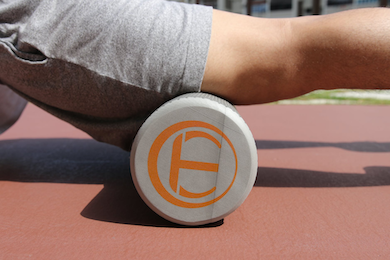
You're welcome to put this into your own programs, on your own templates, and use your team's logo. I'd recommend laminating a copy and putting it near your foam rolling area. Once the foam roller check-in is well-learned and athletes understand its purpose, you can cue it with a quick verbal reminder pre- or post-training and pre- or post-event as part of prep or recovery. Cues may be: ‘check-in,' ‘feel what you're doing,' ‘brain and body; same place, same time.'
