

Takeaways From Physical Preparation for Ice Hockey II
My Takeaways from Anthony Donskov's New Book: Physical Preparation for Ice Hockey II: The Gain, Go, Grow Manual
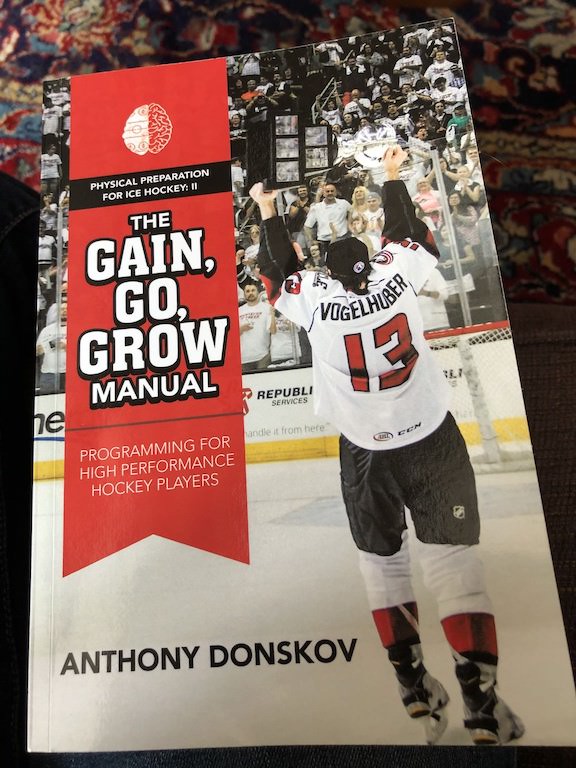
Too many resources, no time to absorb them all. That's how I felt at the onset of my strength and conditioning career. With all the books, online courses, blogs, and more, I didn't know where to begin.
Yet, I started to filter my content consumption by embodying the classic Mike Boyle concept, “Are you a chef or a cook?” Are you making the recipes or following them? As an 18-year-old, I was looking for great recipes I could insert into my work with athletes.
So, when I heard about Anthony Donskov on the Hockey Strength Podcast, and his book Physical Preparation for Ice Hockey, it stood out as a blueprint I could follow, the recipes I could use for my athletes and my own training.
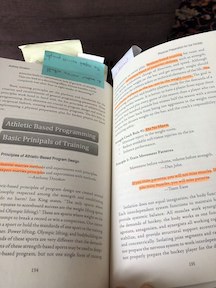
Within a week of its arrival, it was engulfed by orange highlights and sticky notes. It became a go-to resource to guide me at the onset of my career.
So when Coach Donskov advertised his latest work: Physical Preparation for Ice Hockey II: The Gain, Go, Grow Manual, I ordered it right away.
And as a fellow word nerd, I had an austere admiration for the alliterative title.
With a full list of homework I didn't want to do, I instead posted up at one of my favorite workspaces in Manhattan, the Highline Hotel right next to our rink in Chelsea Piers, and devoured the whole book in one sitting. Here's what the book left my mind lingering on.
Interdisciplinary Concepts
As an interdisciplinary student, I smiled ear to ear in confirmation bias as Coach Donskov relayed the first chapter: Be a Neo-Generalist. Yet, although conceptual I already agreed with him, placed into a strength and conditioning context illuminated it to the hockey world.
“The performance horizon is a complex, interdependent network,” (3) Donskov writes. Athletes' training doesn't exist in a vacuum. Rather, it intertwines with everything else, from their sleep and nutrition to their mindset and mental health.
Strength training programs must recognize the broader context of how our work goes into making better hockey players. Beyond that, though, becoming a better hockey player feeds into the greater goal of becoming better human beings, better equipped to manage life. Any program ignoring the broader context is like digging a trench without realizing another person is digging a trench right next to you, as you're preoccupied with your ditch to look over and collaborate.
Radical Openmindedness
A big problem plaguing many industries in our the world—from strength and conditioning to polarizing political tension—stems from our inability to detach from our ideas, to admit we're wrong, to adjust when better evidence presents itself. One of Coach Donskov's superpowers is adopting an open-mind, the mindset that everything we do may be fallible. It's the same mindset Ray Dalio (billionaire hedge fund manager) in his book Principles calls Radical Openmindedness.
Coach Donskov detaches from his ideas by framing them as scientific experiments. “Our programs are hypotheses to be tested, not treasures to be guarded,” (131) he asserts on multiple occasions.
Dear Up & Coming Coach: Your science doesn't prove. My science doesn't prove. Our science provides explanations with limitation. The goal is to produce the best explanation w/the fewest limitations. In essence, science is a game with no end. Play long enough & you're humbled.
— Anthony Donskov (@AnthonyDonskov) May 21, 2020
As coaches, despite pouring years of investigation, experience, and our hearts into our programs, we must accept some of those ideas we hold dearly may be wrong. They're the best current hypotheses, and we should seek to replace them when a better hypothesis reveals itself.
I love the way Coach Donskov frames this, because it allows him to more easily distance himself from his work, to constantly be searching for ways to improve the hypotheses.
Admitting you're wrong is hard. But, admitting your experiment didn't yield optimal results gives you the distance from your work to foster the objectivity necessary to constantly seek improvement. In this sense, when Coach Donskov changes his mind it's not an attack on his intellect, but on his experiment, and that's easier to detach from and move on to better methods.
Of course, just as we want our workouts to transfer to the ice, this mindset should transfer beyond your life in the gym. All our thoughts about the world are just our best current hypotheses.
Simplicity Within Complexity
Training elite athletes can intimidate me. Despite having the experience with NCAA D1 athletes, there's something about working with the elite athlete that reminds of me doing a damn dissection in biology class. I'm too timid I'd just fuck something up. These athletes are damn specimens. At that level, there's no way a basic program would get the job done, right? Right??
No, actually.
The Gain, Go, Grow process outlines how continuing development at the elite levels —although starkly different from classic progressive overload—is simple.
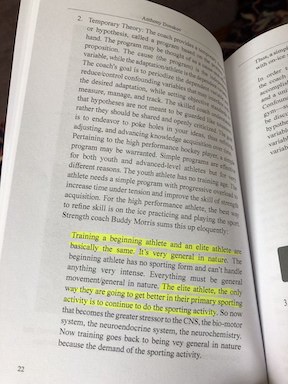
Throughout, Coach Donskov reminds us of the overall zeitgeist, that the athlete's main stress at the highest levels will almost always remain on the ice. He asserts, “...the only way [the elite athlete] is going to get better in their primary sporting event is to continue to do the sporting activity” (22).
Although we recommend our youth and high school athletes to take significant time off the ice, that's not necessarily the case for guys who make a living on the ice. So, the strength and conditioning program simplifies.
This example magnifies how Coach Donskov's general thought processes apply to the program. He's viewing all the factors in the athlete's life and accepting that his role in the athlete's development is not as grandiose as strength coaches may desire it to be.
By thinking broadly and critically, Coach Donskov makes the adjustments he needs to his program—which culminates in his new work—to continue to develop athletes at all stages in their career, even at the elite level.
Of course, at this point, I'm going to recommend you get the book. You can find it on Amazon here. If you haven't read Physical Preparation for Ice Hockey I, the OG, that's also on Amazon.
Finally, Anthony spoke with Brian Sipotz on the Hockey Strength Podcast about working with elite hockey players. Here's the link to the episode.
If you had other takeaways from the book or comments on my ramblings, post your thoughts from on the forum. Let's get the discussion going.
For all you non-elite athletes like me, keep training hard too. Beach season is HERE.
