

Maximum Velocity Sprinting For Hockey Players
“I want to get faster.”
When I ask the hockey players I coach what they need to improve, some variation of speed is typically the first response. “Faster” can mean several things due to the array of different skating skills players need to execute in both small spaces and open ice.
The ability to accelerate and reach high top speeds is advantageous in many game scenarios and can be a differentiating factor between players of higher and lower competitive levels.1-3 At each competitive level there likely exists a minimum skating speed threshold that players must possess. A player with speed abilities below the threshold would struggle to keep up with the open ice pace of play, even if they have strong small space skating abilities.

One of the primary goals of my PhD projects is to attempt to identify the off ice assessments that represent the physical underpinnings of skating speed. The off ice assessment values that most strongly relate and predict on ice skating performance turn into the off ice key performance indicators (KPIs) for skating performance. The purpose of this article is to specifically highlight off ice maximum velocity ability and its relevance to the on ice speed abilities of hockey players.
Do Hockey Players Need to Train For Maximum Speed?
One doesn't have to spend much time in the world of strength and conditioning social media to realize that maximum velocity sprinting has become an extremely popular discussion topic as a training tool for team sport athletes. It is not difficult to make a case for the importance of assessing and training maximum velocity for field sports such as soccer and rugby. The question that arises is whether the same value exists for hockey players. Why or why not?
The range of skating skills needed to be executed on the ice is significant with many variations of forward acceleration, forward maximum velocity, full stopping, turning, crossing over, pivoting, and backwards skating. Andy O'Brien uses a great analogy that hockey players are similar to decathletes in the multitude of skating skills they must possess and execute with precision. The more complex the skill, the less of the performance that can be attributed to general physical abilities and the more that relies on skilled execution of the task itself.
For example, a figure 8 cone drill that involves tight turns with a crossover acceleration step on the exit requires more skill than a 20m forward skate. I would hypothesize that forward skating falls on the lower complexity end of the skating skill continuum meaning general physical abilities such as lower body power would underpin a greater amount of the assessed performance than more complex skills.
Similarities Between Off and On Ice Speed
Sprinting and linear skating are not biomechanically identical tasks due to the lateral components of the skating stride. However, if we take a step back and take a more global approach to analyzing the two tasks, we realize that there are many more similarities that drive linear speed both off and on ice than are often acknowledged.
- Both share foundations as bipedal gait patterns that allow the athlete to propel themselves through space via alternating cycles of stance and swing phases.
- Impulse, the amount of force applied during ground contact, will determine the movement of the centre of mass (COM) both on and off the ice. Thus, applying a larger propulsive net horizontal impulse during ground contact will result in the COM moving at faster velocities during sprinting and skating.
- The movements of the athlete can be described by their stride length and stride rate. There likely exists an optimal range of stride length and stride rate depending on whether the athlete is accelerating or at top speed, the athlete's current levels of strength, technical abilities, and anthropometrics.
- Both require the skill to coordinate the movement of the torso and limbs through space. Athletes who are more proficient at these motor skills are able to rapidly and efficiently position their joints into biomechanically favourable positions setting the table for favourable kinetics.
Vince Anderson uses an analogy that the 100m acceleration pattern is the base language of speed. All speed tasks seen in sport are some derivative of this base language including skating. Looking more closely at the data between sprinting and skating speed assessments we can objectively determine how related these two speed tasks are for a given population of hockey players. Running basic correlations is a great place to start to increase our understanding of how on and off ice performance metrics relate.
Comparing Results Of On and Off Ice Speed Tests
A project I worked on with Cory Kennedy (formerly out of Institut national du sport du Québec) in 2018 heightened my interest on the value of sprinting ability, and specifically maximum velocity sprinting for hockey players. Data was collected from 92 university and professional women's hockey players which represents a large sample size when considering most single-study research papers that compare off versus on ice performance. Linear speed was assessed on and off the ice over a 30m distance with timing lights at 10m/20m/30m and a radar gun to determine peak speed. Change of direction (COD) ability was assessed using a modified 505 (5m out and back). Additional off ice tests included countermovement jump (CMJ), squat jump, and broad jump.
The off ice metrics that most strongly correlated with on ice performance measures including acceleration, peak speed, and COD were peak speed and CMJ (r = 0.6-0.8).4 This suggests that moderate to strong relationships exist between an athlete's ability to reach high sprinting speeds off ice and skating performance across linear speed and COD tasks.
Of further interest were the lower correlations between off ice acceleration and on ice skating speed. It appears that whether an athlete is slow or fast over the first 10m off the ice is less related to their ability to be fast over short or longer distances on the ice. This may indicate that acceleration abilities require a higher level of skill and may require more technical focus.
Analysis of sprinting and skating speed in groups that I work with, including university women and men, have shown similar trends. Figure 1 presents a pooled dataset of the above teams and with an additional university men's team and university women's team.
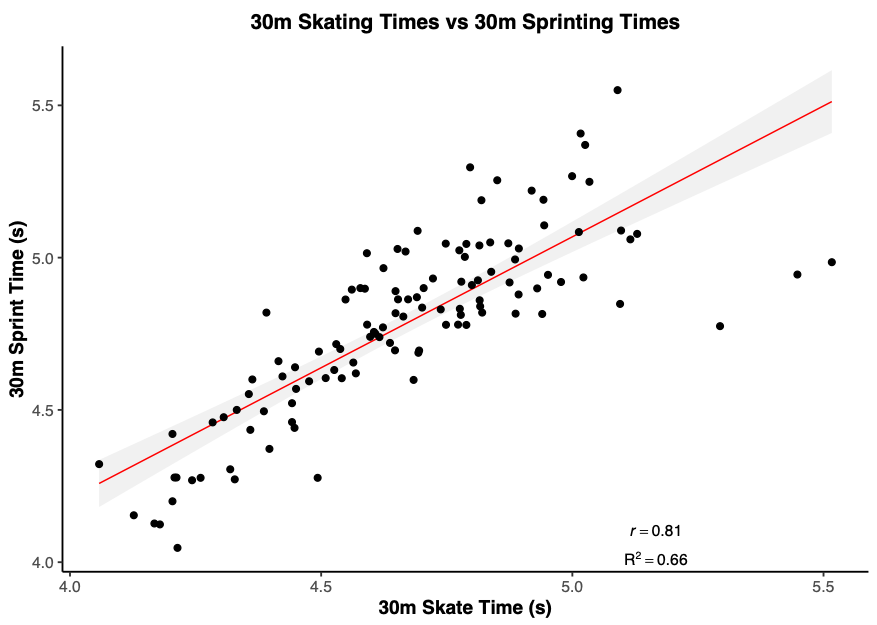
Figure 1. 30m Skating Times versus 30m Sprinting times for pooled dataset of 115 men and women university level hockey players.
From this we can conclude that for these groups, players who can reach faster sprinting speeds across 30m tend to be faster skaters.
These relationships are supported by previous studies citing correlations between off ice sprinting and on ice linear skating between 0.6 to 0.81 in high school males,5,6 university men and women,7 and elite women,8 although some studies have found weaker relationships.9,10
The relationships presented so far are just that. Relationships. They are descriptive of the specific dataset being analyzed and do not statistically tell us that we can predict skating ability from sprinting times in other populations. Statistical modelling is necessary to make objective predictions. Although the consistent moderate to strong correlations between them may suggest a reasonable probability that that improving sprinting off ice could potentially transfer to an improvement in skating speed, they do not provide conclusive evidence of this.
Longitudinal analysis of off and on ice speed metrics or a training study that improves sprinting speed and assesses skating speed pre and post-intervention are two methods that could accomplish this statistically.
As players reach elite levels, general physical abilities will likely be less of a differentiating factor between the on ice performance of players. Most who reach this level have high training ages and already acquired the minimum physical performance thresholds needed to compete at that level. For these players, specifically determining factors off the ice that may improve on ice performance becomes highly individual. However, for developmental players, the improvement of general physical performance makes a meaningful impact on their ability to progress through competitive levels.
How can this information be used to inform how we approach the assessment and training of speed abilities in hockey players? It suggests that maximum velocity ability off the ice should be measured, trained, and developed along with acceleration. Sprint training over distances greater than 20m are necessary to expose athletes to the maximum velocity speed stimulus and should be a consistent component within a player's speed development program. Treating sprinting as a skill and coaching the technical execution of acceleration and maximum velocity is important for longitudinal speed improvement compared to only emphasizing the stimulus of sprinting.
Vicki Bendus, MSc, CSCS, Current PhD Student
Lead Sport Performance Coach, Men's & Women's Hockey/Soccer, Brock University
Lead Strength & Conditioning Coach, Canada's National Women's Development Team
---------------------------------------------------------------------------------------
You can wave hello to Vicki over in our community area.
Follow Vicki on Twitter (@VickiBendus) and Instagram (@VickiBendus)
