

The Challenges of a KHL Strength Coach
In May 2020 I got a call from my friend Kevin Chapman, who asked me if I wanted to replace him in the KHL working for Torpedo Nizhny Novgorod, as he had taken another job elsewhere. My future head coach, David Nemirovsky, happened to live twenty minutes away from me in Toronto, Canada. We went for a coffee and he hired me on the spot.
I've now been on the Torpedo NN coaching staff for the past two years. David and his assistant coaches Sandis Ozolinsh and Artem Chubarov are approachable, knowledgeable, and always open to any questions. They run our team like an NHL coaching staff.
However, as much as there are similarities from hockey in North America, life in the KHL presents unique challenges.
Language Barrier
Everyone in our organization speaks Russian, except me. It certainly has been a bonus that the coaching staff is fluent in English and Russian, but most of the players aren't.
In the KHL, teams inside Russia are only allowed a maximum of five Import players (non Russians) in the active lineup. They're generally from the NHL, AHL or a European league. With less than one-quarter of the team speaking English, Google Translate quickly became the most frequently visited app on my cell phone.
Sometimes a twenty second conversation in English can become a 5-minute conversation with Google Translate in Russian, because the translation just gets lost between languages. The first couple of months of this were difficult to get my point across or have personal conversations with some of the players, so I decided I needed to learn Russian. I've been working on it for the past year and a half, and I'm happy to say that I can now lead a full workout session with a majority of my instructions in Russian.
If you're a strength coach who's bilingual, there are often coaching opportunities others won't have. We talk so much in our field about the importance of communication, yet forget that players often don't speak the same language at all. Or at least, they don't share the same language. A bilingual skill set can bridge that gap.
(Note from David: Professional baseball is always looking for coaches who speak Spanish, and even in hockey, Stephane Gervais is a great example of a coach working in his second language. is another bilingual strength coach, who works in France.)
Cultural Habits
Strength & Conditioning coaches in Russia are looked upon as authority figures. They are highly respected members of the coaching staff. Because of this, Russian athletes will ALWAYS do exactly what the coach tells them to do, without question. A common practice dating back even 10 years ago was a workout that could range from 3-4 sets, 8-12 repetitions of 8-12 exercises during training camp or an in-Season workout. Sometimes these workouts were done twice a day plus an hour of on-ice practice.
To most strength coaches reading this article that is extreme and potentially dangerous.
While in North America the culture means strength coaches often have to sell the idea of training, in Russia we have to sell the idea of recovering.
With the help of our import players, who are used to a more systematic workout approach, the Russian players on our team have seen the benefits of a more planned and tapered approach. We use a FirstBeat HR system during every practice with TRIMP as our main training load indicator. I also incorporate RSI weekly testing (specifically the 10/5 RSI test), as I have found it to be a good indicator for CNS readiness and neuromuscular fatigue.
Bringing in a new strength and conditioning system is always a challenge. Once the players saw individual improvements in their fitness levels, sleep, nutrition, and performance, they wholeheartedly embraced my methods of training.
Another challenge was communicating with the medical staff. In the past they never spoke with the Strength & Conditioning Coach directly and have always collaborated on their own. This year, after many discussions, we've created a workflow system where we're all communicating during the rehabilitation process. Now I assist our medical team with first stage rehab, working as a unit to help injured players.
With so many players coming from different countries, implementing daily health and recovery check-ins has been challenging. But once the team members see their own personal improvements based on these protocols, they open up to change.
Travel Schedule
The KHL season starts early September and runs until late February, with playoffs in March and April. The 2021/22 season consists of 24 teams and is an Olympic year, reducing the number of games every team plays from 62 to 56.
Like any pro sports team, travel comes with the territory. Our road trips span 2-6 days and are generally 1-3 games, played every other day. The league spans over five countries (Finland, Latvia, Belarus, Kazakhstan, and Russia) and seven time zones (eight time zones when Latvia and Finland are on daylight savings time). That's right, we have a seven hour difference between some of our road games.
To say travel is hard for any team would be a major understatement. On eastern road trips to Khabarovsk and Vladivostok, we're going to battle jet lag and fatigue.
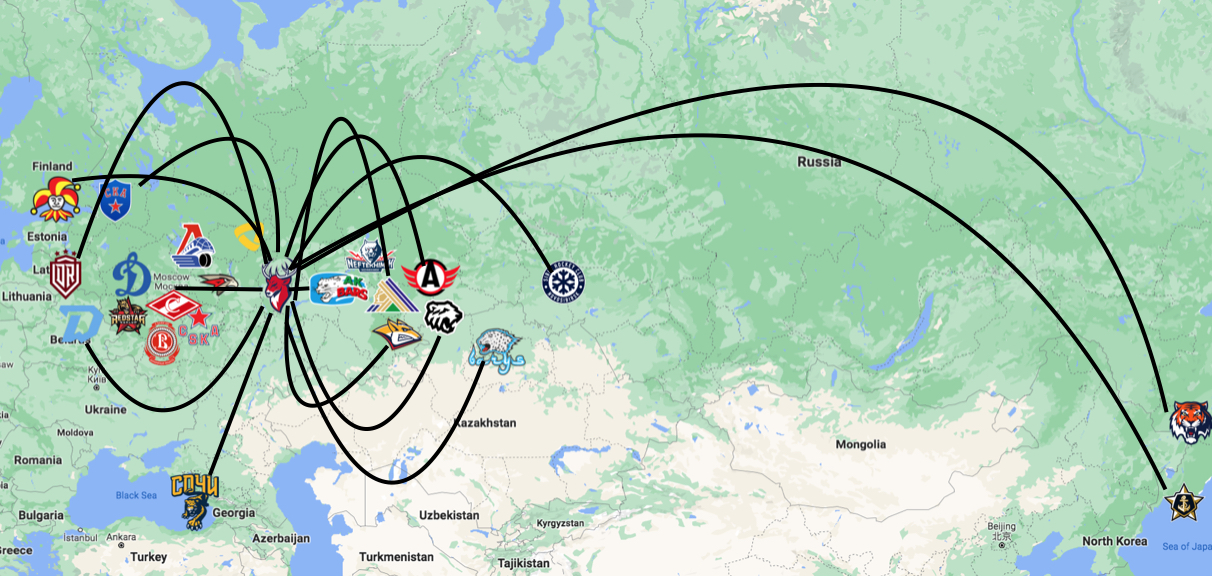
These long flights can lead to cognitive impairment, fatigue, and sleep deprivation. We try to combat the stress put on our players' bodies by making sure they're prepared for the travel by educating them on small steps to improve recovery while traveling:
- Hydration before, during, and after the flight
- Prioritizing sleep the day before traveling
- Keeping the rooms dark and the temperature cool
While on the road, we stay on our Moscow time zone. We've found this helps with delaying the effects of fatigue and it's easier for the team when returning home.
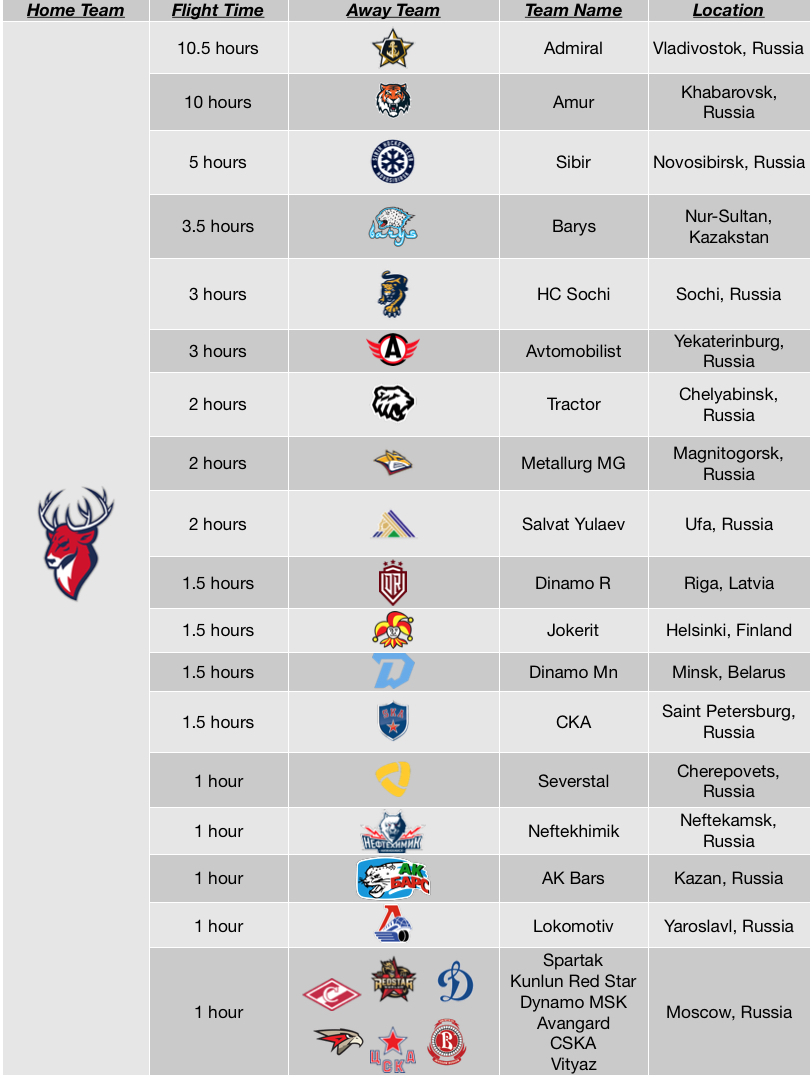
Flight Times from Nizhny Novgorod
About Andrew
Andrew Kacsor got his start in 2013 working for Matt Nichol. In 2019, Andrew moved to China to work as the Head Strength & Conditioning Coach for the KRS Vanke Rays, winning their first championship in team history. Currently, Andrew is in his second year as the Head Strength & Conditioning Coach for Torpedo Nizhny Novgorod in the KHL. You can find Andrew on Instagram (@akacsor).
