

Building The Hockey Player's Engine: Sequential Vertical Integration and Energy Systems Development
Introduction: The Demands of Hockey
The sport of hockey comes with both mechanical and metabolic demands. From a metabolic perspective, shift duration, frequency, and intensity are all volatile. Noonan in 2010 found shift length in NCAA D1 players to range from 55s to 145s (mean= 87.5s), intra-shift work intervals to be 29s to 102s (total work length mean=65s), and intra-shift work-to-rest ratios to be zero to 1.66.
Although specifics are contextual and will vary, all of the human bioenergetic pathways play a role. During anaerobic high intensity bouts fermentation facilitates the breakdown of glucose into pyruvate, which binds to hydrogen ions creating lactate. When aerobic conditions are met lactate can then perfuse and be oxidized intra- or inter-shift, or contribute to gluconeogenesis2,3. As lactate is a biomarker related to fatigue, a constant battle can be seen between utilization vs. accumulation. In this article, we're going to discuss how you can use sequential vertical integration to build an effective and efficient engine to win this battle.
What is Sequential Vertical Integration?
As a periodization tool, vertical integration involves emphasizing the development of certain qualities at different time points. Each of these qualities should be built upon block-to-block with the end goals in mind. Think of it as though you are cooking a big meal. Each component has its own recipe and cooking instructions; at one point the meat may consume most of your focus, while at another the potatoes may demand it. The individual recipes and instructions must blend to produce a timely warm meal.
Due to the bioenergetic demands of hockey, the multidimensions of repeat sprint ability (RSA) adopt this method well. For example, early in the off-season you may emphasize aerobic development while microdosing sprinting and fine tuning acceleration mechanics. Fast forward to late in the off-season and one may emphasize power and speed development while microdosing aerobic work through active recovery sessions.
The Assembly Process: Pre-Build Assessment
Prior to programming, assessments provide data to guide decision making. Enter profiling, where for the sake of energy systems development (ESD) we can determine high-intensity work tolerance, fiber typology, training responses, and bioenergetic facets in need of attention.
Three potential profiles appear on a continuum; speed, hybrid, and endurance (see Figure 1).
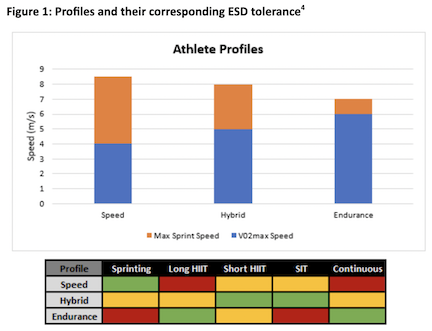
Those with a speed profile have a low maximal aerobic capacity, high maximal sprinting speed/power, a moderate-to-high anaerobic reserve, and are seemingly fast-twitch dominant. Those with an endurance profile have a high maximal aerobic capacity, low maximal sprinting speed/power, a small-to-moderate anaerobic reserve, and are seemingly slow-twitch dominant. Hybrid profiles host metrics that are moderate in comparison to the other two profiles, aside from retaining a relatively high maximal sprinting speed/power4.
Your assessment protocol needs to expose maximal aerobic capacity and maximal sprinting speed/power. Many coaches argue the need for sport-specific protocols for adequate transferability5. Layers can be added such as an on-ice repeat sprint test with heart rate and blood lactate readings to assess bioenergetic integration. As a whole the assessment protocol should contribute to profiling and the goal of enhancing RSA.
Select the Right Parts: Program
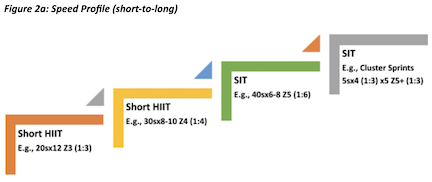
The engine blueprint is now finalized. You must go to the shop and buy the right parts to piece it all together. For hockey, we want to do our best to shift the player's profile along the continuum into a hybrid. Those with speed profiles can produce ATP rapidly, but are limited by their capacity to sustain production and experience an early onset of neuromuscular fatigue. For them the off-season can begin with short high-intensity interval training (HIIT) that lengthens over time, progressing to sprint intervals (i.e., short-to-long approach).
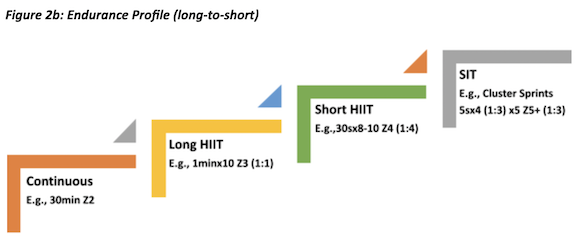
Those with endurance profiles are not as susceptible to overreaching, but are hindered by their lack of rapid ATP production. For them the off-season can begin with steady-state work, progressing to long HITT that shortens over time yet increases in intensity (i.e., long-to-short approach)4.
Lastly, hybrids are “one-percenters” meaning their engine races well and your job is to find where they can gain a 1% advantage over their competition. Time to add the turbo boost.
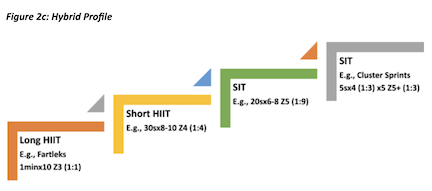
Figure 2 illustrates a basic four-block ESD program highlighting the main quality emphasized for each profile. Although protocols differ, the objective remains to build an engine with a moderately sized aerobic fuel tank and high anaerobic horsepower.
On-ice RSA relies on integrative bioenergetics, as there is a shift in reliance from the alactic and lactic systems to the oxidative system as sprint repetitions increase6. In addition, repeated high intensity bouts that are glycolytic in nature rely on the oxidative system to attenuate muscle acidosis, PCr synthesis, inorganic phosphate accumulation, and glycolytic flux4,6. Relevant to implementing sequential vertical integration, anaerobic capacity work can also attenuate aerobic capacity detraining8. This is why we begin with building the fuel tank first that will feed the athletes' need for repeated speed later.
Buffer Workouts
Once the fuel tank is built, intervals build the pistons of the engine. When programming, performance limitations must be scoped in on alongside your key performance indicators. Interval training does this by continuing to improve VO2max, cardiac output, and mitochondria biogenesis9. High intensity intervals can elicit these adaptations while moving production from aerobic to anaerobic10. The engine can now turn over and the athletes' ability to perform amongst oxygen desaturation is improving.
Prior to training camp most athletes should then be exposed to work above their lactate threshold to increase lactate tolerance. Athletes' lactate threshold, and thus their second ventilatory threshold, correlates with on-ice RSA even more so than their VO2max11. At some point HIIT then can meet sprint interval training (SIT) where an athlete's maximum aerobic capacity can now be challenged by their maximal sprint speed/power. This impacts the athlete's anaerobic reserve and allows them to achieve an optimal average output that is accessible every shift. I call these “Buffer workouts” because the objective is to increase the athletes' ability to delay acidosis. SIT also increases mitochondrial oxygen affinity making it an advantageous final progression to previous adaptation12. Think of this as the exhaust system to your engine, and the last job before the engine can be raced.
Rev Your Engine: Autoregulation & Monitoring
Once it is decided where energy systems development (ESD) fits into the S&C program at large, autoregulation and athlete monitoring are the second and third filters. Collectively, athlete management will help prepare, maintain, and adjust programming. It should not be used to become risk averse, but rather to provide information to be used for feedback, in-session adjustments, day-to-day risk:reward calculations, season planning via average demands, and long-term education13.
Similar to the assessment protocol, the autoregulation strategy applied needs to be suitable to the daily training environment. Options include, but are not limited to, perceived pace (e.g., light, moderate, and maximal) or heart rate zones with drop offs. The objective of the chosen autoregulation strategy should be to ensure the session elicits the intended stimuli. Applicability and having athletes understand the strategy are extremely important.
It is not in the scope of this article to discuss athlete monitoring in depth, but it can be as simple as screening subjective readiness. The athletes' perceived response to the program can then allow further individualization by offering the performance staff a deeper look into the production process as a whole. There's life outside of the factory. Implementing the athlete monitor cycle determines; what did the athlete do?; what is the response (i.e., internal vs. external load)?; how are they coping (i.e., total workload vs. perceptual well-being)?; and are they prepared (i.e., perceptual well-being vs. readiness)14? Figure 3 demonstrates two athlete monitoring scenarios.
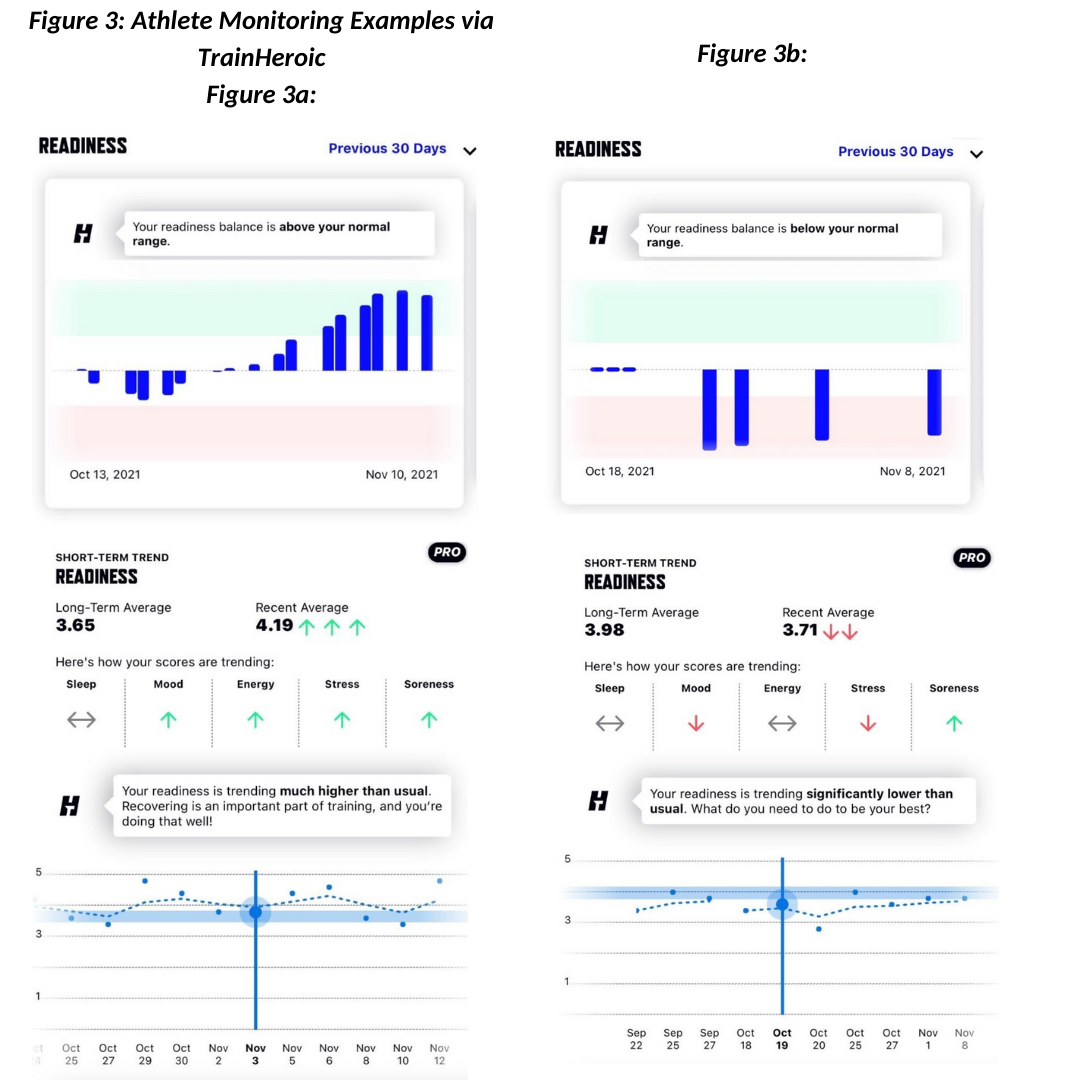
Figure 3a interestingly follows a supercompensation-like pattern, while Figure 3b illustrates a consistent decline in readiness. While both athletes are following programs tailored to their calculated needs, the complexity of human nature will always win and Figure 3b is calling for an intervention.
Conclusion
Building the engine of a hockey player is not achieved with a one size fits all program. The proposed sequential vertical integration model can construct the physiological underpinnings of RSA according to the athletes' predisposition. At the end of production, a hybrid profile leaves athletes with a moderate aerobic capacity, relatively high maximal sprint speed/power, and a reliable anaerobic reserve. Developing the engine to compete at this tune improves RSA by allowing high RPMs to be met with less effort and those RPMs to fall fluidly inter-sprint4. Like all methods there are limitations, that being said this is a versatile programming strategy that can be shaped into different training environments.
About Alexander Morgan, MS, CSCS, RSCC
Alex is the Strength and Conditioning Coach/Applied Sport Scientist for both the men's and women's hockey teams at Nipissing University (U Sports). He is also the Director of High Performance at Peak Centre for Human Performance and the Founder of Area 13 Training Systems.
Twitter: @morgsthemoose
Instagram: @morgsthemoose
LinkedIn: https://www.linkedin.com/in/alexanderjmorgan/
Website: www.area13trainingsystems.com
References
- Noonan BC. Intragame blood-lactate values during ice hockey and their relationships to commonly used hockey testing protocols. The Journal of Strength and Conditioning Research. 2010; 24 (9): 2290-2295
- Rabinowitz JD, Enerback S. Lactate: the ugly duckling of energy metabolism. Nat. Metab. 2020; 2 (7): 566-571
- Brooks GA. Cell-cell and intracellular lactate shuttles. The Journal of Physiology. 2009; 587 (23): 5591-5600
- Sandford GN, Laursen PB, Buchheit M. Anaerobic speed/power reserve and sport performance: scientific basis, current applications, and future directions. Sports Medicine. 2021
- Peterson BJ, Fitzgerald JS, Dietz CC, Ziegler KS, Ingraham SJ, Baker SE, Snyder EM. Aerobic capacity is associated with improved repeated shift performance in hockey. The Journal of Strength and Conditioning Research. 2015; 29 (6): 1465-1472
- Baron J, Gupta S, Bieniec A, Klich G, Gabrys T, Swinarew AS, Svatora K, Stanula A. Effect of rest period duration between sets of repeated sprint skating ability test on the skating ability of ice hockey players. International Journal of Environmental Research and Public Health. 2021; 18 (20)
- Germano DM, Gonsalves-Sindorf MA, Crisp AH, Braz TV, Brigatto FA, Zaroni RS, Cartarozzi DF, Gustavo de Cunha L, Evangelista AL, Lopes CR. Different passive recovery times between repeated maximal sprints influence in performance and lactate removal. Journal of Exercise Physiology. 2017; 20 (5)
- Sozen H, Akyildiz C. The effects of aerobic and anaerobic training on aerobic and anaerobic capacity. The Journal of International Anatolia Sport Science. 2018; 3 (3): 331-337
- MacInnis MJ, Gibala MJ. Physiological adaptations to interval training and the role of exercise intensity. The Journal of Physiology. 2017; 595 (9): 2915-2930
- Astorino TA, Edmunds RM, Clark A, King L, Gallant RA, Namm S, Fischer A, Wood KM. High-intensity interval training increases cardiac output and VO2max. Medicine and Science in Sports and Exercise. 2017; 49 (2): 265-273
- Lowery MR, Tomkinson GR, Peterson BJ, Fitzgerald JS. The relationship between ventilatory threshold and repeated-sprint ability in competitive male ice hockey players. Journal of Exercise Science & Fitness. 2018; 16 (1): 32-36
- Larsen FJ, Schiffer TA, Zinner C, Willis SJ, Morales-Alamo D, Calbet JAL, Bouschel R, Holmberg HC. Mitochondrial oxygen affinity increases after sprint interval training and is related to the improvement in peak oxygen uptake. Acta Physiologica. 2020; 229: 1-9
- West S, Clubb J, Torres-Ronda L, Howells D, Leng E, Vescovi JD, Carmody S, Posthumus M, Dalen-Lorensten T, Windt J. More than a metric: how training load is used in elite sport for athlete management. International Journal of Sports Medicine. 2021; 42: 300-306
- Gabbett TJ, Nassis GP, Oetter E, Pretorius J, Johnson N, Medina D, Rodas G, Myslinki T, Howells D, Beard A, Ryan A. The athlete monitoring cycle: a practical guide to interpreting and applying training monitoring data. The British Journal of Sports Medicine. 2017; 51 (20): 1451-1452
