
Blood Flow Restriction for Hockey Players
When we think of tourniquets or pressure cuffs when training, we might think of someone looking to achieve that extra “pump” in a local public gym. However, Blood Flow Restriction, otherwise known as BFR, holds a plethora of benefits and can become a beneficial tool in any athlete's return to play progression.
With injured athletes and return to play, typically the medical staff takes the initiation of immediate care with initial strengthening and proprioception work before loading the individual in the weight room. But how do we prevent atrophy of an injured athlete if they cannot adequately load the affected region? How do we ensure the athlete does not lose progress and physical capabilities, while patiently waiting for the injury to subside?
When transitioning from the training staff to the strength staff, the athlete could be as much as three weeks or even more from their last high-performance training session. Even then, the athlete might not be able to heavily load the upper or lower body based on their injury and progression for quite some time after getting back into the weight room. BFR may just be the missing link between the rehab table and high-intensity training in the weight room.
What is Blood Flow Restriction?
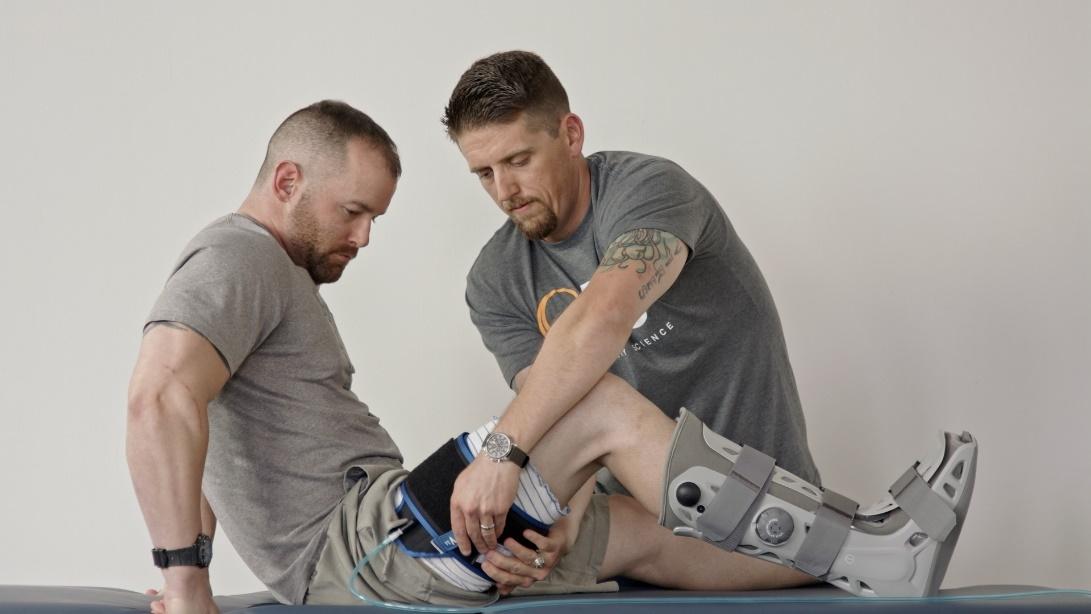
BFR is described as a tourniquet system used on the proximal side of a limb to limit arterial inflow while blocking the venous outflow9. Tourniquet cuffs are placed on the most proximal portion of the arms or legs causing occlusion to the upper or lower limbs.
The standard protocol involving a low intensity, high volume stimulus is applied in a certain criterion of time. By limiting the arterial inflow to the occluded limb, oxygen supply is reduced to the working limb still allowing the muscle to uptake oxygen for muscle activation. Acute, localized hypoxia causes a shift from the aerobic system to the anaerobic system. By occluding 100% of the venous outflow, an environment where lactate and metabolic wastes cannot be freed is created and these byproducts build up.
This highly acidic environment creates systemic and hormonal responses. Coupling the anaerobic response from a low oxygen supply to the immense build-up of metabolic wastes mimics the stress the body would be undergoing with high load strength and hypertrophy training.
Increase in Motor Unit Recruitment
One of the most crucial aspects of training our players is to increase motor unit recruitment, often attained via high-intensity strength training. By increasing the number of motor units in a high-stress, high load environment, athletes can access another level of strength.
During BFR, driven by its high lactate and hydrogen ion environment, muscle activation increases by the recruitment of additional motor units for the need of increased force production. Subjects under BFR protocols increased muscle activation progressively of the biceps and triceps by 46% and 69%, respectively, compared to control which showed an increase of only 12% and 23% respectively16. Analysis of muscle activation of the lower limbs when under BFR showed an increase of the quadricep by 217% compared to 15% of maximum voluntary contraction.

Hormonal Response from BFR
Not only can we increase motor recruitment through BFR, but the hormonal responses created by occlusion can provide significant benefits. Under high load resistance training, we spark the release of growth hormone (GH) due to increased lactate production14. Studies completed under BFR showed a rise in growth hormone to be 290% above baseline, which correlates to 1.7 times higher than standard high-intensity training14.
We know that GH directly aids in collagen synthesis, so how does this help hypertrophy for the player? Accumulation of GH creates the secretion of Insulin-like Growth Factor (IGF-1), a hormone that aids in skeletal muscle hypertrophy. When IGF-1 is released, it acts as the pathway for activation of muscle stem cells and the creation of a new myocyte.
One study found that muscle fiber area in those under BFR protocol during ten days of training and post-training was 30-40% compared to the control. For perspective, 12-16 weeks of heavy resistance training demonstrated only a 15-20% increase in muscle fiber area in untrained men8.
Not only does restriction of blood flow create a cascade of GH and IGF-1 events, but it can also cause down-regulation of the protein myostatin (part of the transforming growth factor-beta superfamily, a protein that helps control the growth and development of skeletal muscle tissue throughout the body). Down-regulation of myostatin is directly related to increased hypertrophy and during nine weeks of heavy resistance training, we see this down-regulation as an increase in muscle mass12.
A study completed in 2012 showed that down-regulation of myostatin during BFR was similar to that of high-intensity resistance training4.


VO2Max & Bone Density
Thus far, we know BFR can benefit the anaerobic system, however, it has been shown to improve both VO2Max and aid in the process of bone growth. In 2010, a BFR group cycled at 40% VO2Max for 15 minutes in comparison to the control group who cycled for 45 minutes at 40% VO2Max. In less time, the BFR group showed more mass, strength, longer time to exhaustion, and improvement in their VO2Max2.
This showed that not only does BFR create a local improvement but has a positive neuromuscular and systemic response. Gains in the VO2Max can certainly be due to the increased heart rate caused by an increased need for cardiac output. Going back to the increased production of GH, healing times of bone fracture were accelerated under blood flow restriction protocols11.

Limitations of Blood Flow Restriction
Some limitations do come into play when utilizing BFR training. Typically, only single joint and low-level cardio exercises work for BFR. We are also limited to occluding only the upper and lower limbs as we cannot physically occlude the trunk. So how is it possible to make proximal gains above the cuffs?
BFR subjects have been shown to increase their squat strength by 17% and leg curl strength by 23%. In addition, the size of the gluteus maximus muscle has been shown to increase as much as 9.1% (Abe 2005). In 2010, bench press 1RM was shown to increase in BFR subjects by 6%15.
owever, when low-load BFR was compared to high-intensity training at 80% 1RM, the BFR group increased, but less than that of the 80% 1RM group16. Under BFR protocol, low load creates an environment where the athlete doesn't need to stabilize themselves or a dumbbell for example, as much as one would need with heavy dumbbells or heavy single-leg work. With BFR protocols, we are working at high volume, which does not correlate much to power, taking away from our power energy systems, explosive low repetition movements, and multi-joint movements.

Safety
Safety is a big concern of on-lookers of blood flow restriction. It's largely recommended to use a personalized electronic system that considers the user's real-time blood pressure. Using a clinical-grade system, such as the Delfi system we use here, real-time pressure readings will be assessed and monitored by the device for your specific athlete.
Another factor is the width of the pressure cuffs. Wider pressure cuffs increase safety compared to smaller cuffs or bands, as they can dangerously increase pressure with less surface area leading to nerve damage. This system also has a duration of use feature and a locking mechanism when cuffs are deflated to ensure they are not re-inflated in less than 60 seconds, giving the athlete ample time for recovery. Speculations of thrombus have been made regarding blood flow restriction training, however, according to a study in 2010, a thrombus is not of concern and actually has reverse effects, reducing the risk of blood clots5.

BFR Protocol
The protocol we use, recommended by Johnny Owens with Owens Recovery Science, is simple and effective. When completing a lower body exercise, the lower body cuffs occlude 80% of the lower limbs. When completing the upper body exercise, the upper body cuffs occlude 50% of the upper limbs. To reiterate, these occlusion percentages are based on the pressure to limit arterial inflow and block venous return respectively.
When the system accurately finds the pressure needed to carry out the workload, the protocol can start. The athlete will complete 30 repetitions of a two-second eccentric, two-second concentric movement, followed by a 30-second rest. The pressure of the cuffs does not turn off during the rest, and the athlete will then complete three more 15 repetition intervals with 30 seconds of rest in between equating to a total of five minutes of full inflation work.
If an athlete has a hard time completing a set, that athlete can rest for more than 30 seconds before the proceeding set and the total inflation period can be extended beyond the five-minute mark. When all 75 repetitions are completed, the cuffs can be deflated. Depending on soreness, it is recommended this be used as frequently and often as possible because of both its local and systemic benefits.

Applying BFR to Professional Hockey
So how does this BFR help us in professional sports, specifically hockey? It's the missing link in the rehabilitation and the return to play protocol. Through BFR we can reduce the risk of atrophy for an injured athlete, and reversely, even make positive gains for that athlete under low load.
Let's use the example of a player with a torso/oblique injury who is out about six weeks. Based on injury, pain, mobility, and medical staff involvement, that athlete could be doing table work or non-load bearing exercises out of the weight room anywhere from one to three weeks. Even when the individual first returns to the weight room, the beginning progression starts with low load and impact work, which can begin to deteriorate muscular stature. In some cases, it has been shown to lose up to 14 percent of VO2Max in as little as two to four weeks7.
Muscular strength will hang around for up to three weeks post-injury without training, however, decay of strength begins to increase around this mark6. Under this sort of injury, the individual can't bear much load for the upper or lower body without engaging the torso for max stability. Using BFR, we are immediately able to complete lower body table exercises and low weight dumbbell upper body exercises, creating an environment and adaptation similar to high-intensity training.
Even when the athlete is ready to merge back into the weight room but not quite ready for heavier impact or loading, using BFR we are still able to complete low load unilateral and bilateral work with a larger range of motion and increased exercise options.
What happens when the athlete has worked up and is ready to return to high load, high-intensity training? When the medical staff slowly begins to clear the athlete of restricted movements, we begin to slowly reduce the amount of BFR prescription and add more stimulus to the injured region through both assisted and free weight work. BFR can still be added into the day's training session, however, the athlete should begin to slowly ramp up to high-intensity resistance training. By slowly reducing BFR, and adding in routinely prescribed resistance training encourage stabilization, proximal effectiveness, and the merge of prior routine training prescription.
Return to play focuses largely on getting the player back onto the ice as quickly and healthy as possible but lacks the focus of effectiveness. Blood flow restriction training allows us to be effective at merging the gap between medical room care, and high-intensity demand at the return to play dates while making progress along the way.
About Nick
Nick Orioli is the Assistant Strength and Conditioning Coach with the Columbus Blue Jackets. Before Columbus, he worked with the St. Louis Cardinals as a fellow, and graduated from Ohio State in 2019 where he majored in exercise science.
You can find Nick on Instagram: @Nick_Orioli_
References
- Abe T. Effects of short-term low-intensity KAATSU training on strength and skeletal muscle size in young men. J Train Sci Exerc Sports (2004); 16. 199-207
- Abe, T., Fujita, S., Nakajima, T., Sakamaki, M., Ozaki, H., Ogasawara, R., Ishii, N. (2010). Effects of Low Intensity Cycle Training w/ Restricted Leg Blood Flow on Thigh Muscle Volume and VO2MAX in Young Men. J Geriatr Phys Ther, 33(1), 34-40
- Kadi F, Schjerling P, Andersen LL, Charifi N, Madsen JL, Christensen LR & Andersen JL (2004). The effects of heavy resistance training and detraining on satellite cells in human skeletal muscles. J Physiol 558, 1005-1012
- Laurentino, G.C., Ugrinowitsch, C., Roschel, H., Aoki, M.S., Soares, A.G., Neves, M., Jr., Tricoli, V. (2012). Strength training with blood flow restriction dimishes myostatin gene expression. Med Sci Sports Exerc, 44(3), 406-412
- Madarame, Haruhiko, et al. “Effects of low-intensity resistance exercise with blood flow restriction on coagulation system in healthy subjects.” Clinical physiology and functional imaging 30.3 (2010): 210-213
- McMaster DT, Gill N, Cronin J, McGuigan M. The development, retention and decay rates of strength and power in elite rugby union, rugby league and American football: a systematic review. Sports Med. 2013 May;43(5):367-84. doi: 10.1007/s40279-013-0031-3. PMID: 23529287.
- Mujika, I. & Padilla, S. (2000). Detraining: loss of a training-induced physiological and performance adaptations. Part I. Sports Medicine, 30. 79-87.
- Nielsen, J.L., Aagaard, P., Bech, R.D., Nygaard, T., Hvid, L.G., Wernbom, M., Frandsen, U. (2012). Proliferation of myogenic stem cells in human skeletal muscle in response to low-load resistance training with blood flow restriction. J Physiol, 590(Pt 17), 4351-4361. 773-782
- Owens, Johnny, MPT, (2018). Personalized Blood Flow Restriction Rehabilitation. Owens Recovery Science (2015).
- Pierce, J.R., Clark, B.C., Ploutz-Snyder, L.L., & Kanaley, J.A. (2006). Growth Hormone and muscle function responses to skeletal musche ischemia. J Appl Physiol (1985), 101(6), 1588-1595
- Raschke M, Rasmussen MH, Govender S, Segal D, Suntum M & Christiansen JS (2007). Effects of growth hormone in patients with tibial fracture: a randomized, double-blind, placebo-controlled clinical trial. Eur J Endocrinol 156, 341-351
- Roth SM, Martel GF, Ferrell RE, Metter EJ, Hurley BF, Rogers MA. Myostatin gene expression is reduced in humans with heavy-resistance strength training: a brief communication. Exp Biol Med(Maywood). 2003;228(6):706-9
- Takano, Haruhito, et al. “Hemodynamic and hormonal responses to a short-term low-intensity resistance exercise with the reduction of muscle blood flow. “European jornal of applied physiology 95.1 (2005): 65-73
- Takarada, Y., Nakamura Y, Aruga S, Onda T, Miyazaki S, Ishii N. Rapid increase in plasma growth hormone after low-intensity resistance exercise with vascular occlusion. J Appl Physiol (1985) 2000; 88:61-65
- Yasuda T, Fujita S, Ogasawara R, Sato Y, Abe T. Effects of low-intensity bench press training with restricted arm muscle blood flow on chest muscle hypertrophy: a pilot study. Clin Physiol Funct Imaging (2010); 30: 338-343
- Yasuda T, Ogasawara R, Sakamami M, Bemben MG, Abe T. Relationship between limb and trunk muscle hypertrophy following high-intensity resistance training and blood flow restricted low-intensity resistance training. Clin Physiol Funct Imaging (2011); 31: 347-351