

Using Moxy to Identify Isometric Strength and Conditioning Demands of Elite Hockey Players
As in many sports, elite-level hockey is evolving at an incredibly rapid pace. Speed and skill are more present than ever before. They are the very nucleus that elite-level hockey is growing around. As we experience this transition in gameplay, we also see a trend in certain performance qualities. With speed and skill increasing, power and strength deficiencies are becoming ever more present in younger prospect pools. Such players have been able to achieve entry to this level of hockey based on their elite skill set.
One of the more pressing issues is that when these younger populations are reaching the pinnacle of elite-level leagues, the competition population is older and generally possesses a significantly higher baseline of strength. This is also an issue on the medical end of the high-performance model, because the risk of injury for these highly skilled but weaker athletes increases due to the number of games played, higher velocities, multi-directional impulses, and the sheer volume of contacts.
These factors potentially shorten players' careers. In many cases, these athletes are in a state in which their physical body is not cohesive with their skill level.
For this reason, many highly touted players may have to be held back in the development stages simply because they're not strong enough to withstand the rigors of the sport. With limited time to train strength qualities in the crazy schedules that many of the top leagues have, the question becomes:
Is there an effective way to maintain, even improve conditioning levels as well as increase strength levels in the athletes that need it?
Coaches often care more about conditioning levels than any other physical attribute. Sure, they want to know that their players are getting stronger, but they need to see that they are in game shape from a conditioning standpoint.
Research has shown that a single VO2 max training session per week or every other week can aid in maintaining conditioning levels throughout a competitive season (Slettaløkken & Rønnestad, 2014). Also, this research discussed how important the need for specificity in conditioning is to allow for optimal transference to the sport (Slettaløkken & Rønnestad, 2014).
For example, this could be change of direction-based sprints for soccer or various skating-based conditioning during the in-season for a hockey player. However, not all of our players may need that weekly or bimonthly session. If we were to correlate internal load along with external load, some of the players may be getting this stimulus during short; high-intensity practices. Not to mention the strains placed on a player during intense gameplay two to four days per week.
Are we exposing some athletes to unnecessary metabolic stress by globally incorporating conditioning protocols in our in-season models?
The players that play fewer minutes (but are expected to be ready at any time) may need this physiological stress to account for unexpected workload variables. However, what if we were to put in place a structural approach that meets these strength-deficient players' conditioning and strength demands while simultaneously decreasing their metabolic stress?
This is where isometrics could come into play and can be a powerful tool during the season. The theory is that the high minute, top line players may be able to work through a system of isometrics to accomplish both their strength and conditioning needs while limiting excessive metabolic stress.
Further, once this system is in place it will allow us to focus on strength for the athletes that need it. Recently, having discussed this theory with the physiologists at Moxy, we were able to expand more on our initial hypothesis.
Let's take a bike repeated sprint ability test for example. Many times, an athlete presents as weak or “out of shape” due to a lack of power or poor drop-off rates. However, we may also see an athlete exhibit a great drop-off rate while still presenting with poor high-velocity force and power data. This athlete may appear to be in good shape, but what if this athlete is underdeveloped and simply is “maxing out” on each rep? This may be a sign that they do not possess the qualities required to truly tap into the systems that need to be stressed during the bout. Many times, this will sync up with a poor rate of force development on a force plate or poor three stride metrics on the ice. This is not always the case due to varying efficiencies in skating mechanics.
If we examine what's going on in the muscle during the test, we can identify more individual physiological issues. This allows us to dig deeper into what is happening from a physiological perspective, providing optimization in training individual demands.
Moxy provides insight into several physiological parameters during an evaluation. For simplicity, we can look solely at the SmO2 slope trends (rate of desaturation). This is the most important and easily identifiable characteristic in performance. SmO2 slope is a visual representation of how rapidly the muscle can extract oxygen during bouts of intense exercise. This is the balance between saturated and desaturated hemoglobin.
It also provides us with real-time data to assess and identify the strength questions that we may have.
The fact is, we simply cannot have an entire elite young population that's weak. More importantly, there must be a way to address these issues from a deeper, more individual physiological perspective.
Using Isometrics to Build Strength Without Adding Metabolic Stress


This is where the theory that one can do that through varying forms of isometrics comes into play. The isometrics implemented can vary in intensity as well as the duration to stimulate different physiological pathways. Yielding isometrics (figure 1), in which an athlete is holding a weight and resisting gravity, and overcoming isometrics (figure 2), in which an athlete is producing force against an immovable object, can both play a pivotal role in addressing an athlete's needs based on a Moxy assessment.
The normal approach with an elite athlete would typically be to try and address this issue during the offseason and micro-dosing sessions appropriately throughout the season when and where appropriate. Some research has shown that strength qualities typically have the highest correlation to the isometric phase of training with differences in how they affect the rate of force development (Wang et al., 2016).
The same research found early RFD correlates with sprint and agility performance and late-stage RFD correlates with strength (Wang et al., 2016). This is an important factor when identifying why an athlete cannot produce repetitive maximal efforts as late-stage RFD is a key element in correlating strength and oxygen utilization qualities of an athlete.
We can take several approaches to increase strength in these athletes. As demonstrated in the above study, implementing overcoming isometrics into programming may offer the greatest stimulus and largest transference to strength qualities in the most efficient amount of time. Beyond mid-thigh pull, athletes can perform overcoming isometrics in any sport-specific position to increase transference and positive systemic feedback.
On the other end of the spectrum, submaximal isometrics (depending on load and duration) are commonly used for tissue remodeling, structural strength development, developing tendinous qualities, increasing myelination, and even conditioning. Setting aside neural adaptations, both forms of isometrics offer completely different stimuli from a physiological perspective. Overcoming isometrics tend to induce arterial occlusion whereas submaximal yielding isometrics target venous occlusion.
General guidelines in understanding arterial vs venous occlusion can be viewed as:
During venous occlusion, blood is able to enter the muscle, but cannot escape. Typically, under intensity levels of approximately 30-70%.
During arterial occlusion maximal blood flow is limited. This is commonly achieved during very high-intensity activities performed at 70-100%.
For a deeper look: Moxy for Strength Training
Isometrics Target Oxygen Usage Adaptations, Require Low Coordination
As a secondary note, isometrics offer a great approach to targeting the adaptations that influence oxygen usage within the muscle. This can be especially useful when modeling around in-season demands and what the coach deems necessary, whether that's post-game, practice days, etc.
Isometrics require low coordinative abilities, which is great in a fatigued state and also allows us to increase muscular recruitment and muscular tension, both of which are primary factors to target when addressing the limitations that are associated with the inability to efficiently desaturate the muscle. We can then create tension in ROMs that require it, by doing so, the athlete will desaturate the muscle very quickly as they are under constant tension.
Moxy's ability to identify the rate of desaturation is the most important variable to assess when delegating which isometric variable each athlete demands. As discussed, overcoming isometrics and submaximal isometrics create a slightly different occlusion stimulus within the body. Luckily with the Moxy unit, this can be done very quickly and efficiently without necessarily needing to dig deeper if you don't have time.
Using the Moxy to Assess Oxygen Desaturation Rates
When it comes to assessing oxygen desaturation rates during bouts of exercise there are three primary limiters that can be seen: utilization limitation, delivery limitation, and supply-respiratory limitation. Simply put, assessing these three performance markers can give us insight into whether the lungs (pulmonary system), muscles (skeletal muscular system) or heart (cardiac system) are the athletes greatest performance limiter.
Supply-respiratory limitation typically has to do with reflexive patterns within the lungs, pelvis positioning, thoracic spine mobility, diaphragmatic down-regulation, and general strength of the lungs.
We can combat these issues with a postural assessment, breathwork, and training with a Spirotiger for example. When determining an approach utilizing isometrics, the supply-respiratory limitation does not need to be a deciding factor. This limitation is typically addressed with a case-by-case approach.
For more content regarding Supply-Respiratory Limitations: Moxy Academy - Training Integration
If an athlete is experiencing a utilization limitation it means that the athlete is unable to desaturate and pull oxygen from the muscle during bouts of intense exercise efficiently. These athletes don't have issues getting blood to the muscle when needed, however, the muscle may be unable to process this flow, thus turning in a lower rate of desaturation. This is commonly seen in athletes with lower repetitive power output. When put into a visualization, this will be represented by smaller slopes that are typically closer to the same depth after each rep. If an athlete expresses flat desaturation curves, it signals a need for very high-intensity exercise.

Let's say this athlete is unable to truly desaturate as well as unable to recover from a heart rate perspective.
In this situation, the question then becomes, “What's the fastest way to instantly create stress on the heart as a muscle and also increase blood pressure?”
Theoretically, it is overcoming isometrics.
The Solution: Using Overcoming Isometrics and High-Intensity Sprints
Overcoming isometrics (along with supramaximal eccentrics) creates massive pressure through the heart's aortic valve and this increases stroke volume potential (Longhurst & Stebbins, 1992). Traditionally an athlete with utilization issues would need to perform very high intensity, max VO2 sprints to target arterial occlusion and increase maximal output abilities. However, there is also a large rush of metabolic waste that then needs to be cleared.
Therefore, performing this method in-season may place too much stress on an athlete. Another way to train this from a weight room perspective is to perform heavy clusters with limited rest. On the other hand, this may not be the safest or most efficient way to address the limitation during the competitive season.
After having a discussion with Moxy's physiologists about incorporating isometrics to target the athletes' limitations, our proposed consensus was that it would be best to combine isometrics with high-velocity conditioning bouts.
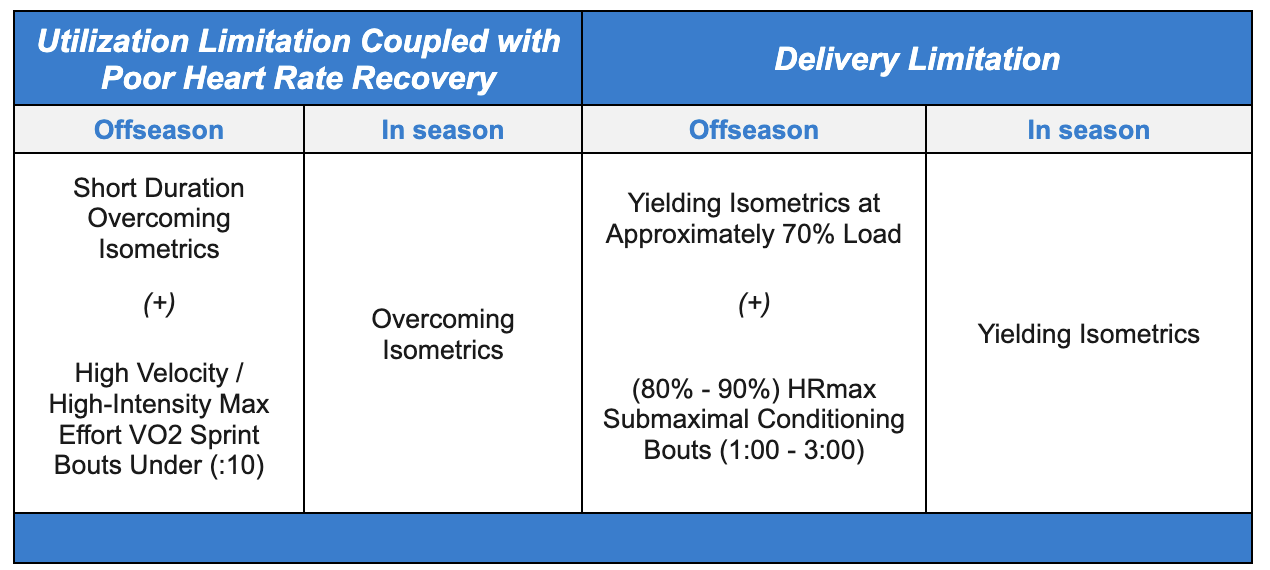
This would produce the physiological adaptations that are looking to attain at an accelerated rate over simply performing conditioning. For example, if an athlete presents with utilization issues, this athlete is to perform an overcoming isometric for ~:05 -:10 seconds, immediately followed by a maximal effort sprint bout. This distribution of methods will maximally target their utilization issue by taxing desaturation demand in a very short and high-intensity manner. The goal is to produce rapid desaturation which in turn should create a massive increase in mitochondrial density.
From a layout perspective, one could perform this method for the first couple of weeks of preseason and once the season begins, we simply remove the high-velocity sprint work.
This will help to elevate the stress that is placed on the athlete when forced to process large recurring amounts of metabolic waste.
During the in-season, the athlete then performs allotted sets of overcoming isometrics when appropriate without the sprint after. By doing this during the season the athlete will be hitting both the conditioning and strength demands at one time.
The athlete may not hit maximal isometric force as it is in season, however as long as the effort and intent are there, we are hitting our conditioning demand. This is happening even though the force created may not reach the level it is in the offseason.
If needed, we can always use a force plate or portable Bluetooth Tensiometer to track and measure real-time force production for ourselves as well as supply live feedback for the athlete. From a neurological perspective, one does not need to be overly worried about the fatigue induced as we will only perform this method in-season when the schedule allows for time to thoroughly recover.
Performing this method can also aid in neurodevelopment in athletes that lack maximal strength responses. If we're concerned about accumulated fatigue, we could do a drop-off-based approach, monitoring each set and building out an appropriate drop-off window by level or age of the player.
For players that meet cardiovascular demands, we can run the rest off of heart rate recovery. For athletes that may need an additional push on the cardiovascular system, we simply run off of work to rest ratios.
Lastly, we could use Moxy (coupled with thermography or on its own) as a load management system and have the athlete perform sets until they are no longer achieving the desaturation levels needed. Stopping the athlete at the appropriate time can help to limit excess structural stress and compensatory patterns.
Desaturation of the Muscle can also Happen to Quickly
The third limitation that an athlete can exhibit when examining desaturation rates is a delivery limitation. Quick and steep desaturation peaks coupled with slow recovery are a sure sign of delivery limitations. This means that the athlete is not moving enough oxygenated blood when the demand is there.

When represented in a graph form during live testing you will see a large sharp slope followed by sharp slopes that quickly decrease in size with each rep performed. The image above gives a great example of rapid desaturation during exertion.
Sometimes when an athlete exhibits a major limitation here, we will see these drops remain sharp but significantly decrease in-depth with each set completed.
While desaturation is important it's possible that the athlete is desaturating too quickly. If an athlete is exhibiting delivery issues it means that we need to target venous occlusion via a submaximal stimulus. By incorporating longer duration, escalating submaximal isometrics, we create a large buildup of blood in the muscle. Upon release, the body is forced to pull this blood from the working limb, making the heart work harder to pump fluids throughout the body thus increasing stroke volume.
As with the previous method, optimally we would have an athlete perform a longer duration yielding isometric at approximately 70% - 80% load followed immediately by a conditioning bout of about 80% - 90% of max heart rate for a duration of approximately 1:00 - 3:00. This technique will very quickly target venous occlusion.
Another suggestion would be with the overcoming isometric approach to do this early in training. Once the season hits, we remove the repetitive sprints and perform the isometric portion of the model which targets venous occlusion very efficiently. This will once again decrease metabolic stress and any unnecessary intensities placed on the body. Optimally one could increase the load of each set as well as alternate limbs top to bottom and in an anterior to posterior fashion.
General Principles for Applying This Method
*Blood flow restriction training does present similar hemodynamics as yielding isometrics, however when considering that strength qualities are the priority, we should focus primarily on implementing heavy yielding isometrics over BFR protocols during these periods of training.
Conclusion
By using this information as a quick check, we can begin to hit these athletes from two sides thus improving their physiological development in the most efficient manner. By no means under this method do we remove conditioning for all players. We are looking solely at the players that exhibit major strength deficiencies. A certain percentage of our developed athletes can handle or even need in-season sprint, speed, and power training.
Elite-level hockey is widely considered the peak of skill-based sports. Many people outside of our realm are not accustomed to the fact that while elite in their sport, many athletes have reached a high level with underdeveloped physical traits.
There are a multitude of physical assessments that we can use to identify performance deficiencies and help us as coaches help our athletes become better, more structurally sound individuals. Balancing workloads, gameplay, and limiting unnecessary metabolic stress becomes a very difficult task for a wide range of sports performance coaches. If we consider using desaturation profiles as the delimiter in the distributing conditioning and strength work, we can quickly attack the physiological demands of the athlete and create a flow from preseason to in season that allows the athlete to quickly and efficiently train both qualities.
About Derick
DeRick O'Connell is the assistant strength and conditioning coach of the Philadelphia Flyers. He has served in many leadership roles as a Regional Director of Sports Performance, Head Strength Coach, Sports Scientist, Senior Strength Coach and consulted with Special Forces members. He was a contributing member of the Medical Advisory Board in a joint venture between Hackensack University Medical Center and the New York Giants.
He also previously served as the Performance Manager for Team Gomez, a professional fight team. He has made multiple stops with the Strength and Conditioning Department at the University of Minnesota, spending over 5 1/2 years serving as a sports scientist and strength coach with the Men's and Women's Gopher Hockey programs. During this time he also served as a strength coach and sports scientist for the USA Women's National Hockey Program. He is also the author of "Triphasic Training: Manual to Elite Aerobic Health; Implementation and Concepts of General Preparation Phases" and active author/contributor to several other released and soon to be released works.
Instagram: https://www.instagram.com/derickoco/
About Dan
Dan Warnke is the head strength and conditioning coach of the Philadelphia Flyers. Prior to joining the Flyers, he spent three seasons as the strength and conditioning coach for the Lehigh Valley Phantoms and served as an assistant director of strength and conditioning at the University of Minnesota. He has worked with professionals from the NHL, NBA, MLB and a number of professional soccer leagues and is also a member of the National Strength and Conditioning Association.
References:
Longhurst, J. C., & Stebbins, C. L. (1992). The isometric athlete. Cardiology Clinics, 10(2), 281–294. https://doi.org/10.1016/s0733-8651(18)30244-3
Slettaløkken, G., & Rønnestad, B. R. (2014). High-intensity interval training every second week maintains v[combining dot above]o2max in soccer players during the off-season. Journal of Strength and Conditioning Research, 28(7), 1946–1951. https://doi.org/10.1519/jsc.0000000000000356 ;
Wang, R., Hoffman, J. R., Tanigawa, S., Miramonti, A. A., La Monica, M. B., Beyer, K. S., Church, D. D., Fukuda, D. H., & Stout, J. R. (2016). Isometric mid-thigh pull correlates with strength, sprint, and agility performance in collegiate rugby union players. Journal of Strength and Conditioning Research, 30(11), 3051–3056. https://doi.org/10.1519/jsc.0000000000001416
