

Thinking Outside the kBox: Holistic Eccentric Training for Hockey Players
Eccentrics. It's a polarizing word, isn't it? One of those words that summons a devilish smirk to a strength coach's face. It's the same word that simultaneously instills a guttural fear into every college hockey player that cheated on their Kinesiology 101 test. Strength coach sadism aside, there is little doubt that eccentric training benefits just about every aspect of human performance (3).
Aside from the pain of doing them (e.g. DOMS, H+ ion buffering, counting to “five Mississippi” with 315 on your back, etc.) and the pain of setting them up (e.g. eccentric hooks, super bands over a barbell, instructing WHL players to spot supramaximal loads, etc.) they're wonderful. So wonderful, they've become a sacred S&C cow. As with all sacred cows, there comes a time when you must question them.
We're not here to dispute the benefits of eccentrics. Instead, maybe we should reflect on how we do them, who we do them with, and whether this type of training should be exclusive to the weight room. Of equal importance, we need to reflect on the frequency with which we prescribe these exercises.
This article is our best attempt to explain our thought process on eccentric training for hockey players.
Before we can begin to explain our thought process, we first need to take you back to three major reflections we've had over the years. These reflections helped inform our thought process:
- Is there equipment and technology that could make eccentric training harder, smarter, safer, and faster?
- Should we do these exercises without first considering our players and what they're going to do on the ice?
- Is there a better way to “check the eccentric box” than doing tempo squats 4 weeks out of a 52-week annual plan?
Let's start with #1, and an old piece of equipment that arrived in Edmonton, Alberta, with a renewed sense of Swedish style.
Reflection #1: Equipment and Technology
Flywheel Training: Full circle?
Flywheel training has certainly become in vogue for athletic performance professionals over the last few years. As popular and trendy as they've become, these training devices are far from new. In fact, the first known research study using a flywheel device was conducted at the University of Copenhagen in 1923 (5); however, there is documented use of flywheels for exercise dating all the way back to the late 18th century (6).
Today, there are numerous companies that manufacture flywheel training devices, including Exxentric (kBox), Heart Rate Inc. (VersaPulley), nHance (Yo-Yo) and Desmotec. The products that we use are manufactured by Exxentric (kBox and kPulley) and are staples in our training programs. Interestingly, the co-founders of Exxentric, Fredrik Correa and Mårten Fredriksson, have strong ties to ice hockey. The two friends developed their original prototype while working with a Swedish ice hockey club (6). In 2011, Exxentric was born and has become an industry leader in flywheel training, not just for ice hockey.
Physics Behind Iso-inertial Training
While an in-depth review of the physics and research behind flywheel training is outside the scope of this article, here's a brief synopsis.
Flywheel based resistance training can also be referred to as iso-inertial training, which describes the unique way it loads the muscle. The larger the mass and radius of the wheel you use on the device, the higher the potential inertial load. Unlike traditional gravitational resistance training (e.g. dumbbell), iso-inertial resistance acts independent of gravity and dependent on velocity (15). In practical terms, this means that the intensity of any given flywheel exercise can be increased by adding larger flywheels and/or more of them.
More importantly, it means that an increase in intensity can be generated via an increase in a user's volitional effort. I.e. the harder you push, the more resistance you get. Theoretically, there is no limit to the resistance of any single flywheel. It just depends on how hard you can push/pull.
Additionally, the intensity of the eccentric phase is directly affected by the momentum generated in the concentric “push” of the user. The harder they push in the concentric phase, the faster the flywheel will spin, and the faster the wheel spins, the harder it will pull the user into the eccentric phase. Another difference from free weight is that there's no pause between reps. The transition between concentric and eccentric phases is immediate, requiring the user to work constantly for the duration of the set.
Theory: Flywheels & Eccentric Overload Training
The primary benefit of a flywheel training device is the ability to easily overload the eccentric phase of an exercise. Douglas and colleagues (2017), highlight the benefits of eccentric overload training in their systematic review published in the journal of Sports Medicine. The authors found that the use of eccentric overload training produces significant neural, morphological and architectural adaptations (3). Arguably two of the more important neural adaptations generated by this type of training are an improvement in ability to recruit high threshold motor units (i.e. type IIa and IIx) and motor unit firing. Furthermore, training with high eccentric outputs will positively impact a player's ability to change direction (12). In hockey, the fastest players can absorb eccentric forces, then generate a concentric action quickly and forcefully. Every time a player accelerates and decelerates on the ice their muscles are producing an eccentric contraction. An intense and brief deceleration phase allows storing and reusing of elastic energy, increasing the subsequent production of concentric force. This ultimately translates into a reduction in ground contact times in both the braking and re-acceleration phases (4, 11).
The peer reviewed literature on flywheel-based resistance offers strong support that these training devices, if used appropriately, can facilitate many of the adaptations mentioned above (7, 8, 10).
Comfort, experience, and the ability to approach each rep with maximal intent, is crucial for harnessing the benefits of eccentric overload training via a flywheel. It is also important to find the exercises and loads to produce significant eccentric overload; particularly if improvement in eccentric strength is your training goal.
Application: Flywheels and Eccentric Overload Training
While it's clear that flywheels offer a unique way of overloading the eccentric phase of an exercise, we need to understand how exercise selection and loads affect eccentric overload. Fortunately, Exxentric has a user-friendly solution to quantifying power, force, and speed during flywheel training. The kMeter, which is a built-in device and Bluetooth app has numerous metrics to choose from during any exercise on the kBox (Figure 1). This valid and reliable app is very useful in helping a coach determine appropriate loads and provide feedback to the athlete (14).
Figure 1. kMeter App Interface

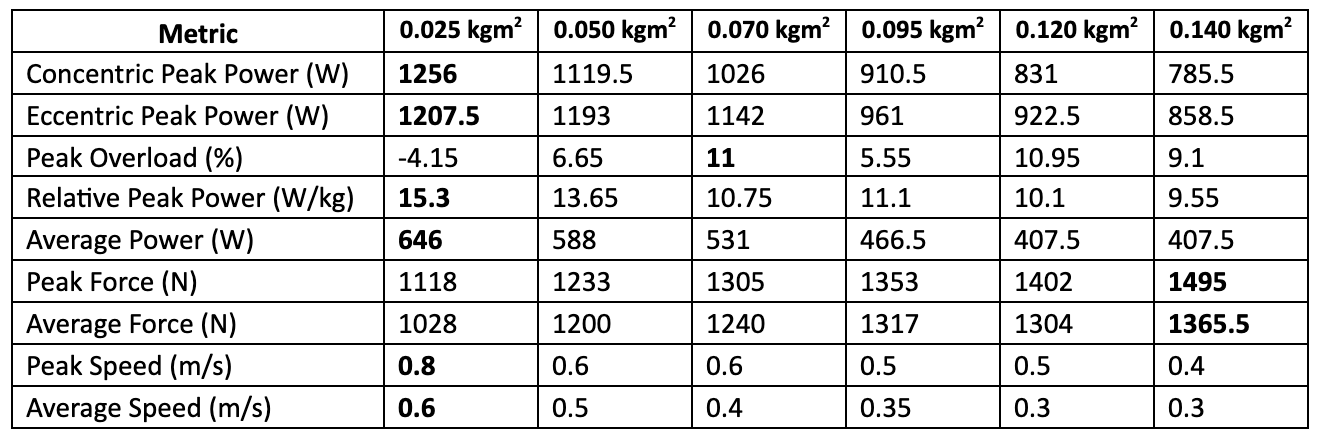
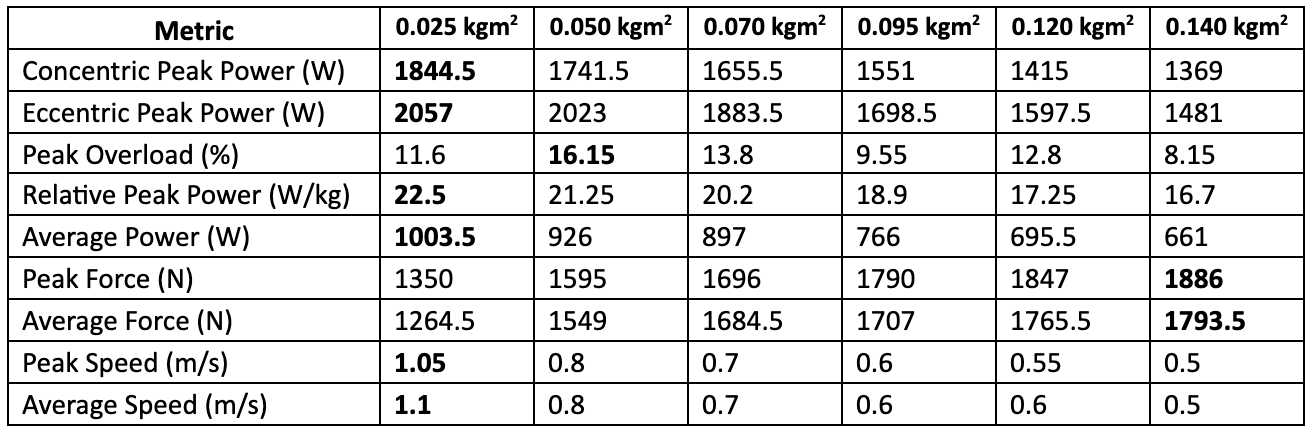
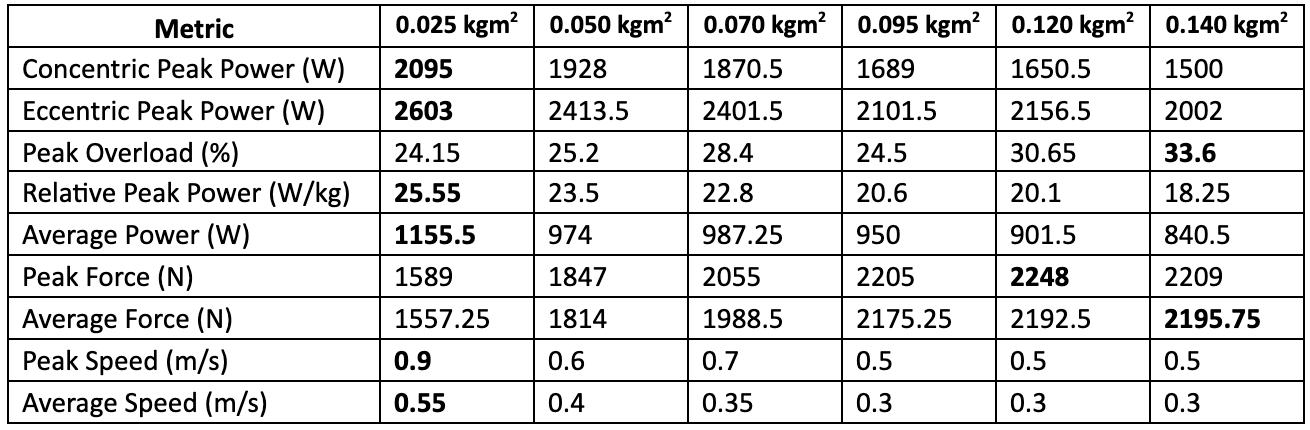
Below is a detailed breakdown of three different kBox split squat variations. You will notice how power and force metrics change dependent on the inertial load applied (kgm2). Table 1 shows how the size and number of wheels corresponds to the inertial load. Tables 2-4 summarize a load progression and metrics gathered from each split squat variation, as well as a video link showing how the exercises are performed. For the hands free and hands assisted variations of the split squat, three reps were recorded on each leg for all six loads. For the hands assisted eccentric overload variation two reps were recorded.
Table 1. Wheel Size and Corresponding Load
| kBox Wheel Size | Inertial Load (kgm2) |
|---|---|
| Medium | 0.025 |
| Large | 0.050 |
| Extra Large | 0.070 |
| Extra Large + Medium | 0.095 |
| Extra Large + Large | 0.120 |
| Extra Large + Extra Large | 0.140 |
Table 2. Power and Force Metrics. kBox Split Squat (Hands Free).
*All values are an average of the right and left sides. Peak values bolded.
Table 3. Power and Force Metrics. kBox Split Squat (Hands Assisted).
*All values are an average of the right and left sides. Peak values bolded.
Table 4. Power and Force Metrics. kBox Split Squat with Eccentric Overload (Hands Assisted).
*All values are an average of the right and left sides. Peak values bolded.
Like traditional gravitational resistance training exercises, speed and power are higher with lower loads. As load increases, speed, and power decrease, but force increases. Two interesting things to note are how significantly all metrics are increased when using the hands assisted variation over the hands free and how much the eccentric overload is impacted by the “hard stop” element of the last variation.
Not one of these exercises is better than the other, but when they are used in the program is key. The principles of periodization help to guide where each variation should be appropriately placed throughout the year.
Reflection #2: The Player & Complimentary Stressors
Eccentric Training and the Player
Before implementing the kBox, it is important to review the player's training history, assess their strength and competency in movement and complete an in-depth review of their injury history. Any contraindications should be thoroughly assessed. The flywheel can add a lot of stress to a player. We need to carefully consider the player and their training phase when using flywheel training. Below is a list of things we consider before performing flywheel exercises with our players:
Player Training Age & Proficiency
- Do they have the strength, coordination, and motor control to perform this exercise with limited risk?
- Will they grasp the coaching cue of finishing the exercise in “triple flexion”, so they don't accept large eccentric forces with a straight leg?
Developmental Needs & Key Performance Indicators (KPI)
- What do they need? Eccentric strength, concentric power, concentric force, etc.
- Does the exercise I'm selecting align with their needs?
- What is the KPI (i.e. metric) for this exercise we can use to measure their improvement?
Matching On-Ice Stressors
- What has this player been doing on the ice for the previous week?
- Does this exercise match the theme of our training day?
- Will this exercise potentially result in an overexposure to any training stimuli (i.e. volume, intensity, density, and/or tissue load)?
Training Phase
- Does this exercise fit best during the season or in the offseason? Early, mid or late offseason?
Matching Stressors: Pushing the Player in the Same Direction
There is an inherent risk that eccentric training may increase fatigue, which can negatively impact on-ice performance. However, consistently providing a minimal effective training dose is critical in managing delayed onset of muscle soreness (DOMS) and creating adaptations to eccentric training. To maximize our benefits and minimize our risks, a holistic approach is key (13). The performance staff and coaches need to be on the same page when developing monthly training plans, outlining the days that we can pair on and off ice deceleration and change of direction (COD) work. Catapult wearable devices have been instrumental in how we quantify the demands of on-ice sessions. It provides us with hundreds of metrics, but more importantly, it leads us to having more insightful conversations with our players and staff. To pair eccentric training with on-ice training we rely heavily on IMA impact events. Drills with higher G Force Load (derived from IMA impacts) will result in higher eccentric stress on the player. If you don't have access to a tracking system like Catapult, planning is critical for proper implementation. Knowing how stressful this pairing is, your general rule should be to keep the more strenuous variations furthest away from the game.
In general, our primary lower body exercise in-season is the kBox split squat (hands free). We use this variation due to the demands of an 82-game schedule over a 7-month span. As seen in table 2, we start to get higher eccentric peak power at inertial loads around medium to large flywheels (i.e. 0.025 and 0.05 kgm2 respectively). We are always aware of the on-ice demands, and we tend to only use the kBox for higher eccentric peak powers with low volume. The schedule and on-ice load will impact the use of other kBox split squat variations. Two player groups get consistently exposed to eccentric overload on the flywheel, are our scratched and low minute players. While it's no substitute for eccentric loading they are missing during game play, we believe it can be a helpful supplement.
From a performance perspective, our goal is to positively impact deceleration and COD while managing allostatic load. Strategically placed small-sided games (SSG), along with flywheel training can be used to obtain these performance benefits in-season.
Young and Rogers (2013) looked at SSG in the Australian Football League and found that they improved reaction speed and overall capacity (16). To create an environment where there are increased COD, decelerations, and G Force load, we opt for SSG (Figure 2). Shrinking the playing space can lead to increased eccentric load, which we support with flywheel training off-ice.
Figure 2. Dotted lines outline the training area of SSG specific to deceleration and COD.

Reflection #3: Consistent Eccentric Training
Off-Season Training: kBox Implementation
During the off-season, we utilize the Bondarchuk General – Specific Continuum (Figure 4) and when implementing the kBox, we focus on the GPE, SPE, and SDE (1). The previously mentioned kMeter app is used to individualize the inertial load placed on the flywheel and the metrics that we look at are dictated by the focus of the off-season phase.
Figure 3. Bondarchuk General – Specific Continuum (1).

General Preparatory Exercises (GPE)
In early off-season the goal is to build motor control, and muscle, joint and tendon capacity. Time off ice is spent cross training and recovering from stress associated with in season play. Throughout each microcycle we also include isometric holds, traditional weighted tempo eccentrics, and hopping drills. The kBox Split Squat (hands free) is one of our starting exercises for the off-season. Ideally, we build a base that is required for more intensive training and keep the total set volume low but spend a high time under tension within working sets.
General Training Prescription:
Sets: 2-3
Reps: 15
Inertial Load – 0.025 kgm2 (player dependent)
Specific Preparatory Exercises (SPE)
In the SPE we transition to a kBox split squat (hands assisted) where our focus is on strength of movement and traditional strength training variables. In this phase the kMeter can be used as an incentive to drive intent and speed of movement which is important in flywheel training. When looking at table 3, you will notice that around 0.140 kgm2 (Extra Large + Extra Large) the average speed decreases to about 0.5 m/s. Depending on the player, loads are fluctuated in order to reach velocity ranges that are typically used in velocity-based training (VBT). The ranges we focus on at this time are acceleration strength (0.5-0.75m/s) or absolute strength (0.3-45m/s).
General Primary Training Prescription:
Sets: 3-4
Reps: 2-4
Inertial Load – 0.120 – 0.140 kgm2 (player dependent)
When pairing exercises, methods that have been more recently popularized in the book Triphasic Training, by Cal Dietz and Ben Peterson can be used (2). Because there is a strength focus with the SPE, contrast training over other pairing variations is preferred. In our contrast training, the player performs the same unilateral movement over two exercises where the second exercise requires a faster eccentric contraction.
This can be achieved with a kBox by reducing the inertial load and increasing the velocity of the movement. Here we are harnessing the potentiation effect from the primary exercise to achieve a higher eccentric peak power in the second exercise.
General Contrast Training Prescription:
Sets: 2-4
Reps: 2-4
Inertial Load:0.025-.050 kgm2 (player dependent)
Refer to Table 3 for optimal power ranges in this exercise.
Due to the movement complexity and velocities experienced in the practice setting we begin our day on-ice and finish in the gym. The on-ice component that falls on eccentric focused training days has a heavy emphasis on technical skating, addressing areas of edge work, vision, approaching deceleration and deceleration angles.
The technical work is then followed by drills addressing both deceleration and COD at high velocities. To understand the impact on performance relative to deceleration and COD we use on-ice testing that includes a 15-0-15 COD and a 30-meter sprint.
The player covers a distance of 30 meters during the 15-0-15 so if you pair it with a sprint of equal distance it allows you to see their COD deficit (9). The COD deficit is simply their 15-0-15 time subtracted from their 30 m sprint time; a lower number is an indication that the player is more efficient at changing direction. The COD deficit (mean) is calculated by averaging all trials, whereas COD deficit (peak) only considers their fastest trial.
An example of data drawn from this testing battery is available in Table 5. We test-retest at the beginning of SPE and just before the beginning of training camp.
Table 5. 30 m Sprint, 15-0-15 COD and COD Deficit. 15-0-15 On-Ice COD Test

*Example of a player's baseline test.
Specific Development Exercises (SDE)
The kBox split squat with eccentric overload (hands assisted) is introduced in SDE. This exercise should only be implemented with a player that has completed the previously mentioned training progressions and is able to handle a highly stressful training stimulus. Technique, quality of movement, and experience are key in this phase and therefore, we do not use it with young players.
When performing the kBox split squat with eccentric overload the player must use the handles to pull themselves out of the bottom position then generate a “hard stop” in the eccentric phase. This hard stopping action increases eccentric peak power and therefore, increases peak overload (%). As seen in Table 4, peak overload (%) is achieved at a variety of loads, but higher power numbers are reached at lower loads. We will typically start the SDE with players using a high inertial load, but rarely exceed 0.140 kgm2 (Extra Large + Extra Large). Although Table 4 does not show this a significant drop off in peak overload is observed once these high inertial loads are surpassed.
General Contrast Training Prescription:
Sets: 3-5
Reps: 2-3
Inertial Load: 0.07-.140 kgm2 (player dependent.)
-
- Loads or training variables are adjusted if the player's eccentric peak power drops below 5% of their max value.
- Refer to Table 4 for optimal power ranges in this exercise.
A unilateral eccentric focus is maintained with the SDE performed in this phase of training, as we transition into complex training. Complex training involves a high-load primary exercise paired with a low-load power exercise that is biomechanically similar. When selecting exercises at this point of the off-season, specificity to hockey is important (angle of force, speed of eccentric contraction and ground contact time). An example of an exercise we may use here is a linear skater bound.
For the on-ice component, we continue to emphasize technical skating, COD, and deceleration, but spend less time using structured drills and more time playing SSG. Small-sided games allow the player to apply the technical skills in a dynamic game like environment. On this day, our tactical focus with SSG will address gap control, creating space, in zone forward or defensive position, reaction, contact and repetition. This is all performed at maximal effort and with the appropriate work to rest ratios. The percentage of technical to tactical content to start the SDE is about an 80/20 distribution and by the end of the phase, it will shift to 40/60. Three weeks prior to the start of preseason, we transition into competitive exercise (CE) and implement our in-season philosophy using flywheels. On-ice training consists of a few priming drills but is dominated by SSG specific for this day. The technical to tactical distribution shifts to about 15/85 at this point.
Conclusion
Let's review our reflections and quickly summarize each of them:
1) Is there equipment and technology that could make eccentric training harder, smarter, safer, and faster?
Yes. Most definitely. Flywheel training offers several distinct advantages to gravitational training including:
-
- Unlimited resistance
- Variable resistance
- Simple eccentric overload set-up
- Monitoring of load using the kMeter
- Ease of set-up
You would be hard pressed to find a safer method for an athlete to achieve a 33.6% eccentric overload. That is why the kBox is so important to what we do.
2) Should we do these exercises without first considering our players and what they're going to do on the ice?
We should always, “keep the main thing the main thing.” If we just stick to doing our own thing and the head coach just sticks to doing their own thing, we're probably not going to be working together for very long. By putting forth the effort to communicate with your coaching staff and understand their thought process, there is a better chance they will reciprocate the gesture down the road. When you do your best to compliment a coach's vision with your methods in the gym there is no doubt that they will value it.
Even if the theory of matching stressors is false, at least you've opened some lines of communication that might not have been there previously. Rest assured; players notice these things. Attempting to be on the same page as the rest of the staff goes a long way in an even longer season. It takes multiple departments to push the player in the right direction.
3) Is there a better way to “check the eccentric box” than doing tempo squats 4 weeks out of a 52-week annual plan?
Absolutely. Everything is omnipresent. If we think that eccentrics are important than we need to keep them as a staple in our program on and off the ice. The types of eccentric exercises we do just vary in volume and intensity based on where we are in the calendar.
Off-ice eccentric exercises are so important to what we do that two years ago we started bringing a kBox on the road with us. Not only is it a consistent training option for scratches we also have several players strategically use different kBox variations as part of their pregame warm-up.
Please note, that this thought process was never intended to appear like a finished product. Surely, we will have many more reflections on this topic in the years to come. We look forward to hearing about any that you have: past, present, or future.
About the Authors
Chad Drummond is the Head Strength and Conditioning Coach of the Edmonton Oilers. He's been with the Oilers since 2010-2011.
Joel Jackson is the Assistant Strength and Conditioning Coach of the Edmonton Oilers. He's also the co-founder of Competitive Thread, a company that provides on-ice speed testing technology. You can find him on Twitter (@joeljacksonsc) and Instagram (@jackson_joel)
Patrick Love is an Applied Sports Scientist at Catapult Sports. He currently supports 20 NHL and 14 AHL teams that use Catapult's wearable technology. Prior to working at Catapult, the Plano, Texas, native was the Assistant S&C Coach with the Edmonton Oilers (‘19-‘21). You can find him on Twitter and Instagram (@PLoveToTrain).
References
- Bondarchuk, A. (n.d.). Dr. Anatoliy Bondarchuk's Classification of Exercises [diagram]. GC Performance Training. Retrieved February 6, 2023, from https://gcperformancetraining.com/gc-blog/periodization201
- Dietz, C., & Peterson, B. (2002). Triphasic training: A systematic approach to elite speed and explosive strength performance. Bye Dietz Sport Enterprise.
- Douglas, J., Pearson, S., Ross, A., & McGuigan, M. (2017), Chronic adaptations to eccentric training: A systematic review. Sports Medicine, 47(5), 917-941. https://doi.org/10.1007/s40279-016-0628-4
- Fortier, A., Turcotte, R.A., & Pearsall, D.J. (2014). Skating mechanics of change-of-direction manoeuvres in ice hockey players. Sports Biomechanics, 13(4), 1-10. https://doi.org/10.1080/14763141.2014.981852
- Hansen T.E., & Lindhard J. (1923). On the maximal work of human muscles especially the flexors of the elbow. The Journal of Physiology, 57(5), 287-300. https://doi.org/10.1113/jphysiol.1923.sp002066
- History of flywheel training. (n.d.). Exxentric. https://exxentric.com/about/history/#:~:text=History%20of%20Flywheel%20Training,Hansen%20and%20Lindhard%20(1).&text=This%20is%2C%20however%2C%20not%20the%20first%20documented%20flywheel%20device
- Maroto-Izquierdo, S., García-López, D., Fernandez-Gonzalo, R., Moreira, O.C., González-Gallego, J., & de Paz, J.A. (2017). Skeletal muscle functional and structural adaptations after eccentric overload flywheel resistance training: A systematic review and meta-analysis. Journal of Science and Medicine in Sport, 20(10), 943-951. https://doi.org/10.1016/j.jsams.2017.03.004
- Munoz-Lopez, A., Floria, P., Sanudo, B., Pecci, J., Perez, G.C., & Pozzo, M. (2021). The maximum flywheel load: A novel index to monitor loading intensity of flywheel devices. Sensors, 21(23), 8124. https://doi.org/10.3390/s21238124
- Nimphius, S., Callaghan, S.J., Spiteri, T., & Lockie, R.G. (2016). Change of direction deficit: A more isolated measure of change of direction performance than total 505 time. Journal of Strength and Conditioning Research, 30(11), 3024-3032. https://doi.org/10.1519/jsc.0000000000001421
- Nuñez Sanchez, F.J., & De Villarreal, E.S. (2017). Does flywheel paradigm training improve muscle volume and force? A meta-analysis. Journal of Strength and Conditioning Research, 31(11), 3177-3186. https://doi.org/10.1519/jsc.0000000000002095
- Pearsall, D.J., Turcotte, R.A., & Murphy, S.D. (2000). Biomechanics of ice hockey. In W.E. Garrett & Kirkendall (Eds.), Exercise and sport science (pp. 675-692). Lippincott Williams & Wilkins
- Puustinen, J., Venojärvi, M., Haverinen, M., & Lendberg, T.R. (2021). Effects of flywheel vs. traditional resistance training on neuromuscular performance of elite ice hockey players. Journal of Strength and Conditioning Research, 37(1), 1-5. https://doi.org/10.1519/jsc.0000000000004159
- Valle, C. (n.d.). 5 myths about eccentric training every coach ought to know. Simplifaster. https://simplifaster.com/articles/5-myths-about-eccentric-training-every-coach-ought-to-know/
- Weakley, J., Fernández-Valdés, B., Thomas, L., Ramirez-Lopez, C., & Jones, B. (2019). Criterion validity of force and power outputs for commonly used flywheel resistance training device and bluetooth app. Journal of Strength and Conditioning Research, 33(5), 1180-1184. https://doi.org/10.1519/jsc.0000000000003132
- Worcester, K.S., Baker, P.A., & Bollinger, L.M. (2020). Effects of inertial load on sagittal plane kinematics of the lower extremity during flywheel-based squats. Journal of Strength and Conditioning Research, 36(1), 63-69. https://doi.org/10.1519/jsc.0000000000003415
- Young, W.B., & Rogers, N. (2013). Effects of small-sided game and change-of-direction training on reactive agility and change-of-direction speed. Journal of Sports Sciences, 32(4), 307-314. https://doi.org/10.1080/02640414.2013.823230
