

Addressing The Hip In-Season: Exercises, Programming, and Key Considerations
Paying attention to the hip, specifically the groin and hip flexor is nothing new for those involved in the sport of hockey.
Strengthening the muscles of the groin and hip flexors is usually a large focus during the off-season to help prevent the risk of injury for our hockey athletes. But finding ways to address this issue during the season can be much more difficult.
In-Season Considerations
During the season, players are typically skating 6-7 days per week. This means the groin is exposed to a large amount of eccentric work (Chang et al., 2009). After the first couple of weeks, players' soreness levels usually subside as they adapt to skating more frequently.
But large spikes in volume (like an increased playing role or a few hard practices in a row) or time off (Christmas break/All-Star break) can bring these issues back to the forefront.
Additionally, players are constantly in a flexed hip position. This is largely due to skating, sitting in meetings, traveling, or relaxing during their personal time. Because of this players, athletic trainers, and strength coaches look to include stretching, mobility, and soft tissue work daily. However, if we want to add length or decrease tension in the muscles of the hip flexor, we should also look to strengthen it.
My Approach
With a large volume of eccentric stress being placed on the groin in-season, we don't need to add this additional stressor. This leaves us with the options of isometric or concentric work.
Isometric work brings a lot of benefits to the table:
- The player can control how much tension they can create and tolerate
- No or very minimal muscle damage is caused
- Low chance of soreness
- Tendon “Creep” can help to repair possible damage that has occurred (Paxton & Baar, 2007)
Use of concentric work can:
- Add some strength with less stress than eccentric focused exercises
- Allow the muscle to move through its full active ROM
- Feel more “sport specific” to the player
When programming I try to mix my groin and hip flexor work in with my core work. It's a great way to sneak in some strength work for these two important areas without creating a lot of stress. For exercises addressing the groin, I bucket them into:
- Long lever exercises
- Short lever exercises
- Concentric exercises
For exercises addressing the hip flexors, I bucket them into:
- Isometric exercises
- Concentric exercises
Long Lever Groin Exercises
We do these the furthest away from a game day and typically on strength days. These exercises will always be some form of isometric. They place the largest amount of stress on the groin for what we do in the gym, hence why we want it as far away from a game as possible. Some examples are below:
Short Lever Groin Exercises
Performed 1-2 days out from a game, these exercises still allow us to isometrically address the groin, but in a less stressful position than earlier in the week. Examples:
Concentric Groin Exercises
We typically perform these on days that are more “Power” focused. I find this pairs best with our theme of the day while still helping us to address the groin concentrically. I will usually rotate between the two exercises below, looking to strengthen the groin in a flexed and extended hip position:
Isometric Hip Flexor Exercises
We program these exercises at any point in the week, but it depends on the other core work I have planned for the day. I try to pair these exercises with other core work that involves: anti-lateral flexion, anti-rotation, or rotation. A few sample exercises are below:
Concentric Hip Flexor Exercises
These exercises are mostly used in our warm-up or on our “Power” days as I find it pairs better with that type of session than an isometric. Band resistance is important with these exercises, I will usually only use green or yellow mini bands as higher resistances have caused some soreness in the past. Examples below:
Putting it all together
Addressing groin and hip flexor strength doesn't need to be complex. Finding ways to sneak it in with other exercises, especially the core, can help you get more bang for your buck, and help you avoid programming too many exercises in a session to check all your boxes. The framework I typically follow is game and schedule dependent:

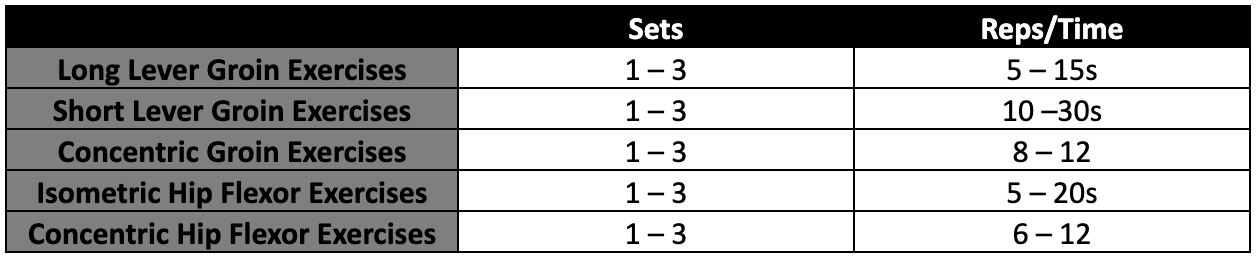
The volume of exercises don't need to be very high. I prefer to follow a micro-dosed approach, keeping volumes low and touching on these exercises more frequently either in our lift or warm-up. Prescriptions I use:
Shoutout
Lastly, I'd like to quickly shout out and recognize Abe Edson of the Springfield Thunderbirds. This framework was inspired by much of his programming philosophy that I learned in my time spent interning with Abe.
Bio
Andre Carere is the Head Strength and Conditioning Coach for the Ontario Reign. He holds a Master's Degree in Strength and Conditioning from Springfield College, and a Bachelor's Degree in Kinesiology from Brock University.
You can follow Andre on Instagram (@acarere93) and Twitter (@AndreCarere)
References
- Chang, R., R. Turcotte, and D. Pearsall, “Hip adductor muscle function in forward skating.” Sports Biomechanics, 2009. 8(3): pp. 212-222.
- Paxton, J., and Baar, K, “Tendon mechanics: the argument heats up.” Journal of Applied Physiology, 2007. 103: pp. 423-424.
- Just Fly Performance Podcast #156. “Dr. Keith Baar on Tendon Health, Rehab and Elastic Power Performance”.
- Donskov, A. “The gain, go, grow manual.” 2020.
