

Powermax Super Deadlift Bar (U Bar) Split Squats
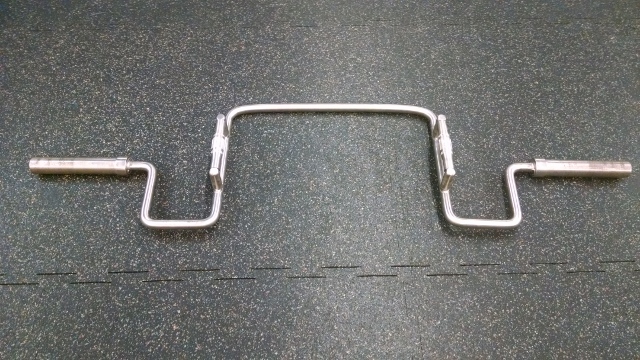
The U bar is a great tool that I have added to my programs which has many advantages over straight bars and trap bars. Especially when loading squatting pattern exercises. I like it because it allows us to use heavy loads in more ergonomically advantaged positions than straight bars. Unlike a trap bar, the U bar allows for one leg variations of squats and deadlifts because it is open in the back.
Since I am talking about squats and deadlifts here I think I should start by actually clarifying what I mean by each term. To me, a squat pattern is simultaneous flexion and extension of the knees and hips. For instance, a one-leg squat, a split squat, and a back squat are all obviously squatting patterns. However, I also think that exercises that are traditionally referred to as 'deadlifts' are actually squats as well. For example, I think powerlifting style 'deadlifts' are really a squat pattern. Also, I think trap bar 'deadlifts' are a squat.
A deadlift to me is a hip hinge pattern. In other words, there is only flexion and extension of the hips and there is little to no movement at the knees. Therefore, examples of deadlifts include exercises like straight leg deadlifts or Romanian deadlifts and good mornings.
The real advantage as I see it with U bars is how the weight is held. The arms are down at the sides in a neutral shoulder position and this is the safest and most stable position for the shoulder joint to be in. This is key since squat pattern exercises are typically where we use the heaviest weights. So it only make sense to me that the heaviest loads are carried in the strongest and safest shoulder position.
This is the real problem with back squats. The shoulder is put into its weakest position of external rotation and abduction to carry a very high load. Many athletes have a difficult time getting into this position. Also, many athletes don't have the necessary should mobility to get into this position at all. As a result we often see excessive lumbar extension to compensate for poor shoulder motion and this leads to low back pain. Not to mention that when the barbell is across the back it causes a bit of forward lean which further increases lumbar loads.
The problem I see with front squats is two fold. Athletes with long arms will jam their lumbar spine into excessive extension when front squatting. Athletes with short arms will not be able to get their elbows up when front squatting and therefore will not be able to hold heavy loads.
The trap bar squat is a much better alternative than back squats or front squats. This is primarily because of the shoulder position used to carry the weight. Also, since the trap bar goes around the athlete rather than in a straight line, it places the center of the load more in line with the athlete's cernter of mass. This seems to place less stress on the lumbar spine. However, the short fall of the trap bar is that it goes all the way around the athlete. Because of this it can not accomodate one leg variations of squatting or deadlifting patterns such as split squats, rear foot elevated squats, or one leg deadlifts.
I know that some people will argue that things like one leg deadlifts and rear foot elevated squats have been done with trap bars. This may be so but I do not recommend it. A trap bar one leg deadlift may work for somebody with short arms. However, most hockey players I train have relatively long arms and if they perform one leg deadlifts with a trap bar the rear leg hits the bar. Also I feel a rear foot elevated squat with a trap bar is a bad injury waiting to happen. Sooner or later somebody will drop the weight and the trap bar will land across their back leg, crushing it between the bench and the trap bar. This is where the U bar really stands out in my view. Because it it open in the back it can accomodate all of these exercises allowing for the use of high loads in a very safe manner. Also, if one is inclined to do so he or she can still perform the two leg trap bar squat variation with the U bar. Therefore I view the Powermax Super Deadlift Bar, or U bar, as a highly utilitarian and versatile tool for any weight room.
