

A New Approach for Handling "Groin" Strains
In my experience as a player and coach, way too many hockey players consider groin strains a normal part of playing. These injuries frequently pop up in the pre-season when players aren't used to a high volume of skating (or skating at all for some players!).
*Quick side note: I say “groin” because that word really refers to an entire muscle group known as the adductors. “Groin” strains can refer to an injury to one or more of the muscles included in this group. With that understood, future use of the word groin really means adductors.
In Restoring Proper Hip Function Part 1 and Part 2, I outlined the exact progression and exercises I use with my hockey players to prevent hip flexor and groin strains. Since implementing those progressions I haven't had a SINGLE player suffer a hip flexor injury. In the interest of full disclosure, I'll tell you that a couple players have slightly “tweaked” their groins. They all had prior problems with this injury and they all had one thing in common: outstanding groin flexibility!
The idea that increased flexibility may be an underlying cause of injury is contradicting to common belief. I don't mean to imply that all stretching is bad or will contribute to injury. I simply mean that blindly recommending “stretching” to prevent muscle injuries is unwise. These players were able to QUICKLY resolve their groin pain by doing the following three things:
1) Stop stretching their groin
2) Start stretching their glutes
3) Strengthen their adductors using isometric exercises
Stop Stretching Pulled Muscles
Muscle pulls (strains, tweaks, etc.) range in severity from a slight over-stretch to a complete tear. Assuming the muscle isn't completely torn, the muscle has some micro-damage/tears (small tears). When I first learned this, it helped me to visualize the injured muscle as a rubber band with small slits in it. Think about what would happen if you stretched this rubber band. The small slits would likely expand, getting larger and wider. Naturally, this ISN'T conducive to your healing.
Furthermore, when a muscle becomes damaged, it will frequently feel tight because it's guarding against movements that could contribute to further injury, such as overstretching. If you're attempting to stretch this muscle, you are essentially trying to stretch an over-stretched muscle AGAINST the muscles' contraction. Not only is this not an effective way to speed up your healing, but it's probably making your injury worse!
Why Stretch the Glutes?
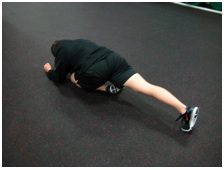
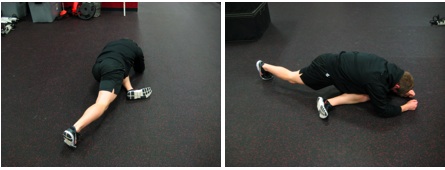
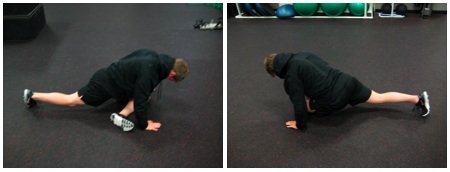
Many muscles are overworked and become strained because of a relative stiffness imbalance with their antagonists (in this case, the glutes). In other words, it's not necessarily the great groin flexibility that contributed to the injury, but the difference in the range of motion and strength of the adductors relative to the glutes. An effective way to bring this relationship back into balance is to start stretching the muscles that oppose the injured muscles. One of my favorite glute stretches is displayed below:
Because the glutes have muscle fibers that run in several directions, you should alter the position of your hip to stretch your glutes in a variety of positions (e.g. back leg straight back, back leg crossing over bent leg, front leg externally rotated).
Strengthening the Groin
In 2001, Tyler et al. conducted a study on risk factors that predict groin strains in professional ice hockey players. They found that groin strains were more likely if the player's adductor strength was 78% or less than their abductor strength. This makes sense in light of the “stiffness” idea I mentioned earlier.
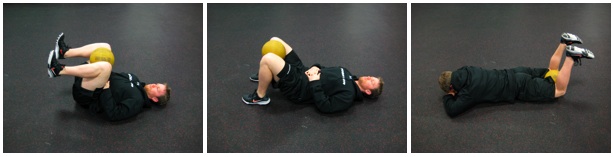
Another way, in addition to improving glute flexibility, to “bridge the gap” regarding this stiffness imbalance is to strengthen the groin muscles. Different muscles within this group help contribute to hip flexion (raising your knee forward) and hip extension (pulling your knee backward). Because of this, and because isometric exercises generally only improve strengthen within ± 15° of the joint angle at which the exercise is performed, it's important to strengthen the groin muscles in a variety of hip positions.
With these considerations in mind, I put together an exercise I call the “6-Way Med Ball Crush”. This exercise series involves placing a medicine ball (or any other object) between your knees and “crushing” it as hard as possible for the specified time. I generally have my players perform each position for 30s for 2-3 rounds through.
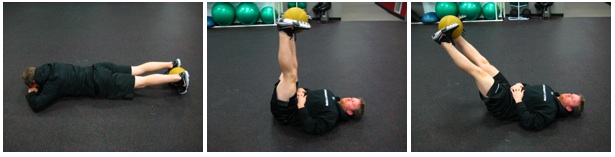
My players that have followed this approach have resolved their groin pain within 2-3 weeks, performing this circuit 2-3x/week. It's important that you know it's a true “groin” injury and not a sports hernia, or sacroiliac or pubic symphysis injury. I'm generally against “umbrella” recommendations, so I think it would be irresponsible to say this will DEFINITELY work for everyone. I will say that I've been pretty surprised at how quickly and effectively this three-step approach has been in resolving groin pain in my hockey players. Hopefully you'll find similar success!
References:
1. Tyler, T.F., Nicholas, S.J., Campbell, R.J., & McHugh, M.P. (2001). The Association of Hip Strength and Flexibility With the Incidence of Adductor Muscle Strains in Professional Ice Hockey Players. The American Journal of Sports Medicine, 29(2), 124-128.
Kevin Neeld, BSc, MS, CSCS is the Director of Athletic Development at Endeavor Fitness in Sewell, NJ, and the author of Hockey Training University's “Off-Ice Performance Training Course.” Through the application of functional anatomy, biomechanics, and neural control, Kevin specializes in guiding hockey players at all levels to optimal health and performance. For more great hockey training information, visit KevinNeeld.com.
