

Change of Direction Skills for Off-Ice Hockey Training
CHANGE OF DIRECTION SKILLS FOR OFF-ICE HOCKEY TRAINING
BY DR. MICHELLE BOLAND
When prescribing exercises and designing programs, we should implement a coherent application of fixed movement principles. Principles are universally valid and do not require context. A fixed movement principle that I will focus on today is that athletic skill acquisition includes the ability to transition from leg to leg.
The ability to transition from leg to leg is an important concept in all sporting activities, from running and throwing a ball to skating and changing direction. Changing direction while skating at high speed is a major component of hockey performance and there are certain movement skills required.
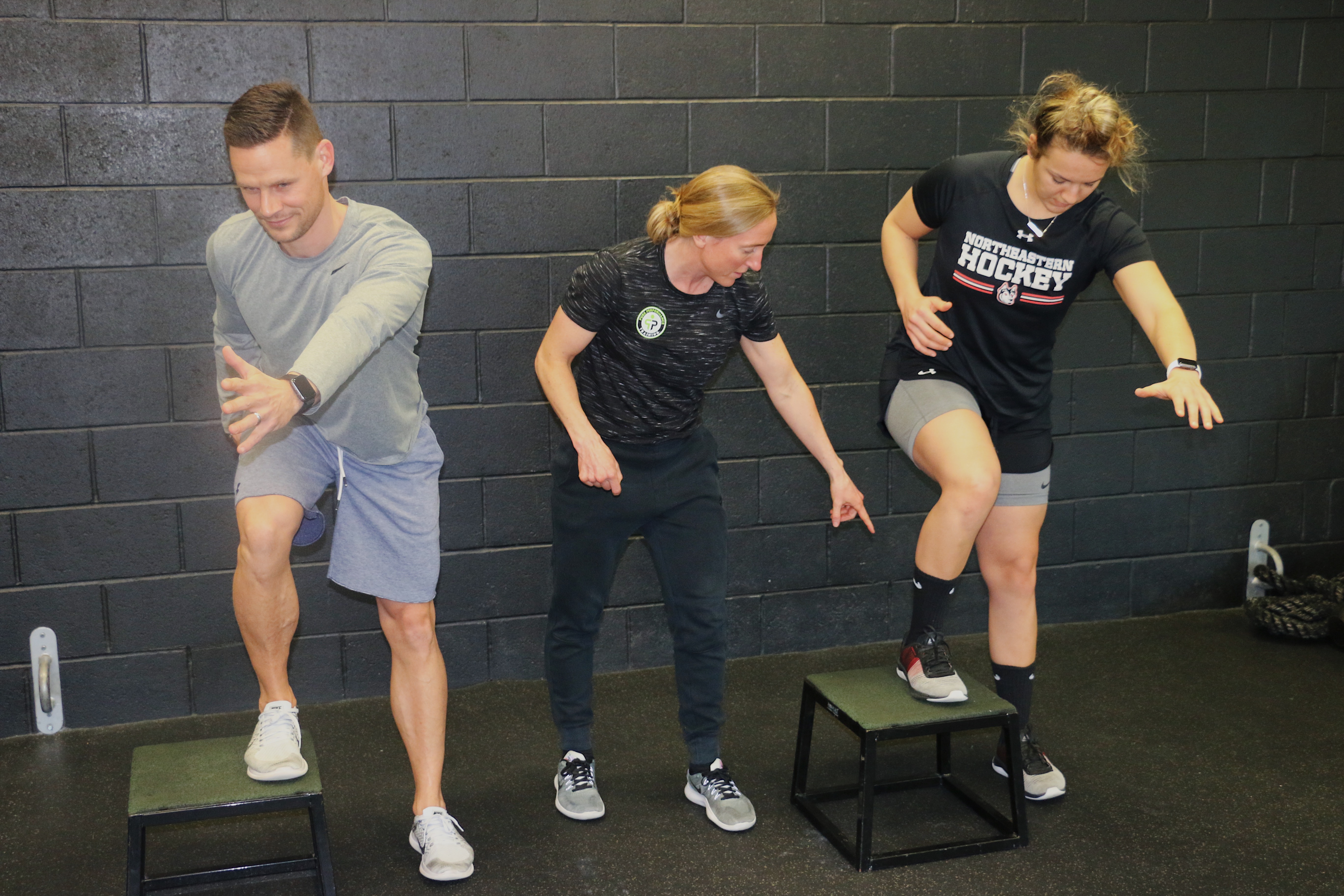
Change of direction movement skills in the sport of hockey are related to the following:
1. Overcoming the forces creating momentum in a direction
2. Creating muscle tension quickly to stop those forces at the transition point (decelerate)
- Absorb force from entering the transition point
3. Being able to create force to propel yourself in the opposite direction (reaccelerate)
- Produce force exiting the transition point
Creating muscle tension or stiffness quickly provides athletes the ability to decelerate and reaccelerate.
This is important in every skating stride, quick change in skating direction, AND taking physical contact within the sport; the degree of intensity vary. The goals of training are then teaching hockey players how to absorb force, produce force, and produce force quickly and repeatedly.
Off-ice strength training can improve elements of performance and develop the skills needed to change direction at high speeds. The movement principle of ‘athletic skill acquisition includes the ability to transition from leg to leg' can be implemented in off-ice strength training with exercises that include the following 5 elements of change of direction skills.
5 ELEMENTS OF CHANGE OF DIRECTION SKILLS
- Trunk rotation
- Alternating actions of the pelvis
- Ability to separate segments of the body (i.e trunk and pelvis) to transfer force
- Ability to absorb force
- Ability to create force (quickly and repeatable)
These skills will dramatically improve a hockey player's ability to create stiffness, quickly entering into a transition, and propel themselves out of a transition, leading to overall improvement in on-ice performance and skating speed.
TRUNK ROTATION
The ability to rotate the trunk will improve change of direction skills by allowing force to be transferred through the body, especially for skating. Here are some examples:
Alternating DB Bench Press with Trunk Rotation
½ Kneeling Medicine Ball Throw
Back Lunge to March Rotational Throw
PRACTICE ALTERNATING ACTION OF THE PELVIS WITH SPLIT SQUAT EXERCISES.
Alternating action of the pelvis means that one side of the hip is in extension while the opposite side is in flexion. The alternating hip position allows athletes to move through space and transition from leg to leg efficiently. Here are some examples:
Split Squat with Medicine Ball Rotation
ABILITY TO SEPARATE SEGMENTS OF THE BODY (I.E TRUNK AND PELVIS) TO TRANSFER FORCE
The ability to rotate the trunk in the opposite direction of the hips is key to creating speed when changing directions. Here are some examples:
Ipsilateral Split Stance Medball Slam
Front Foot Elevated Anterior Loaded 1 KB Disassociation Split Squat
ABILITY TO ABSORB FORCE
The goal at the transition point of changing direction is to create stiffness to decelerate and reaccelerate. Stiffness is the ability to quickly build up muscle tension. The external load will increase the amount of stiffness the athlete will have to create. These type of drills are called false throws. Here are some examples of exercises that work to improve force absorption and stiffness:
Lateral Shifting with Medicine Ball
Shuffle to Lateral Shifting Chops
Shuffle to Lateral Shifting with Medicine Ball Chop Throw
Partner Mirror Side Shuffle to Medball False Side Chop
ABILITY TO CREATE FORCE, CREATE FORCE QUICKLY, AND CREATE FORCE QUICKLY AND REPEATABILITY.
The goal of exiting the transition point of changing direction is to produce force. You can progress athletes by working on producing force quickly and repeatedly. Here are some examples:
Band Resisted Push-Off Sprint Step
Propulsive First Step Acceleration Drill
Loading and Propelling Series Drills
*Emphasis on pushing the ground away to produce in opposite direction athlete is moving towards.
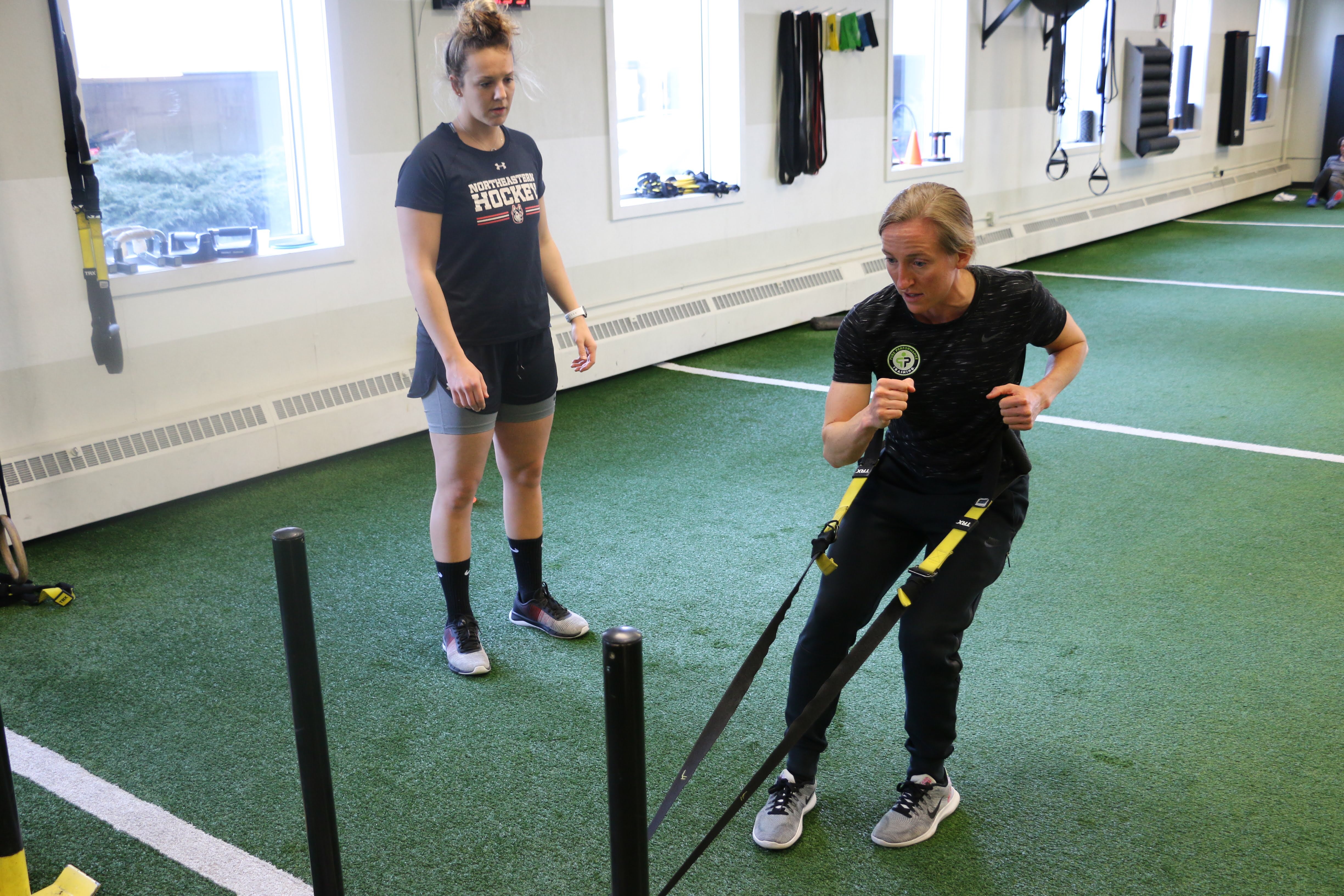
Off-Ice Change of Direction Drills to Implement:
Lateral Push Mechanics Progression Push to Base
Change of direction Lateral Transition Drill
Four Corner Change of Direction Drill
*Emphasis is placed on effort through these drills
You can also incorporate change of direction drills into strength training activities. The following exercises represent what is required of the pelvis, at the transition stage for changing direction. The above drills can be mimicked through split stance exercises to reinforce mechanics at the pelvis. Here are some examples:
Contralateral "Into the cut" Split Squat
Ipsilateral “Out of the cut” Split Squat
*We are training for sport movement coordination with resistance, heavy loading is NOT the goal.
SUMMARY
Strength training overall for sports performance should be coordination training with resistance. Training should not be maximization of loading as there are secondary consequences, such as reducing the rotational abilities of athletes. Emphasizing movement principles within strength training activities serves as a basis for specificity (similarity between training and sport) and transfer to sport (influence of training stimulus on sport; Bosch, 2010) (1).
Off-ice training focused on being able to load into a direction change transition and produce force to exit the transition point, will GREATLY improve on-ice skating performance. Skating includes the movement principle of being able to transition from leg to leg efficiently and effectively.
Improvements in trunk rotation, the alternating ability of the pelvis, and being able to separate segments of the body to transfer force will provide you with the ability to produce a powerful hockey player. Activities that will improve the ability to absorb forces (especially in a contact sport), by creating stiffness and producing force quickly, will guarantee a dominant hockey player.
LEARN MORE
Michelle will be starting her group coaching mentorship on May 18th 2020.
Join Michelle and a group of trainers who want to take their performance knowledge and coaching skills to the next level. Click HERE for ways to work with Michelle and to join the group coaching mentorship waitlist.
ABOUT MICHELLE
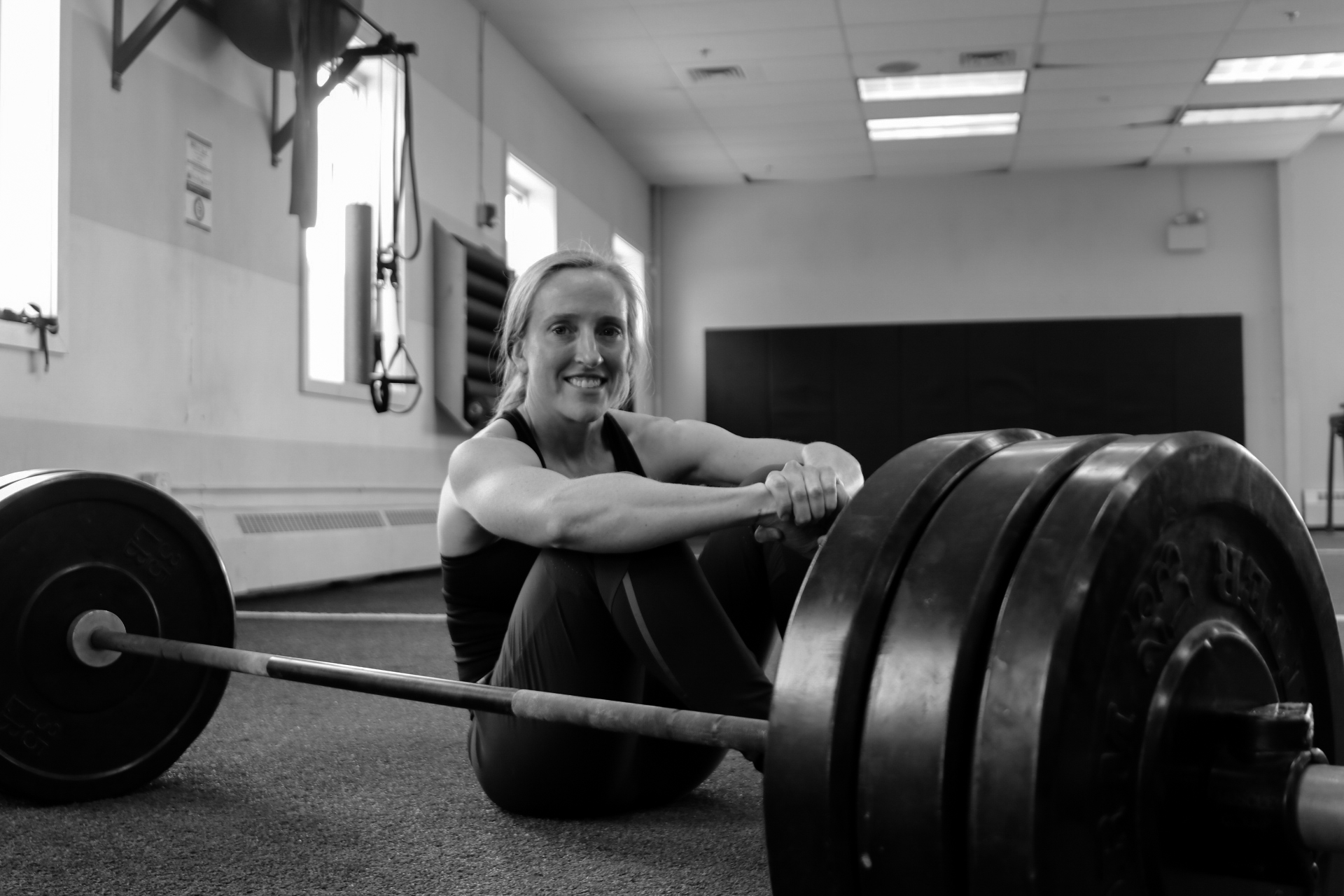
I grew up in central Massachusetts where my interest in athletics and playing sports began. I played soccer, basketball, and ran track at the collegiate level while studying Nutrition (B.S). After reflecting on my life passion for athletics and sports performance training, I decided to pursue a higher education degree in strength and conditioning (M.S.) and exercise physiology (Ph.D.) at Springfield College in Massachusetts.
I have several years of professional experience as a strength and conditioning coach at a Division 1 institution, working with a nationally ranked top 5 Women's Ice Hockey team, a nationally ranked top 10 Men's Ice Hockey team, and other teams including Field Hockey, Women's Soccer, and Men's Basketball. After working at the collegiate level, I pursued a Director of Education position at a private facility and I now have my own company, Michelle Boland Training, in order to support others in achieving their performance and fitness goals to the best of my abilities.
Instagram: @dr.michelleboland
Learn more about Michelle: www.michelleboland-training.com
