

Considerations for Training Elite Hockey Players
When a strength coach is designing programs for elite players there are several things to consider. These players are different than the rest of us and if this is not recognized by the strength coach injury, over training, and poor progress will result. These players have very efficient neuro-muscular systems. They likely have a higher than typical ratio of fast twitch muscle fibers. There are also some body type and posture considerations to take into account.
The elite players have a nervous system that allows them to do things that most of us can not. They are very good at turning muscles on and off rapidly. They can change directions quickly. They can start and stop better and they can change speeds better as well. Therefore they are very deceptive and difficult to play against. Elite players have lots of fast twitch muscle fibers and this makes them explosive and powerful and they can do all of the deceptive things and make it look easy. They are highly trainable and responsive to strength training so they make very rapid progress in the weight room. Even if they eat poorly they do not gain fat.
Because elite players have a really highly tuned nervous system and lots of fast twitch muscle fibers they are producing lots of power and there is lots of mechanical load placed upon them when they play and train. Therefore they are more likely to become fatigued and if a coach is not mindful of this an injury will result. Also, their really dialed up nervous system is likely to perceive fatigue more than most of us. They will also have a stronger perception of muscle soreness and stiffness after a training session.
Body type/posture is a very important consideration as well. These fast twitch, sprinter type of elite players almost always have significant anterior pelvic tilt and long arms. In addition many good skaters are bowlegged. The anterior tilt allows for a greater amount of extension in the hip and back allowing for longer strides and therefore a greater ability to accelerate. Long arms obviously allow for greater reach and range. The bowlegged-ness puts the player onto their outside edges which allows them to put more power into the ice.
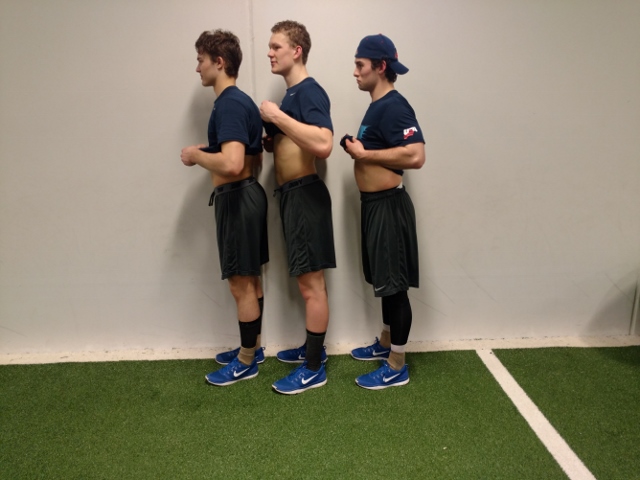
The anterior pelvic tilt is also a major risk for lower back injury so this really needs to be checked as these players need the abilty to brace against falling forward into excessive lumbar extension that can cause back pain. The anterior tilt is being caused for 2 reasons. (1)Because the rectus abdominus and hamstrings are too long and thin. (2)The hipflexors are short and dense.
So what strength coaches need to do here is add strength to the abdominals and hamstrings while avoiding any lengthening of these muscles. So anti- flexion/extension and anti- rotation type core training is a must to add the necessary strength and control to the abdominal wall. Also, good posterior chain training using things like suspension trainer leg curls and stability ball leg curls are needed. It is imperative that the glutes are firing maximally on these exercises so full hip extension is gained. This will also help to get some hipflexor length. SLDL type exercises are also great but they need to be performed with atleast 20 degrees of knee flexion so there is not too much tension on the hamstring. This amount of flexion will also increase glute firing. Of course coaches also need to make soft tissue work and stretching of the hipflexors part of every training session. Diaphragmatic breathing will help with the hipflexors as well.
Avoid stretching the abdominal wall and hamstring because they are already excessively stretched. Things like lying prone and pressing up or lying supine and stretching the hamstring with a band are poor choices for these athletes. (Yes, you read that correctly: do not stretch the hamstrings). There are very few people with posterior pelvic tilt that really need lots of hamstring stretching. Even fewer that are elite hockey players. The combination of rectus abdominus pulling upward on the pubic crest, hamstring pulling down on the ischial tuberosity, and better hipflexor length will allow the pelvis and lumbar spine to achieve a more neutral position.
Players with long arms will also struggle on some lifts so exercise selection is important. The biggest thing to avoid is holding a barbell across the back of the shoulders such as in a back squat or behind the neck press. Somebody with long arms will really struggle to get into this position and they will most likely get there by excessively extending their lumbar spine and tilting their pelvis forward. This shoulder position of external rotation and abduction is the weakest shoulder position. So why should we be using it to hold the heavies loads such as in exercises like back squats. Squatting exercises should be loaded with kettlebells, dumbbells, or Powermaxx Super Deadlift bars. These all allow for the weights to be held down at the sides in our strongest and most stable shoulder position. Also, overhead pressing should be done with kettlebells and not straight bars. Again, a straight bar overhead press puts the shoulders into external rotation and abduction. With a kettlebell the shoulder can internally rotate in the bottom of the pressing motion.
We are not in a demolition derby. We are in a drag race. Train these players correctly and make wise exercise choices and they will make great progress.
