

Diaphragmatic Breathing Summary
Introduction
A couple of weeks ago there was a question on the forum about how to improve an athlete's thoracic extension when other corrective strategies were not providing a solution. The human body can be a funny and frustrating thing. Sometimes no matter what kind of soft tissue work, stretching, activation, or mobility drill we try to incorporate to create a change, nothing happens! When we see no short-term nor long-term change that occurs after exploring all of our options, it can lead the coach, clinician, or trainer scratching their head. I have been in this situation on numerous occasions. Within the last few years systems like PRI, FMS, and DNS have had a large impact on the teaching of functional anatomy to the masses. Lately there has been a growing interest in the diaphragm and the role that diaphragmatic breathing can have on performance and corrective strategies.
In this article I am going to explain how I've taken information from these sources and Kevin Neeld and how I have been applying that information to learn how diaphragmatic breathing can be that small piece that we're missing in our corrective strategies.
Anatomy
First, I have to explain the anatomy of the diaphragm so we can understand how large of a surface area this muscle has. So don't fall asleep on me yet. The diaphragm is composed of two different muscles, the right and left hemidiaphragm. These two hemidiaphragms are innervated by a left and right phrenix nerve and are attatched proximally to a central tendon. The anterior and lateral section of the central tendon attatches to the zyphoid process of the sternum and the ribs 7-12. The Diaphragm itself is dome shaped. The central tendon of apex of the dome is around vertebrae T8. The left hemidiaphragm is attached distally to L1 and L2 while the right hemidiaphragm is attached distally to the anterior surfaces to L1-L3. All those big words just mean the diaphragm is a large muscle and it attaches all the way from the thoracic spine and ribs to the lumbar spine. So it's safe to say that the diaphragm can have a large impact on our posture and how the muscles around it function.
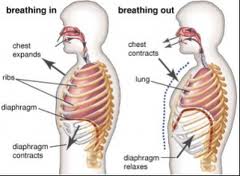
Here is a great resource with an extensive explanation on the diaphragm. The Value of Blowing Up a Balloon
How breathing impacts our brain and nervous system
The body is regulated by two major nervous systems. The central nervous system (CNS) which is comprised of the brain and spinal cord, and the peripheral nervous system (PNS) which is also comprised of the autonomic nervous system (ANS) and somatic nervous system (SNS). The ANS has a major role in conducting impulses or messages from the brain to cardiac muscle, smooth muscle, and glands. This is all done without having to think about it. The ANS is also broken down into the Sympathetic and Parasympathetic divisions. The Sympathetic division mobilizes our bodily systems into a "fight or flight" mode when the body perceives stress or danger. Some of these responses can include elevated heart rate and blood pressure, elevated breathing rate, mobilizes glucose, and circulates hormones such as adrenaline. The Parasympathetic division does the exact opposite functions of the sympathetic division by slowing things down in order to conserve energy, promote functions of rest, and digestion.
Are you still awake yet?
Don't worry here is how everything is all tied together to improving mobility.
If someone has poor breathing patterns and the diaphragm cannot help deliver air into the lungs optimally, then the brain senses something is not right. If the brain senses that our body is not getting oxygen optimally and effortlessly like it should, it's going to go into defense mode and shift more into a sympathetic state. This sympathetic state, or "fight or flight" mode forces our bodies to compensate by delivering oxygen by any means possibly. Our secondary respiratory muscles like pec minor, trapezius group, and scalenes have to overcompensate for what the diaphragm isn't measuring up to. This overcompensation in time leads to the muscles being overworked, overly tight, and increased tension. If our brain senses that oxygen isn't getting delivered optimally and we shift into this sympathetic state, then our bodies will be more tense and will favor these protective mechanisms. This protection mode doesn't allow the body to move freely in the areas we need like the neck, shoulders, t-spine, and hips.
Hopefully all that explanation can show you how improper breathing patterns can affect our movement.
How do I know if someone has compensation or poor breathing patterns?
During my screening process with the FMS, I check for any breathing compensations. It's pretty easy to tell if someone has any compensations. First you ask them to take a big breath in an out. Here are some things to look for. Look for their chest elevating, shoulders and traps elevating, and no expansion with their stomach. A good looking breath should have limited chest and shoulder elevation with most of the motion coming from their waist. If you see them breathing through their chest and their shoulders rise, then make a mental note that you might need to address this in the future.
What causes someone to have breathing compensation?
This is the same as the classic question of which came first, the chicken or the egg? Does faulty body positioning and alignment cause breathing compensations, or does breathing compensations cause faulty body positioning and alignment? A couple of things we do know for sure. 1) Lack of thoracic mobility causes us to compensate with extension in the thoraco-lumbar (T-L) junction. 2) T-L extension changes our pelvic positioning and or can cause a lower rib flare. 3) A lower rib flare puts the diaphragm at a weak disadvantageous position to eccentrically contract or optimally fill our lungs with air because the ribs cannot be effectively pulled down like they are supposed to.
Our resting posture can affect breathing compensation. Pay extra attention to how you or other people stand for extended periods of time. Do you notice yourself or others have a weight shift onto the right hip? We are inclined to do this because our bodies look for the most effective way to survive and our natural structural asymmetries allow us to breathe easier and gain passive stability when we shift to this side. Also check out how you drive or sit in a chair. Do you sit on your right hip and drive with your left hand? Do you sit in a chair and cross your left foot over your right knee? Again these are tactics for our bodies to get in the most comfortable position to breathe and survive. From now on try driving on your left hip while steering with your right arm, try sitting in a chair crossing just your right leg over your right knee, and try to more frequently rest on your left hip while standing instead of the right. Might feel weird or uncomfortable at first but it's okay, just sit there and chill in those positions.
Again I cannot tell you which problem comes first, the breathing or the faulty positioning of the T-L junction, but it's probably a good idea to try and address it. Here's a short video on how a lower rib flare can affect the mechanics of the diaphragm.
What do I do with the information from the screening?
We all have our favorite correctives or stretches for people that have poor range of motion or limited mobility in the areas we need it. I have my set choices of stretches and correctives that I use depending on what body parts are affected and if it's a mobility or flexibility problem. During the training session, we always foam roll, stretch, mobilize, and activate in that order. Everything gets addressed by using the joint-by-joint approach during the warm-up. Within each person's program is a specific corrective that is assigned to them from the results of the FMS that they perform as a superset paired with a lift. For example if we are back squatting, that individual might have to do a deep squat corrective paired with that back squat. If I have an individual that I know has a major limitation from the screen, then every few weeks I recheck that dysfunction pattern. So if someone has terrible shoulder mobility, I will recheck that mobility after 4 weeks. If I have seen 0 change in that persons pattern, then I know that my corrective is not working and something else needs to be done.
If I try another corrective and there still is no change, then I go to diaphragmatic breathing as my last resort. What I do with this is before the session I test whatever the restricted pattern is, then I have them lie face down on the ground and perform 8 crocodile breaths emphasizing breathing circumferentially through their stomach and into the ground. You can tell if they are doing it right if you see their low back rise up and down. Also, you and the individual can get instant feedback of this feeling by placing your hands around their waist and cue them expand and push into your hands. This will help get that feeling of breathing circumferentially. After I have them breathe, they perform a corrective like a rib grab for thoracic mobility and then rescreen the movement. If you see a change then you know that the breathing was the missing link. Now I know their corrective is the breathing and during their session they will be using that as one of their correctives.
Another strategy I have used is to program diaphragmatic breathing after the training session to help aid the recovery process. It can be done by itself or during a stretch. Most athletes are sympathetic dominate and creating an even more excitatory response from the training stress doesn't help that either. So doing the breathing at the end of the session will help shift into that parasympathetic state so the body can start recovering quicker by starting the digestive process sooner and switching from catabolic to anabolic state.
What I've seen.
There have not been many people I've been around where my initial prescription of correctives and stretches did not make an improvement in someone's limitations. Using diaphragmatic breathing as a last resort has not been common in my observations, but when I have had to use it as a last resort I have seen some impressive changes. I've seen an immediate 6-8 inch improvement on the FMS Shoulder Mobility and a poor 1/1 on the FMS Active Straight Leg Raise go to a good looking 2/2.
Closing thoughts
You are probably wondering why do I not introduce diaphragmatic breathing to everyone from the start as a corrective instead of using it as a last resort? Doing diaphragmatic breathes can take a lot of time. If you are not restricted by time, then by all means start with that. Even people with no major limitations can all still benefit from learning to breathe properly and strengthen the diaphragm. But if time is limited I would rather exhaust all my other correctives that are more time efficient.
Another reason I use it as a last resort is because I don't want to have a large group doing diaphragmatic breathes during the warm up where I can't check to see if they are doing it right. Some athletes will buy in and do it properly, but there are others who won't care as much and won't do it correctly.
This won't be the magic pill that will fix everything. There are some people that still may not respond favorably. Structural limitations or other medical factors might prevent certain limitations or mobility restrictions to clear up. I wanted to write up this summary of the structure of the diaphragm, the interaction with the brain, and how the body reacts to breathing to help show you how to use breathing as a clearance screen and how to use it as a tool to improve movement limitations or pain.
I wanted to thank the following FMS, PRI, Kevin Neeld, Jeff Cubos, Greg Robins, and Mike Boyle for the inspiration and sources I used for writing this article. It is because of your passion for sharing knowledge and experiences that help others make our field better. Thank you guys.
