

ESTABLISHING A FOUNDATION: Leg Strength for Young Goaltenders
Establishing a Foundation - Leg Strength for Young Goaltenders
When you build a house what is built in the first stage of construction? If you said the foundation, you are correct. A foundation, if strong, gives strength and support to the upper structure. When you plan a training program the same rule applies as to building a house, foundation first. The foundation of our training program is leg strength and core training. Upper-body work is important, but only after we have developed the two major areas first. Too many training programs focus on the upper extremities for cosmetic reasons and think that handling the puck is the only hockey skill that needs developing. The legs are responsible for dynamic movement, power, and speed. Developing these qualities, in addition to flexibility, quickness, and reaction time are vital to a goaltenders success. The purpose of this article is to educate you, the athlete, on methods you can use to help start building a strong base of strength. As a goalie, this will be vital to your future athletic development and success.
WHERE DO I BEGIN?
When developing leg strength there are many different exercises, but only few whose purpose is related to athletic improvement. This type of training is termed “Functional Training”. Boyle states, “Functional training is best described as a continuum of exercises that teach athletes to handle their own body weight in all planes of movement” (Boyle 2004). The exercises described in this article are both double and single leg exercises that will use balance, varying plans of movement, and resistance to develop strength. The purpose of these exercises is to strengthen our “Foundation” so that you become more athletic and make improvements in strength to meet the demands of your position. Before we move on to the exercises and their descriptions, you first need to be educated on the importance of correct squatting technique and how it relates to safety. The myth that squats hurt your knees is completely false. Squatting with poor technique however, will cause knee pain. Once you understand the responsibilities of your knees and torso during squatting movements, you will become stronger and will remain physically healthy throughout your season. The pictures provided for each exercise will give you a sense of what the exercise is suppose to look like. Training in front of a mirror will further help you analyze and implement the safety principles. The first stage of squatting begins with the upper body. Since torso/back position is one of the two major concerns when squatting, knee position being the other, we start by sticking our chest out and holding a deep breath for the decent (Fig 1.a). Holding your breath creates pressure within our chest cavity thus supporting our spine as a natural weight belt. Our arms are extended out in front of our body which enables us to keep a more erect posture (Fig 1.b). To begin the downward phase of the movement you want your hips to push back as if you were reaching for a chair to sit down on (Fig 1.c).
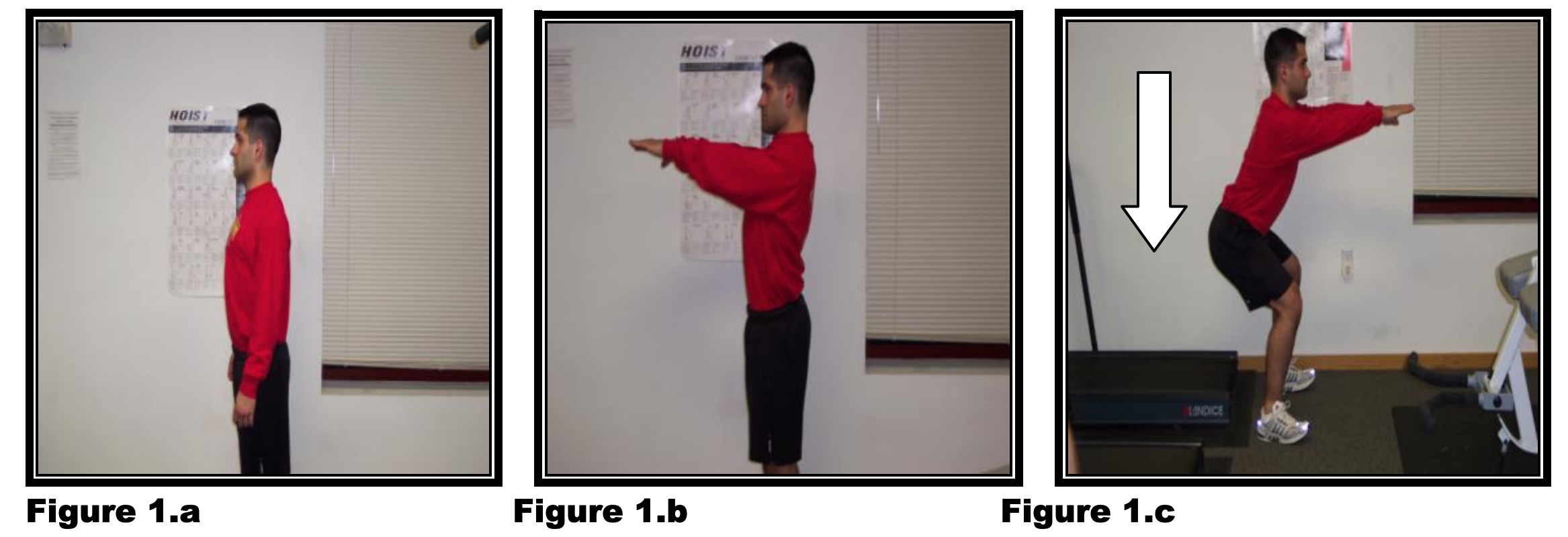
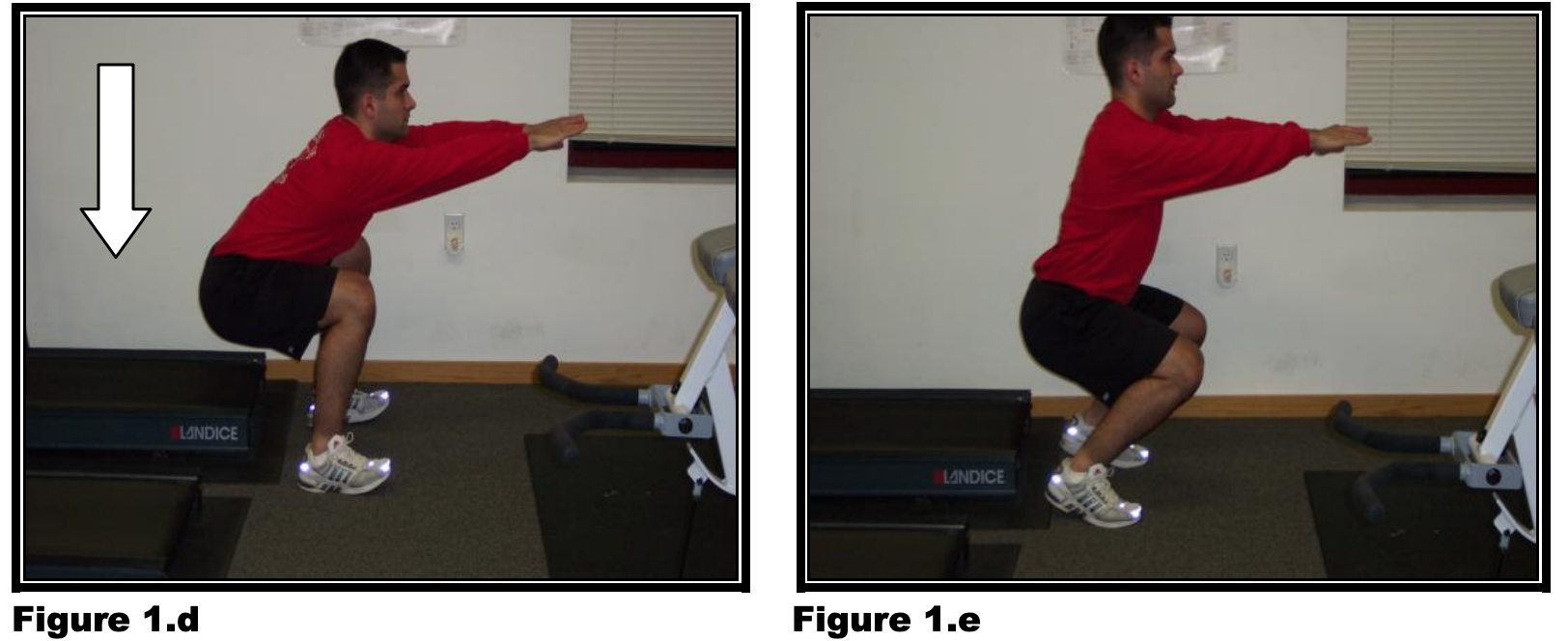
By pushing the hips back we ensure that our knees are in a safe position. From the side, you can see that the knees are behind the toes (Fig 1.d). Once our knees move in front of the toes (Fig 1.e) we stress the knee joint which if repeated over time can cause pain to that area. As you squat down there should be a weight shift towards the heels. This shift helps the hips to “sit back” and the knees to be in the safest position.
... Download the full goalie article here
