

Hip Conditioning
All the time we are hearing about players with groin and hipflexor injuries. Or that chronic hamstring injury that never goes away. Worst of all is a sports hernia. The bad news is that these things are problematic and can sometimes be very serious. The good news is their likely hood is very easy to reduce. All that is needed is a basic program involving some static stretching and basic strength training exercises.
Often times what happens is a player has his or her favorite stretch and exercise. They will repeat these things often and develop an asymmetry. It is very common to see a player that has stretched their adductors a lot and never the hipflexors. Also players have performed only knee dominant type leg exercises with a partial range of motion. Not squatting deep enough to really involve the glutes and adductors heavily.
These very common and avoidable mistakes present very serious issues with regard to long term hip health. So here are some things that I have used to avoid these problems. A few good stretches and strength training exercises can go a long way. Hopefully they will be something you can add to your program.
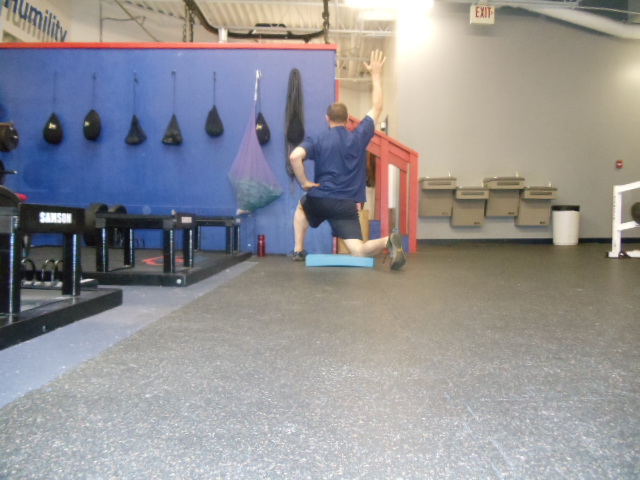
Hipflexor with rotation This is simply a basic kneeling hipflexor stretch. However, the right hip is internally rotated. This will allow for greater lengthening of the psoas muscle. An often problematic muscle because it gets short and tight.
Piriformis Stretch This is a great stretch for the piriformis. It will give the player's hip a bit more internal rotation. A lack of internal rotation is common among players who get sports hernia injuries.
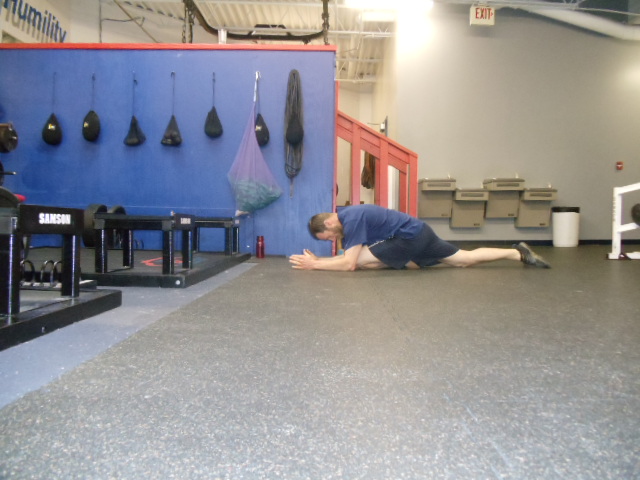
Groin Stretch I like this stretch much better than the old butterfly stretch. There is much less nueral inhibition which allows for great length of the adductors to be achieved.
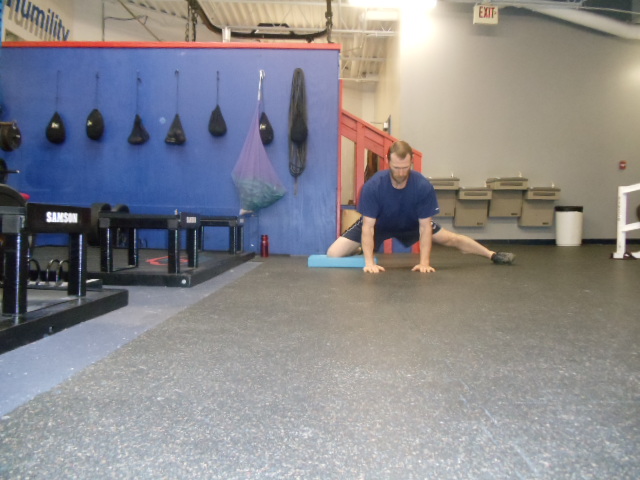
Hamstring Stretch I use this hamstring stretch a lot. Don't allow the players to slouch forward. Keep a straight back and push the hips back like an SLDL. Also, in this picture I am turning my pelvis to the left to get more stretch in the left hamstring.
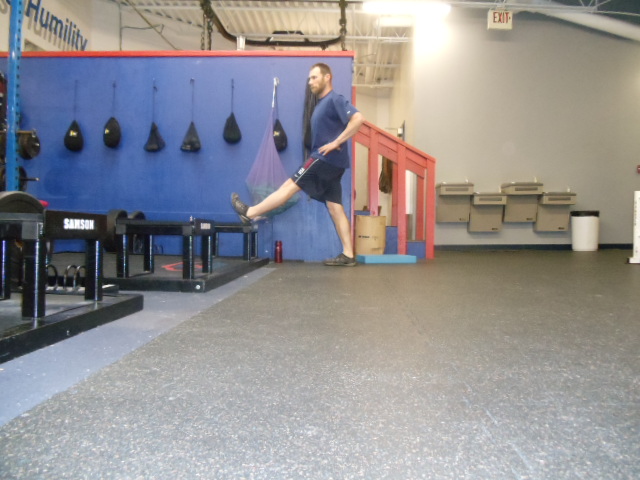
I also use split squats and lateral squats a lot in my programs. I think squatting in multiple planes of motion is important because a skater's stride involves pushing in different planes.
