

How to Adjust a Training Program When You Don't Have All The Equipment
‘Should You Stick to the Recipe?' is a must-read article for every strength coach, but especially for young coaches.
It's a fundamental premise of program design: beginners shouldn't be combining or rewriting programs, they should be following recipes. However, this concept overlooks one aspect: practicality.
To an extent, we're all chefs. In order to perfectly replicate a recipe, you need to be in the same logistical situations.
The same access to equipment...
Identical training schedules...
Similar clientele (age, training age, injuries, et cetera).
And that's almost never the case. In my experience, I can't think of a single time where I've actually gotten to follow the sample program to a tee.
We may be cooks, but we're not cooking in the same kitchen with ingredients coming from the same place.
When I started out running youth classes, I followed the MBSC templates. But I had fifteen to twenty middle schoolers in a relatively small space. Logistically, it became impossible, and I had to make adjustments.
Later when I worked for Devan McConnell at Umass Lowell, I made him print out every workout from the whole summer for me, and all the previous season's in-season workout.
The keys to the program. In my hands. Cue the evil laugh: Bwhahahahahah.
For some more context, in the fall of 2018, I started moving my services to online training, planning for my impending move from Vermont to New York City. By the time I got to Lowell, my private personal training had moved to 100% online.
With online training, every single program has differences, most often based on equipment availability.
A Devan McConnell program, for those unfamiliar, is littered with technology and equipment that isn't in the typical gym. Many of my online clients, even though they were hockey players, worked out at normal gyms.
Not a single client had:
-
Brower lasers (or any lasers. No, not even lightsabers or Buffalo Sabres) to time sprints. This is a facet that Mike Boyle and Devan, among others, have regarded as the biggest change in their programs over the last few years.
-
A Just Jump mat, or any other device to measure vertical jump.
-
An Assault Bike
-
A safety squat bar - A must-have for Devan, this would have been a nice-to-have for my clients.
-
Keiser machine
Fewer than half of my clients had:
-
A sled, another daily staple of Devan's programming. In his in-season college program, it was even the main lower body lift on one of the two days.
-
Med balls and an appropriate med ball wall.
And a few stragglers (high school kids working out at home) also didn't have:
-
A cable machine for chops and lifts
-
A trap bar
So, all my attempts to just follow Devan's program were thwarted. I would have to use my brain to do my job after all. Dammit.
Fortunately, I do have one of those, and I had to use it to think of substitutes that got the closest to the intended purpose of each exercise.
It was like translating. What makes translating texts so difficult, as I learned in my Poetry in Spanish class in college, is that it's often impossible to translate phrases. You have to translate the meaning of the phrases.
In translating Devan's programs into applicable programs for my clients I had to do the same thing.
I couldn't find the most similar exercise, I had to find the right exercise that got the closest to the same goal.
Let's start with easy ones:
Timed sprints would have to be done with a stopwatch. Rather than 10 yards, I prescribed 20 yards so that the stopwatch became a bit more accurate.
Vertical jump measurements, we did both counter-movement and non-countermovement jumps by reaching for a measurement on the wall. Fearing they wouldn't actually be able to jump their max because they'd focus on reaching and tapping the wall, I had my athletes do three jumps: two measuring the height and one not measuring.
Trap bar jumps: Just hold dumbbells at your sides.
Weighted Broad Jumps: At Lowell, we used the Keiser. My athletes used bands (don't try it with a cable machine). Some of my clients have a hill at their house, and did uphill broad jumps.
Chops and lifts: I bought my athletes a resistance band (25lbs seemed to be around the right resistance) and replaced chops and lifts with anti-rotation presses. No, it's not the same exercise, but it accomplishes the same goal (antirotation).
Bike conditioning: most athletes had access to a stationary bike, just not an Assault Bike or AirDyne. On a normal bike, you have to manually change the resistance, so five-second bike sprints don't really work. You just can't ramp up and get the power output you're hoping for. So 5 seconds hard and 25 seconds easy (5/25) became 15/20. I progressed from there.
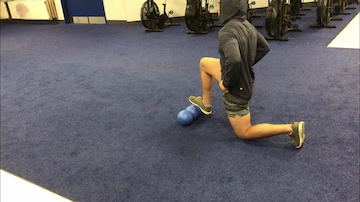
Rear-foot elevated split squats: I had one client (now playing Division III, and a beast in his own right) graduate from his gym's dumbbells. But, he didn't have a vest or a safety squat bar to keep increasing the weight. He was previously comfortable with front squats, so we moved to a Front Split Squat. We tried a Front RFE Split Squat, but it was too much to set up—also just super hard. Front split squats worked well for him. Fortunately, by that point in the offseason, we didn't do them for long because he shifted to higher velocity stuff.
What got a bit more tricky:
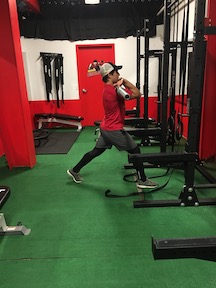
Sleds: The sleds depended on the variation. We replaced heavy forward sleds with a unilateral leg exercise. Which, I know, isn't ideal because these are on the same day as our “main RFE” for the week. So, I kept the reps low and encouraged them to not crush themselves. Also, one of the benefits of the sled is there's no eccentric stress, so on its replacement, we never had a tempo component. FFE (front-foot elevated) split squats (which I wrote about for Muscle & Strength) I played around with here, as well as skater squats.
If it were a “sled bound” or sled run, I replaced it with actual bounding or a similar plyometric. If they had a vest they wore it.
Med balls: All right, these are the toughest.
MB chest throws: Because of the setup of the program, the MB chest throws were a part of a French Contrast set along with bench press and plyo push-ups. For those unfamiliar with French Contrast, just go get Triphasic Training by Cal Dietz. However, I'll summarize here:
The idea is you take the same movement and go:
-
Heavy
-
Medium-light
-
Medium-heavy
-
Light
In Devan's program this looked like:
-
Bench press (heavy af)
-
MB Chest throw (16-18lbs)
-
Plyo push-up (bodyweight)
-
MB side throw (6lbs)
Or, with the lower body:
-
Heavy sled push
-
Single leg plyometric with stabilization
-
Trap bar jump
-
Sprint
So, for med ball chest throws I had athletes do decline plyo push-ups. They put their hands on a bench and did five plyo push-ups.
MB side throws: I just took them out. RIP MB side throws. (Does anybody have any ideas? If so please share.)
MB slams: I had them take a cable or resistance band, and keeping the same cues as the slam, bring the band down quickly from the top.
Here's what the program looked like. Actually, this isn't a real person's program, it's a hypothetical program where I would have had to change as much as possible. In real life clients mixed and matched what they needed, of course. I highlighted everything that I changed from Devan's program.
The program in Excel if you're one of those people who actually understand Excel. Must be nice (hey, @AdamVirgile)
You can learn S&C from the best chef's in the world, and have their whole book of recipes. But you're still going to have to translate those programs into what's practical for your athletes.
-------------------------------------------
About David
David is a writer, personal trainer, the head editor for SCAPH, co-owner of Roman Fitness Systems. Originally from Vermont, he resides in New York City. He loves books, pop-punk music, Vermont maple syrup, and heavy split squats.
He's also quite the handsome cat, so you should follow him on Instagram (@davidrosalesfitness), and Twitter (@dwrosalesvt)
