

Effects of Early Hockey Specialization on Hip and Groin Function
Thank you, Matt, for sharing these research findings with us.
Matt is a former Junior hockey player, who is now a physiotherapist and graduate student in the Ice Hockey Research Lab at McGill University. Matt has worked with athletes of all levels including youth, high school, collegiate, and professional. His current interests include hip injuries, in particular hip injuries in hockey players. You can read more from Matt at www.be-elite.ca.
Follow him on Instagram @alwaysbeelite or Twitter @mkellypt.
-------------------------------------
Long-Term Effects of Early Hockey Specialization on Hip and Groin Function
The opportunity for young hockey players to hone their skills are endless. Some kids can be on the ice 4-5 days per week from September to March with their minor hockey teams. Then there's travel team in the spring, hockey camps and summer league in the summer, and conditioning camps before tryouts in September. I get it, I've been there. Nobody wants to waste an opportunity to get better and the best way to get better at something is to practice. But is there a cost for spending so much time on the ice?
What Does The Research Say on Early Hockey Specialization?
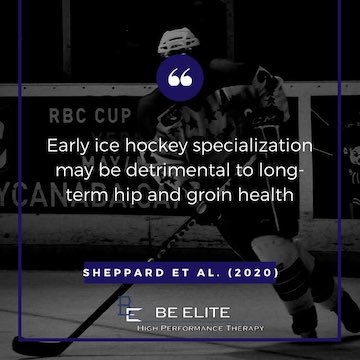
In a recent study, Shepperd et al (2020)(1) looked at the effect early hockey specialization had on hip and groin function in 187 male and female NCAA Division III and club hockey teams. They divided the groups based on three sport specialization criteria. Participants were asked if, at any point before grade 9, they:
1) quit other sports to focus on hockey,
2) trained for hockey more than 8 months out of the year or...
3) considered hockey more important than other sports.
They were then stratified into high- (3/3), moderate- (2/3), and low- (0-1/3) specialization groups. Hip and groin function was evaluated using the Copenhagen Hip and Groin Outcome Score (HAGOS) questionnaire to assess symptoms and function over the previous week.
The results showed that highly specialized players reported greater symptoms and dysfunction in all 6 subscales of the HAGOS while moderately specialized players reported greater symptoms and dysfunction in 2 of 6 (Symptoms and ADLs) than the low-specialization group. The total HAGOS scores also showed that females experience greater hip pain and dysfunction than males and that years of hockey played were not related to HAGOS score. In other words, being highly specialized in hockey before grade 9 was shown to lead to greater hip and groin pain and dysfunction in college hockey players regardless of the number of years played, with females having more issues than males. You can read the full study here.
There is also research to support hip and groin dysfunction originating in youth hockey players. Evidence of the early development of larger asymptomatic CAM deformities has been shown in elite youth hockey players as young as 10-12 years old when compared to elite youth skiers (2). There is also evidence that the size of CAM deformity continued to increase with age and with cumulative participation until growth plates fuse, which was not the case in youth skiers (2). Although these players were asymptomatic, it can be taken as an early sign of overuse and dysfunction as CAM deformities are often associated with symptoms of FAI (3), limited hip range of motion (4,5), labrum tears, and chondral damage (2). The repeated high-velocity hip abduction, extension, and external rotation of skating and fast changes of direction are thought to create abnormally high forces across the hip. This can lead to non-contact overuse injuries such as FAI, labrum tears and other hip and groin pathology.
With Regards to Early Hockey Specialization, Where Do We Go From Here?
The biggest takeaway from this study is that young hockey players shouldn't be on the ice year-round. Yes, players need to skate to improve, but they also need to develop other skills, learn other movements, and be exposed to a variety of environments to become better athletes. When working with young teens, learning how to move well and becoming an overall better athlete should take priority over becoming an elite hockey player. Although this may not necessarily prevent things like CAM deformities and labrum tears down the road, it will reduce the cumulative load on the hips and hopefully lead to longer careers with less hip pain and dysfunction.
References
Related Articles
Has the Early Hockey Specialization Pendulum Swung Too Far?
