

Off-Season Hockey Conditioning
The goal of off-season conditioning is to physiologically prepare the body for the demands of pre-season hockey. When designing an off-season conditioning program, the following things need to be taken into consideration:
• Playing time
• Work to rest ratios
• Movement patterns/body positions
• Intensity of movement
• External loading
Using this information, you can begin to implement hockey conditioning progressions into your off-season training. At Endeavor, we use two slideboard conditioning progressions simultaneously: An external loading progression and a work-to-rest ratio progression.
Loading Progression
The goals of the loading progression are to help ease the transition to off-ice training without equipment to similarly high intensity movement on the ice in full equipment, and provide a greater stress to the hip musculature in both acceleration and deceleration patterns to help minimize the risk of pre-season hip flexor and adductor injuries.
• Phase 1: Body Weight
• Phase 2: + Weight Vest (~12 lbs)
• Phase 3: + Weight Vest + Vertimax Resistance (Hip or Ankle)
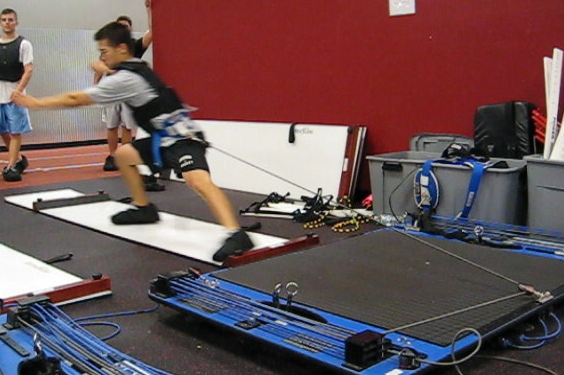
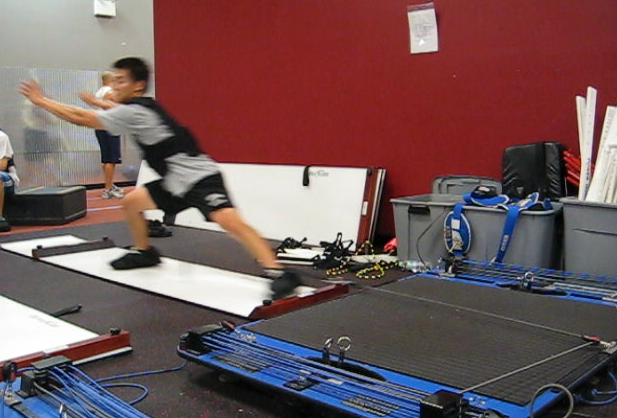
Hip- and ankle-resisted slideboard work
Interval Progression
We use time-based intervals, opposed to heart-rate based intervals for two reasons. First, we don't have heart rate monitors for every player. Secondly, and probably most importantly, it's my opinion that heart rate may be a more physiologically relevant measure, but time is a more hockey-specific measure. Simply, the referees don't wait for your heart rate to recover to some baseline value before dropping the puck. This idea comes back to the main purpose of the conditioning: To best prepare the player for the demands of the sport.
• Phase 1: Traditional Intervals
o :15/:45, :30/1:00
• Phase 2: Heart Rate Accommodating Intervals
o :15/:15 -> :15/:30 -> :15/:45
o :30/:30 -> :30/1:00 -> :30/1:30
• Phase 3: Chaos Intervals
o 3-5 sets of (:15/:15, :30/1:00, :10/:30, :45/1:30)
o 3-5 x (:10/:10, :30/:30), 3-5 x (:10/:20, :30/1:00), 3-5 x (:10/:30, :30/1:30)
Most shifts in hockey last from 20-60s depending on the player, game situation, and level of play. Most shifts also have a stoppage or two and involve periods of gliding. As a result, a 30s shift doesn't always mean 30s of all out effort (a common misconception).
We generally start our off-season conditioning with work:rest ratios of 1:2-1:3. Not only is this somewhat hockey specific (depending on the number of lines on a team, among other things), but these work:rest ratios are great for breaking people into conditioning programs that aren't used to high intensity intervals. We'll use both short intervals (e.g. 15s) with an emphasis on explosive movement and long intervals (e.g. 30s) with an emphasis on maintaining good body position.
The recovery time after the first interval is substantially shorter than the recovery time from a later interval (for example, the 7th interval). By transitioning to “heart rate accommodating” intervals in phase 2, we create a slight overload on the body's systems.
The “chaos intervals” in the third phase are the most hockey-specific. Sometimes shifts are long; sometimes they are short. Sometimes players get a lot of rest; sometimes players get very little. Using short and long intervals with varying work:rest ratios truly mimics the predictably chaotic nature of hockey.
As the off-season progresses, our players move from conditioning 2x/week (Phase 1), to 3x/week (Phase 2) to 4x/week (Phase 3). As the conditioning frequency increases, the volume of strength work decreases substantially. The conclusion of this progression has players working at maximal effort with external loading and intervals similar to what they will see on the ice. With that said, it's important to note that every player is still going to need a transitional period of on-ice work to fully transfer the off-ice conditioning gains to on-ice performance. If you have the resources, it would be advantageous to perform 1-2 of these conditioning sessions each week on the ice during the final phase.
