

Own Your Career
Own Your Career by Justin Roethlingshoefer
My young obsession with hockey and starting out uneducated about basic training and nutrition fundamentals inspired me to read and research. I attended university and established myself as a strength and conditioning coach. I had a quick ascension up the ranks of my profession culminating in employment with the Anaheim Ducks and their minor league team.
I thought I had everything I could want in a career by the age of 27.

Then there are those who are forced to make a change because of circumstances. They have no choice. That was me.
I enjoyed working with the players and my fellow coaches. I was building relationships with players, but guys were coming and going constantly from the team. There had to be more to what I was doing. I wanted to make a real difference in their lives beyond the simple aspect of training, nutrition, and recovery. Brett Bartholomew talks about buy-in, coaching, and leadership. It's more than looking after a player when they walk into the room, but rather seeing them as a person and caring about them deeply, and that includes their mental, emotional, and spiritual well-being. I witnessed the toll it took on the players balancing family, daily pain, pressures of the season, relationships amongst the team, addictions, and other issues that can cripple even the strongest person. I saw the way the guys struggled with addictions, whether it was painkillers or other prescription meds, over-the-counter medications, or alcohol and drugs. For some players, unfortunately, it was all the above.
To the outside world, I was excelling. Inside, I was so conflicted.
I certainly didn't feel fulfilled, more like a lack of purpose, and I didn't like the revolving door of relationships with the players. I wanted to do more but wasn't allowed. I felt as if I were selling myself and those I served short, but I didn't know how to change my circumstances. Hockey was my comfort zone, provided my livelihood, and was all I had ever aspired towards.
What happened next changed the trajectory of my career and was ultimately a blessing in disguise. Because of the charity work, I began to do with Athletes for Care in my Florida business, players began to ask me about CBD products. These are topical creams or oils derived from cannabis (marijuana) to help with pain management without the psychoactive ingredient THC, therefore providing a plant-based pain reliever.
Guys began to approach me because I was educated on the topic and they perceived me to be a safe person to talk to. I always wanted to be a coach for the player instead of coaching for the organization. That is probably because of how I felt as a player when I played hockey. It wasn't easy to find a coach who cared about you as a person. I didn't want to be like that. I tried to make the players feel like they were part of something, that I cared about them and genuinely wanted the best for them.
Players deal with pain constantly, and when they came to me for information about CBD products, I really wanted to educate them. A lot of the players were already using CBD products without knowing their properties and obtaining it from places that they knew nothing about. They saw or heard someone was using it and getting good results, so they wanted to do the same thing. That happens so much in sports. If something works for one player, ten others want to jump on the bandwagon. Besides teaching them what CBD products were and why they worked, I felt it was important to advise players to look for companies that did third-party testing on the products to make sure they were safe and effective.
This did not go over well with the team management group. They asked me if I understood the drug policies of the NHL league. I told them I absolutely did. Then they asked me if I had been administering and distributing CBD and banned substances to the players. I replied an emphatic “NO” and explained I was educating them on what was out there, what was banned and was not.
Team management placed me on official suspension and conducted an investigation. They accused me of profiting from distributing and selling banned products to players.
This all began on December 18, 2018, and an email circulated to the entire organization detailing the reason for the suspension and investigation. No one was allowed to contact me and I felt the deepest sense of abandonment, like I was, placed on a deserted island. It was Christmas Eve when I received the call that confirmed the investigation results—they weren't able to find any incriminating evidence regarding the accusations. However, they were still going to part ways with me.
I lost my job over that whole situation.
I wasn't even on an island anymore; I was cast out to sea in a boat without an oar or a sail. That's how it felt going into 2019.
Our career provides our livelihood and the means for food, shelter, and clothing we need. Seventy years ago, our means of making a living were often passed down from one generation to another. Your father was a farmer, so you inherited the farm; your dad was a cabinet maker, so you learned the trade. In actuality, this still happens today. For young people who don't follow their own aspirations or don't take advantage of education, they only know what they grow up with. You know that when you finish high school you will go to work in the local industry. If the business thrives, that's where you work for the next 40 years.
Then there are those who go after what they want and pursue their passion.
With college more accessible, despite the expense, young men and women can train for the career they want, or create the career they believe in. My short but intense career arc illustrates this. For many people, their career isn't what they do, but who they are.
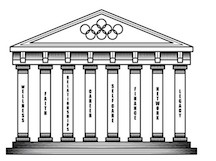
Have you ever found yourself in a room of strangers for a social occasion? What would be one of the most common opening lines to start a conversation with someone? I believe one of the top three questions you would ask someone is, “What do you do for a living?” Isn't that how we identify ourselves? In ancient days, you would identify yourself by your family lineage. “I am Justin, son of David.” Now, our job is our identity for many people. Our career has become our all-encompassing identity. When I was dismissed from the Anaheim Ducks organization, I could resonate with that loss of identity. I was still a strength and conditioning coach, but I no longer worked in the NHL, so I felt it diminished my self-worth.
As you have seen with every pillar we have explored so far in High Performance Living, a person has a broad spectrum to choose from when they try to determine where they fit with any specific pillar. Career is no different. There are various categories to choose from when you think about where you are in your career. You could be:
• Happy in your career and looking to advance.
• Wanting to change careers completely.
• Considering your job as temporary while deciding what you want to do.
• Starting your own business.
• Seeing no reason to get out of bed because you hate your job.
A common assessment for most people regarding their career is: do they like it, do they feel fulfilled, and do they feel they receive fair compensation? This ends up being a sticking point that plagues many people. Are you doing what you want to do or are you doing what you have to do?
Often, we end up taking a job for the money. We say it is temporary until we find the job we really want. Well, twenty years later, with kids in college and retirement closer, we're still in the same job. I know someone who loves golf and was good at it. His goal in college was to retire at 45 and play golf for the rest of his life. He became a very successful hedge fund manager and his wealth skyrocketed. He got married and had two kids. Forty-five was not that far away. Something happened around forty years old, though. Both children developed serious medical conditions. He owned three houses and a place in New York City. Suddenly, instead of retiring, he needed to keep making money to support his kids' medical needs and, quite frankly, he and his wife enjoyed their lifestyle. So, someone who is financially sound can also find themselves “stuck” in a career. When we talked about the relationship pillar, I primarily wanted you to think about the relationship you have with people. Now, though, think about the relationship you have with your job or career. If you love it and you are content, fantastic. If you aren't, you do have to come to terms with how you think about your career and what to do with it.
I have never met someone who hated their job and loved their life.
It's impossible if you're striving for organic happiness. Change is possible and absolutely necessary, especially if it's going to affect your overall well-being.
As you contemplate your career, I challenge you to focus on what you do in your job on a daily basis. Don't worry about how much money you make, what others would think if you switched careers, if you pursued a big promotion, or if your standard of living changed. Initially, pretend your career is sitting in a glass case untouched by any other considerations.
For so many of us, life goes 200 mph, and we never take the time to reflect on any of the eight pillars. I think this is especially true in our careers. You might have some vague notion you're meant for more or your dream job isn't exactly what you thought, the same as I did when working for the Ducks. Reflect on your career without making any rash decisions.
Such periodic reflection allows you to make the adjustments you need to meet your goals regarding your career. As a human being, you change. What might be true today in your career could be different five years from now or even next year. Don't think how you feel now, or how you felt when your career began, will stay the same. Indeed, many people who feel “trapped” in their job think change is not an option.
Allow yourself the freedom to consider what your true calling is.
Don't judge yourself as you search. If you love what you do, then you can ring the bell because that's a satisfying feeling. Don't feel bad, though, if you aren't all that happy in how you are making a living. To have an accurate and authentic evaluation of how you feel about your career, write down the first descriptive words that come to mind when you think about it. What is your “gut feeling” or first response? Then you can evaluate your thoughts and feelings and begin to put a plan together to get where you want.
After reflecting on these questions, then you can add other factors to unpack what direction you want your career to take. Money, location, amount of work, travel requirements, etc. can all come into play. Constantly refer to your values as the filter to examine all parts of your career.
1. What emotion do you attach to your career?
2. Do you control your career or does your career control you?
3. Make a list of things you like about your career.
4. Do the “con” list of what you don't like.
5. If you stayed in your current career, what would be the next career milestone for you to reach? What is your ultimate goal?
6. Write down any other education requirements or prerequisites you need to reach those short-term and long-term goals.
7. Do you often think of a different career?
8. If the answer is yes, what do you need to do to make it a reality?
9. How is your identity wrapped up in your current career?
10. Write a paragraph or two on what your ideal career path would be over the next year whether you are staying with what you currently do or if you wanted to change or branch out into something different.
