

Quantifying Athleticism in Hockey
Quantifying athleticism in hockey
When selecting players for your teams, consider the following two approaches. Do you pick A) good hockey players and then try to make them more athletic, or B) good athletes and try to make them better at hockey?
If you're interested in winning the next tournament you take part in, the chances are that you'll follow route A. However, if you're ‘in if for the long haul', you really need to start thinking about treading the path to B.
Recent research(1) has shown that exposure to a number of sports at a young age enhances fundamental movement skills, promotes long term engagement, and leads to a reduction in future injuries due to improved gross motor coordination. These fundamental movement skill are the basis of physical literacy, and include stability (maintaining balance and reacting accordingly), locomotion (moving the body from one place to another) and manipulation (using movement for sending, receiving, or travelling with, an object)(2). Basically put, the more athletic the individual as a youngster, the more successful they will be in learning and performing new skills as they get older.
Over in the UK, I work for the English Ice Hockey Association. For most of its history, the EIHA has adopted strategy A. It sort of made sense. The talent pool here is small. We currently have 4,170 registered junior (under 18) players. The USA has over 307,000 and Canada has over 500,000(3). With such small numbers by comparison, it is hard for a coach to overlook the league's top scorer, just because they don't have a great VO2max score. However, things are starting to change. Since taking the (voluntary) role of Head of Strength and Conditioning two years ago, I have worked hard to change the perceptions of the coaches and managers of the junior national teams. The national team selection camps now include informed athletic testing which ranks players according to their overall athletic ability, the results of which are given to coaches for them to consider alongside scouting reports and notes they have made over the camp.
So how do we rank them? We use a method called Total Score of Athleticism (TSA), developed by Anthony Turner of the London Sport Institute at Middlesex University(4). TSA is simply a statistical model – it can be adapted to any sport. I'll provide a quick overview of how it works, and then explain how it can be adapted for hockey.
How TSA works
Consider the fitness test results in the table below:
|
Athlete |
1RM Squat (kg) |
30m Sprint (s) |
Pro-Agility (s) |
Countermovement jump (cm) |
|
A |
95 |
4.7 |
10.2 |
27.2 |
|
B |
110 |
4.6 |
9.8 |
25.5 |
|
C |
105 |
4.5 |
11.1 |
21.2 |
Which athlete is the most “athletic”? The answer is: you can't tell. Comparing a sprint (measured in seconds) to a jump (measured in cm) doesn't make sense. However, if you convert test results into z-scores (which simply put, are unit-less values based on where the athlete ranks in comparison to the group average), a comparison of a jump to a sprint starts to make sense (at least in a quantifiable way).
Once all scores are converted, they can be added together to give a total – hence Total Score of Athleticism. That way, an athlete may not possess great strength, but has above average speed, agility, power, balance etc, and therefore ranks high up the list. I then use a ‘RAG' rating system (that is, red, amber, green) to quickly show coaches who are the above and below average performers. In turn, the coaches use this data to help with squad selection. I also use this to monitor the athletes over time, as it allows me to see who is working on fitness away from the camps.
How can TSA be used in hockey?
As mentioned, TSA can be adapted to any sport – it really just depends on what parameters you consider important for that sport. A few years ago I published an article in the Journal of Strength and Conditioning Research discussing what might be considered when testing hockey players(5). To summarise, I concluded that acceleration, speed, agility, aerobic capacity, power and strength are important factors. Given the restraints I work under with the national teams, we streamlined this work to give us a workable testing battery, made up of a 5m sprint, 20m sprint, hand grip strength, countermovement jump, squat jump, and the YoYo IR1. Once this data is collected, it is fed into a formulated Excel spreadsheet which looks like Figure 1 (below). A simplified version is then provided to coaches.
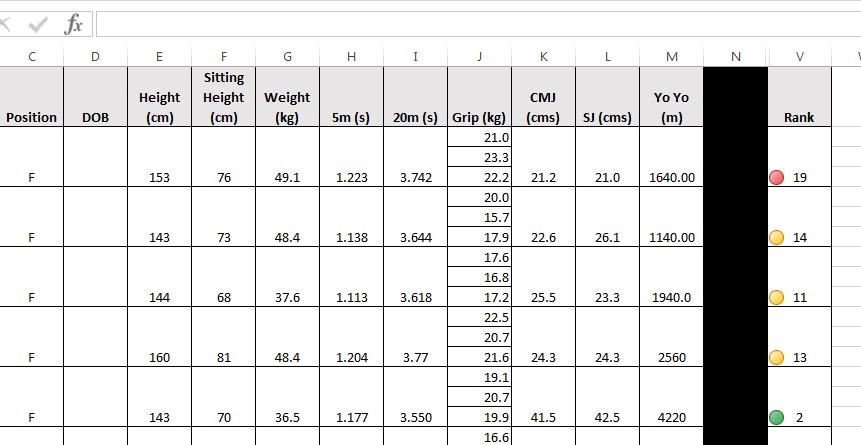
Figure 1: Example TSA Excel sheet.
What else do we do?
Alongside this testing, anthropometric data is collected. We are working with junior athletes (from 10 years old to around 17), so tracking their maturational status is important. In addition, the players are put into ‘athletic situations' (a fancy way of saying we make them play soccer and basketball) to watch for elements we can't really test for – for example spatial awareness, decision making and competitiveness.
The size of the talent pool isn't going to change overnight. But I'm not really about overnight changes. The use of the TSA, alongside continued training and education of the athletes from an early age at the national team training camps, is starting to highlight just how important ‘athleticism' is, and how we are looking to find athletes first, and hockey players second.
References:
- Lloyd et al. (2015). Long-term athletic development- Part 1: A pathway for all youth. Journal of Strength and Conditioning Research. 29, p.1439-1450.
- Mandigo, J., Francis, N., and Lodewyk, K. (2007). Physical Literacy concept paper. Ages 0-12 yrs. Canadian Sports Centres. Vancouver, BC.
- International Ice Hockey Federation. IIHF Member National Associations. Available at: http://www.iihf.com/de/iihf-home/the-iihf/members/. Accessed 22nd October 2015.
- Turner, A. (2014). Total Score of Athleticism: a strategy for assessing an athlete's athleticism. Professional Strength and Conditioning. 33, p13-17.
- Nightingale, S., Miller, S., and Turner, A. (2013). The usefulness and reliability of fitness testing protocols for ice hockey players: a literature review. Journal of Strength and Conditioning Research. 27, p.1742-1748.
