
The 3 Keys to Making Your Testing Fit The Environment
I am sure many readers are aware of Anthony Donskov's new resource, “The High Performance Hockey Podcast.” I was fortunate to be invited as Anthony's guest for the third episode of his new show, and a large portion of our conversation was centered on fitness testing in the sport of hockey.
One of the points I tried to home in on is: that depending on a number of factors, we need to make a chosen testing battery fit well for any situation. In this follow-up article, I want to expand on the concept and highlight three aspects that need to be considered before choosing the appropriate assessments for your hockey team: Resources available; reliability and validity of the tests; and reproducibility of the tests.
1) Resources Available
Resources include things like budget, equipment, work force, time, space, etc. More often than not you will be limited in at least a few of these, but it should never be an excuse to let the quality of your data collection and your analyses suffer.
During my time at the University of Alberta we were limited by budget and equipment; however we had an abundance of student volunteers to bolster our workforce, and coaches supported allocating time for testing, and we had ample space. Nevertheless, we had to test 500+ athletes, across 24 different teams; meaning we needed to be efficient without sacrificing quality of the athlete experience and data collection.
A situation where significant limitations in budget, equipment, and work force recently presented itself when I was asked to help with the fitness testing for my former University team, the Augustana Vikings. They hired a new coach in the 2021 off-season. Since the new coach and I already had a good relationship, he asked for my help in implementing fitness testing with his new team.
Being a proud member of the alumni, I was happy to lend my time, in turn that helped navigate the budget issue. However, there was still the matter of equipment restrictions and qualified personnel to help run the testing. Here it was a ‘bang for your buck' type of scenario. What would provide the best all-around evaluation of the team, but require minimal resources?
Resource Availability in the NHL
In my current work situation with an NHL organization, there are very few limitations on resources. The question here goes from:
What tests will provide us with the best information, but require minimal equipment?
… to
What tests will provide us with the best information? Period.
The Keiser Leg Press, for example, is a machine that can safely take an athlete to a maximal load in a progressive fashion over ten individual repetitions and give force, power, velocity and limb symmetry numbers for each of these repetitions. It is a fascinating piece of equipment that can safely and seamlessly be built into testing and training, providing the coach with a plethora of valuable information, but expensive and cumbersome. However, if it is within your means it is an incredible tool to have in your toolbox.
One of the challenges that the performance staff in my current situation is faced with is deciding what doesn't make the cut for your testing battery, because you can very quickly become overwhelmed with information.
2) Reliability & Validity of the Test
Going back to the University testing scenario, my colleagues and I decided to take a combine type approach where athletes signed up throughout the day in 15 minute time slots and in groups of 4-7. The benefits to this were that every athlete went through the battery of tests in the same order, and the same testers would run one station for the entirety of the testing day. This model was also efficient, as each athlete could complete all tests in roughly 45 minutes.
When it came time to choose which assessments to include, we decided that a well-rounded combine, providing an outline of the athlete's overall fitness, would be best. This gave us an opportunity to see what, if any, patterns emerge in certain sports and how fitness changes throughout an athlete's eligibility.
If you look at images 2 and 3 below, you will see some interesting data we found by looking at averages across all male and female varsity athletes. It turns out that the average varsity athlete, regardless of gender, will peak in their third year of eligibility.
With this approach in mind, the test selection was put in place to provide an assessment of the following qualities: Anthropometrics; full body strength; lower body power; speed; agility; and aerobic fitness.
From there, we chose tests that would provide an accurate and reliable evaluation of the previously mentioned qualities. The tests used were as follows: Height; weight; seated height; wingspan; grip strength; mid-thigh pull; vertical jump; broad jump; t-test; 20 m sprint; and beep test. For equipment we used a stadiometer, tape measures, scale, grip dynamometer, mid-thigh dynamometer, vertec, timing lights and a stereo. All relatively inexpensive, readily available and portable.
We also encouraged individual teams to add in more testing that was relative to their sport, if they saw fit. Examples of this included the hockey teams using on-ice testing and the volleyball teams using the block and spike jump in their lower body power assessments.
Image 1: An athlete having his wingspan measured at one of the common testing areas used at the University.
Image 2: Interesting findings on Male varsity athletes and how their fitness changes throughout their five years of eligibility.

Image 3: Interesting findings on Female varsity athletes and how their fitness changes throughout their five years of eligibility.

The only pieces of equipment the coach of the Augustana Vikings could get his hands on were a vertec and a chin-up bar, so I decided to test lower body power, upper body strength and aerobic fitness. The tests I suggested were vertical jump, broad jump, single leg lateral jump, chin-ups and beep test.
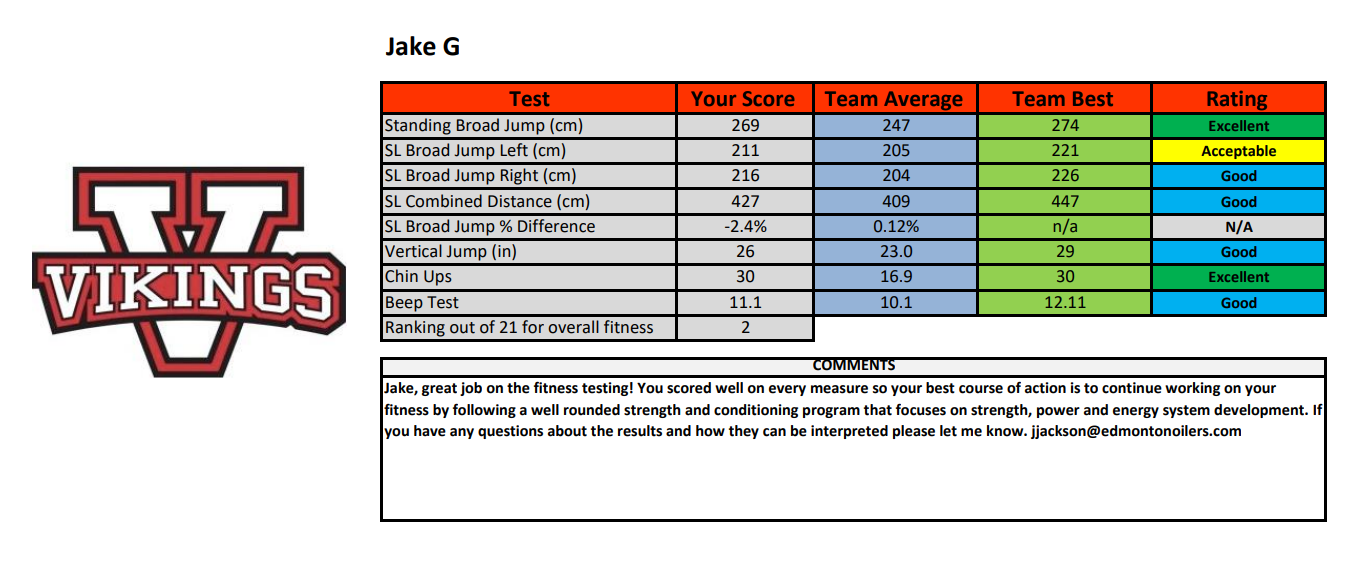
The thought here was that we would at least get a good indication of the players lower body power by assessing it in the vertical and horizontal plane as well as unilaterally. All in all it was a simple testing battery to implement and can be easily added to if the team has the means to do so in the future. How I tried to add value for the coach and players was through the analysis and communication of the results. Below you will see an example of what the players received for feedback afterwards.
Image 4: Feedback template provided to the Vikings players.
With the Edmonton Oilers, we try to capture data with chosen assessments on the following qualities: Force development; concentric rate of force development; eccentric rate of force development; velocity; conditioning; mobility; hip/shoulder/trunk stability; and body composition. As a performance staff, we try to establish the importance of the fitness testing by effectively communicating results to the athletes and using the data to help guide a more individual focus on certain training days. There's always the inherent risk of injury with most of the activities an athlete undertakes in a testing or training environment, but we should always place importance on the safety of the assessments and lowering the risk of injury as much as possible.
3) Reproducibility of the Test
Arguably the most value fitness testing can provide is in the return to play setting. If you have baseline fitness values for an athlete who is working their way back from an injury, it can be instrumental in setting the most accurate benchmarks in the rehab process.
If the athlete in question is able to come within 5-10% of a previous performance metric, it will provide that individual and their coaches confidence that they can return to competition with minimal risk of re-injury and perhaps even more important, perform at a level similar or better than what they were at pre-injury. In order to use baseline numbers the tests used need to be reproducible, which depends on a number of things, including equipment availability and logistics.
At the university, we had access to a number of sophisticated pieces of testing equipment; including metabolic carts, isokinetic dynamometers, force plates and hydrostatic weighing. The metrics these tools could provide are intriguing; however, we couldn't feasibly incorporate them into a combine that 500+ athletes needed to make their way through. Barriers like location, portability and cost prevented the use of many of these measures, and for the same reasons it would have also made it difficult to reproduce the same testing environment for an athlete returning from injury and needing to retest. In this scenario simplicity reigns supreme.
Augustana's coach and I talked through several different testing options, which included bringing the team to Edmonton to test at a neutral location, or bringing equipment to them in Camrose (an hour south of Edmonton). Both scenarios would have provided a more robust testing protocol, but at the cost of low reproducibility. We found a small amount of equipment that he could get consistent access to and built the assessments out from there.
In my current role, we do our best to keep our testing in-house, so that all assessments are easily reproducible. At one point, the club used the VO2 max as a measure of aerobic fitness at training camps.
There is no question that this test is one of the gold standards for measuring the efficiency of the aerobic energy system, but it wasn't easily reproduced. If an athlete needed to be retested it required them to go off-site, and even though it wasn't a massive inconvenience, it still added another layer of scheduling, cost, and time. It ended up taking a significant amount of energy from the athlete in a nonspecific manner, where we want all available resources going towards improving their game.
When players are coming back from an injury, something like a VO2 test can't be performed until later stages of rehab and by that time everything on ice is ramping up. With that in mind, we have tried to turn our focus towards on-ice monitoring and testing by using tools like Catapult. With this wearable tech we can design on ice programming that is easily monitored and progressed according to the injury.
Through consistent communication with our coaching staff, and monitoring several key parameters from Catapult, we can appropriately periodize the on-ice training stimulus and know exactly where they are from a performance standpoint, throughout the return to play process. This allows us to put stock into a sport specific model that is non-invasive and safe, which typically translates into exceptional buy-in from the athlete and confidence in their ability when they insert back into the line-up.
Conclusion
Whenever you find yourself in a situation where you need to put forth an effective fitness testing battery for a group of athletes, make choices that will give you the best bang for your buck. Find out what resources are available first, then let reliability, validity and reproducibility guide your assessment choices. On top of this, if you can provide good feedback that can help the athletes take appropriate steps to improve potential limiting factors, you are on the right path.
About Joel
Joel Jackson is the assistant strength and conditioning coach of the Edmonton Oilers and the co-founder of Competitive Thread, a company that provides on-ice speed testing technology. You can find him on Twitter (@joeljacksonsc) and Instagram (@jackson_joel)