

The Benefits of Floatation Therapy
Thank you, Stéphane, for this great overview of floatation therapy.
Originally from Windsor, Ontario Stéphane played his junior hockey split between junior B and the OHL before moving to Vancouver to play 4 years of varsity hockey at the University of British Columbia while earning a Bachelors of Kinesiology in 2007. After graduation, Stéphane began his professional hockey career in Epinal, France and went on to play 10 seasons in France's Elite League Ligue Magnus) while also serving as his team's Strength and Conditioning coach. After retiring from playing in 2017, he moved into the full-time role as the Head of Strength and Conditioning/Sport Science for his former team Bruleurs de Loups de Grenoble. Stephane also is the Co-Founder/Owner of the Float Centre “Silence” in Grenoble, France where is lives with his wife and 2 children.

I, for one, am excited to hear Stéphane's French accent, but maybe that's just me. Maybe we will tease that out in our upcoming podcast.
Enter: Stéphane Gervais
-----------------------------------------------------------------------------
What is Floatation Therapy?
Previously known as Sensory Deprivation, floatation therapy is more often referred to now as “REST” which stands for Restricted Environmental Stimulation Technique.
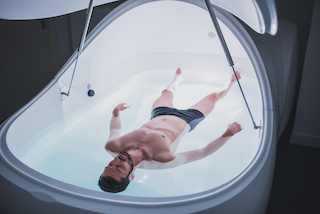
This practice takes place in either a float pod, cabin, or a traditional float tank. The person lies down in about 25cm of water that's heated to the temperature of your skin and saturated with over 1000lbs magnesium sulfate, better known by its street name EPSOM SALTS.
The float pods are free from all external stimuli, no light or sound will disrupt the floating experience. In essence, you can't sense anything.
There are numerous benefits to floating, ranging from a decrease in stress and anxiety, improved sleep, reduction in chronic pain, and aiding in muscle recovery.
So Where Is The Link To Strength And Conditioning And Hockey?
In April of 2017, I retired from professional hockey after playing 10 seasons in Europe. For 8 of those 10 seasons, I also served as my team's Strength and Conditioning coach, a role that I now occupy full-time with my former team. A few months after retiring from the game, two teammates and I opened our own Float Centre called “Silence.”
I discovered floating back in 2010 in Vancouver. I had graduated from the University of British Columbia a few years earlier and loved coming back to live there in the offseason. I was only a few years into my pro career when a friend of mine, Mike, introduced me to the floating practice. I was always looking for new ways to improve performance and longevity and Mike, who now owns Float House, was running an underground float business out of his North Vancouver apartment. A bit sketchy but once you are inside the darkness of the float tank, it doesn't matter where you are.
Much like when I discovered Yoga, I was hooked after the first experience. With yoga, it was the mind-body connection, but with floating, it streamed down to a much deeper level. Lying weightless, hovering on top of the warm water, after only a few minutes I could no longer tell where my body ended and the water began. All of the tight muscles were releasing and letting go.
I also found it to be the perfect environment for meditation. Meditation is a practice with a multitude of benefits, that has existed for centuries, yet most of us struggle to connect with it. With no light, no sound, and no external stimulation, I was able to just drift off and completely lose a sense of the time. When the music came on at the end of the 60 minutes to signal the end of the float it felt like only 15 minutes had passed.
I was thinking I might be on to something here…
Coming out of a float is not like after a sauna or hot tub where you feel relaxed but also just drained. You're boosted. Since your senses were basically in OFF-MODE for 60 mins, they are now in a heightened state. Things seem brighter, you are more alert and aware.
It doesn't stop there either, some of the best nights of sleep come after having floated that day. Is it the magnesium in the water? Is it the nervous system reset? While the ‘nervous system reset' is a bit more nebulous, there's lots of research on magnesium's positive impact on sleep (1). And, although most of that research is done with oral magnesium, there's a debate about the efficacy of absorbing magnesium via the skin (2). Regardless, bringing it back to the senseless environment, there's promising research about floatation therapy reducing anxiety (3), which would, of course, also help us unwind and sleep better.
Many first-timers are a bit worried about feeling claustrophobic?
For true claustrophobic people, the most important thing is knowing they can control their environment. They're not locked in the float pod and are able to open the door or turn the light on at any time. They can even leave the door open if they choose. What has been remarkable is that they don't report feeling closed in but actually the opposite as when it is total darkness, they feel like they are floating around in outer space!
How We Use Floatation Therapy In a Team Setting
With our team here in Grenoble, France we encourage the players to float as often as possible and begin to develop it as part of their routine. Since improved sleep is a great benefit from floating, we often have the players come in for a session after a road trip after spending the entire night on the bus after having played a game. Getting to spend an hour suspended in a magnesium-rich warm water solution, their body weightless and free from all external stimuli. Not only do they leave relaxed they also have improved sleep that night.
For professional athletes, being able to consistently perform at the top of their game will determine how long a career will last. With 2-3 games per week being able to physically recover is a big part of a player's performance. A study published in the Journal of Strength and Conditioning Research examined the acute effects of floating on muscle recovery and found that it helped reduce lactic acid in the blood allowing you to recover faster from hard training sessions (4).
Since there are so many benefits to floating, often we encourage our players or clients to come in with an intention. Their intention could be as simple as to just get a break from all the noise and distractions to as complex as mentally preparing for a competition.
The external distractions which allow the left brain to dominate are basically shut off during the floating experience, allowing us to relax and more easily activate the right brain.
Since floating has been shown to activate the “right brain,” which is responsible for creativity and visualization, we have many high performers come in to specifically work on their mental game.
Floating can be something very different from one person to the next. So when asked the question “what is floating”, I try to use language that connects with the person asking.
You can frame floating as a nervous system reset, a visualization, a muscle recovery tool, and a sleep aid.
Without a doubt, floating is a unique experience allowing us to disconnect from all external stimuli to better connect with ourselves.
