

Posterior Femoral Glide During Hip Joint Mobilizations
Posterior Hip Joint Mobilizations Are a Common Technique Used in Patients With Hip Pain and Hip Impingement.
This type of treatment is often performed to restore normal joint accessory motion, such as a posterior femoral glide with hip flexion to decrease impingement in the anterior hip.
For hockey players, the hip can often be a source of pain and dysfunction. With the high prevalence of CAM lesions and FAI often limiting hip ROM and causing impingement symptoms, maximizing and maintaining the remaining available hip flexion, within anatomical constraints, can be essential for skating performance.
But does performing this technique truly create enough mechanical translation — Translation is the sliding or gliding of the bones that is required for a motion — to improve hip flexion?
What Does the Research Say About Femoral Glide During Hip Joint Mobilization?
Loubert et al (2013) attempted to measure femoral translation during a posterior hip joint mobilization using ultrasound.
They had the participants lie supine with the hip flexed to 45 degrees as the examiner applied a posteriorly directed force on the hip equal to 50% of the examiner's body weight. They found small translations with posterior hip mobilizations (0.8-4.2mm) and no relationship between mobilization force applied and glide amplitude. They also found that the tangential glide during hip flexion, described as the gliding of articular surfaces during angular motion, to range between 43.2-64.8mm. This suggests that the average translational glide is about 4% of the average tangential glide.
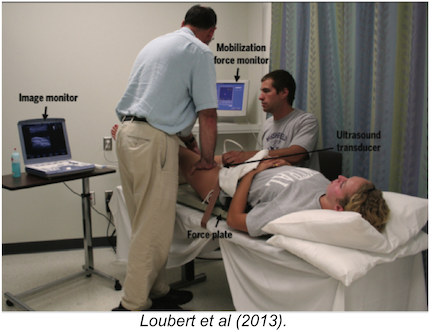
In other words, the study found that a posterior hip mobilization may not lead to a significant mechanical increase in hip joint ROM considering the small portion of translational glide for the total tangential glide necessary for full ROM. Theoretically, the small magnitude glides make sense when considering the anatomy of the hip joint.
When we think of the ball and socket analogy for the hip, there shouldn't be much arthrokinematic motion because of the congruency of the joint.
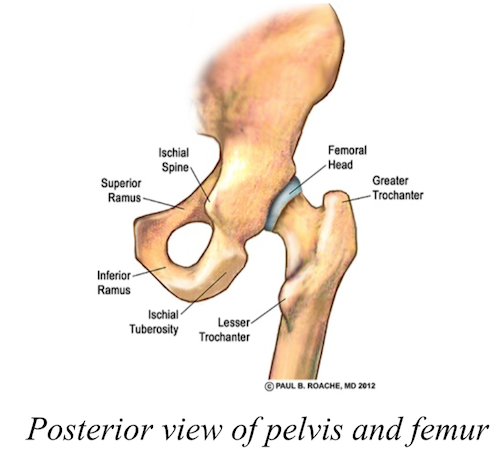
Additionally, if “normal” acetabular version is slightly anteverted, then any direct posterior force applied to the femur will be limited by contact with the posterior surface of the acetabulum. Performing a posterior hip mobilization in a resting position or even at 90 degrees may not necessarily lead to mechanical changes, but the authors suggest that performing such a technique at end range flexion or during angular motion (ie Mulligan techniques) where tangential motion is lacking may be more beneficial.
A lack of posterior translation in deep hip flexion could lead to early bony restriction and possibly soft tissue irritation of the anterior hip. By restoring the posterior translation at that end range, we could see a slight improvement in hip flexion and even a reduction in tissue irritation.
Other Benefits of Joint Mobilizations
Joint mobilizations can also have other benefits than purely mechanical. Bialosky et al (2009) describe many neurophysiological benefits of joint biased manual therapy, including decreases in pain, increased muscle activity, and improved range of motion.
The mechanical stimulus from the mobilizations is thought to create a chain of neurophysiological responses from the peripheral nervous system, spinal cord, and brain that lead to these outcomes. Although these outcomes are short-lived, they may be beneficial in accomplishing specific goals for a single session.
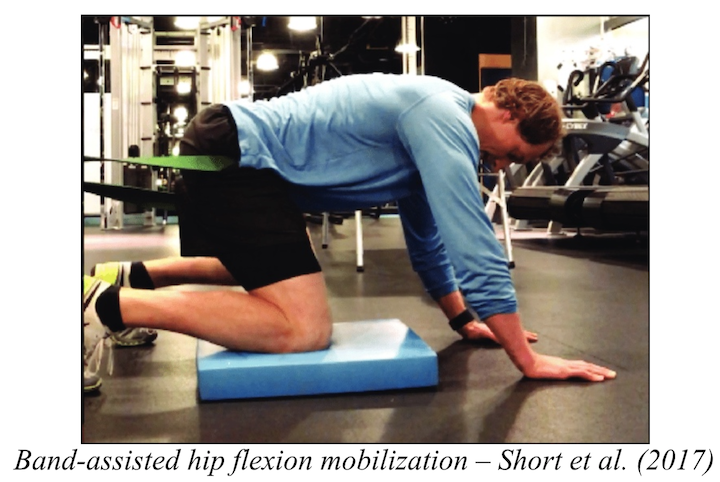
For larger deficits in hip motion, you may get more bang for your buck using other techniques than a posterior hip mobilization, such as foam rolling and basic hip stretches. If you're trying to gain end range motion, mobilizing at that end range or throughout the motion may give the results you're looking for. Joint mobilizations may also show short term improvements in pain, muscle activity, and ROM.
References
-------------
Thank you, Matt for this article.
You can read more from Matt at www.be-elite.ca.
Follow him on Instagram @alwaysbeelite or Twitter @mkellypt.
