

Conditioning with Mental Strength
Building mental skills training into conditioning allows you to double-up the benefits to your athletes without adding time to the training day.
You won't tinker with the protocol, instead, you'll package mental skills into your programming through mindful cueing. Incorporate confidence-building and mental training into workouts by adapting the way you instruct drills.
From our last conversation, you know mindfulness is ‘paying attention in a particular way.' You're effortfully present-focused, non-judgmental of your situation, and unattached to distractions or concerns over the past and future (Gardner & Moore, 2004; Kaufman, Glass, Pineau, 2018; Giges, 2011).
Athletes train to be okay with difficult situations and do their jobs under physical and psychological stressors through learning acceptance and willingness. Both qualities help players accept what's happening without dwelling on what's wrong, willingly experience the discomfort of it, and commit to performing when it's challenging.
Practicing acceptance and willingness often requires a difficult situation to:
1. Accept
2. Be willing to experience
3. Perform despite
Mindfulness During Conditioning
Conditioning recreates game-like physical and psychological stresses whether you're using ‘run/skate until this line' drills or small area conditioning games (Jeffreys, 2004).
Athletes will increase physical capacity while building skills to tolerate and perform in the presence of the difficult internal states they'll experience on game days (e.g. fatigue, challenge to stay motivated, time pressure).
To instill those qualities, create a challenging controlled environment and speak to it.
For example:
You've set up a 10-yard sprint with a 5-yard fly. Your athletes need to keep their intensity up in late repetitions. Ask what they're feeling like and remind them of what's normal.
Instruct your players to notice the discomfort and desire to ‘phone a rep in,' accept it as ‘just the way things are right now,' and commit to exploding into their sprint.
‘How you feel doesn‘t change what you need to do' is an easy reminder once you've given these instructions a few times.
You've set up an off-ice, non-sport-specific small area game that encourages change of direction (Tyler Travis of Mercyhurst Hockey builds creative, productive games into training if you haven't seen his posts).
After a few reps, remind your players that fatigue, time pressure, and a desire to take it easy are normal.
If they get distracted by what they're feeling, they have a specific task to focus on performing.
The ability to let what you're feeling just be while playing is easily promoted as a program differentiator.
Scott Cochran's 4th Quarter program took an all-encompassing approach to building culture, conditioning, and the mental game. It went as far as fans holding up four fingers in the 4th quarter because they knew about the program.
Bama built being 4th quarter dominators into their conditioning and culture.
How deep that culture and pride went was an incredible feat – it means players, students, and news outlets talked about it, coaches bought in, and finishing strong became a programmatic strength.
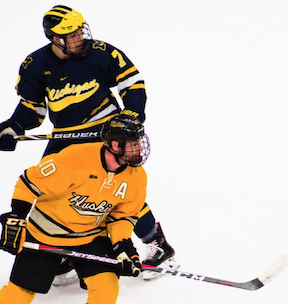
Conditioning Provides Opportunities to Build Mental Training Into Drills.
Your formula is: help athletes identify what they're feeling and when it's normal; accept normal feeling as ‘just how things are right now;' develop a tolerance (willingness) to experience challenging internal events by committing to and focusing on something performance-relevant instead.
With practice, players will learn to accept a situation ‘as is' without getting caught in their heads and build a habit of refocusing on the play on the ice.
As a fringe benefit, physical and mental preparation are facets of sport confidence (Vealey & Chase, 2008).
Celebrate mental and physical work done in the training and it might bump player confidence.
With thoughtful preseason training, players build confidence through preparation, mental skills for coping, and the physical capacity to play.
This is likely a new process and approach, so you're welcome to email me questions ([email protected]).
Two hockey strength coaches and I developed an online mental skills training protocol that supplements player warm-ups, called Win Your Warm Up.
WYW teaches athletes mental skills, building them into your existing warm up – it's a ready-made toolkit for coaches and athletes that eliminates the guesswork.
Feel free to email me.
I'm happy to answer questions and help you get mental skills training built into your season plan.
