

Teaching Hockey Players How to Run
You've all seen it: the wide choppy steps; zero hip extension; pumping the upper body. It's the hallmark of hockey players trying to run. A coach has lots of attributes to address with his or her players. Power, fitness, movement quality, readiness, and on and on. I'm here first and foremost to try to convince you that it's worthwhile to coach basic running technique. Second, I'll give you some simple ideas that can fit right into your existing plans.
Hockey involves concentrating leverage on sharp edges, upper body flexion, short bursts and a stick in at least one hand. Running involves distributing load, relatively steady-state exercise, the big toe, and tiny shorts. Not too similar, it would seem. Why should you bother trying to help your hockey players run more efficiently? Here are a couple reasons:
1. Running is all about control of your posture. Lose that and all kinds of things go wrong (figure 1). Many soft-tissue hockey injuries have the same root cause – poor control of proximal segments.
2. The forces acting on the core are similar in gait and skating. We're still subjecting the body to lots of single-leg stance demands.
3. Hockey players spend so much time in flexion that learning proper extension provides valuable balance. Those of you unhappy with your hurdle-step scores can reap major benefits.
4. Many hockey players won't get paid to play. If they do, it won't be for very long. Once they retire, running is a common way to stay in shape. Unfortunately, many people get hurt running to stay in shape. A little coaching can help them be fit and healthy for life.
Running Basics
In our lab we use fancy technology to drill into every detail of a runner's (or golfer's) mechanics. And yet the basics remain much of what we coach and preach. Here are a couple primers to get us started.
1. Posture. What matters is where the foot lands. P osture dictates so much of that. Whether you heel strike or not is actually pretty irrelevant. Compare figures 1 vs. 2:
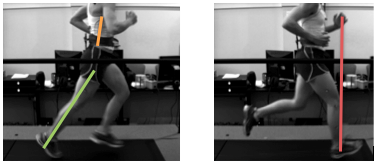
Figure 1: Loss of posture (broken lines) leads to a foot strike too far in front of the body. She is just slowing herself down and stressing the knees, IT band, hip rotators, and lower back.
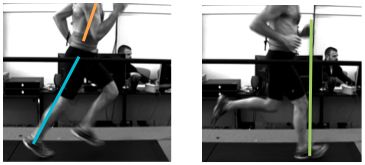
Figure 2: Better posture allows the foot to land closer to the hips. There is less braking (eccentric) stress.
2. Use the tendons for “free speed.” It's no accident great distance runners have high calf muscles with a very long Achilles tendon. Ideally, the calf is like your hand holding the top of a slinky (figure 3). It just tensions the spring, letting it boing up and down without interruption. It's the material properties of the tendon (or slinky) that make this so efficient.
a. It becomes clear that ankle dorsiflexion (and 1st MTP head) is incredibly important. We need that mobility to allow the Achilles to do its thing.
b. Here you'll note a pretty big difference between running and hockey. The boot and shin pad set-up can restrict ankle dorsiflexion. That makes practicing dorsiflexion even more valuable.
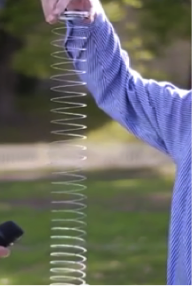
Figure 3: One key to effortless running? Yep.
3. It's all in the hips. A common running instruction is to pull or rip the ground behind you and that's unfortunately not great advice. Pulling exaggerates lumbar erector involvement which creates our poor posture seen in figure 1. Now the quads/knees have to do lots of extra work as the next foot lands too far in front of the body. Note in figure 4 how our running coach is ready to push down into the ground. That's much more of a hip/glute contribution. We want hip extension with minimal lumbar extension.
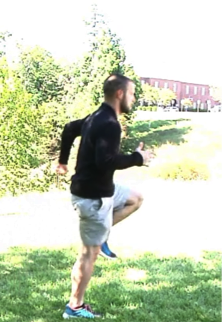
Figure 4: Posture sets the table for hip drive - it's more push than pull
4. Big toe is king. About 80% or so of your balance should be through the big toe. This requires a stable arch and good posture. In general hockey players are in good shape here as learning to use edges requires a lot of arch stability. Some will have foot injuries that make this tougher.
Room for Improvement
OK, so where do hockey players go wrong and what can we do about it? Skating often takes place in upper body (esp thoracic) flexion. This makes true hip extension rare. Good running involves 10-20 degrees of hip extension. In skating, the hips significantly abduct for several reasons. If that carries over to running it's a ton of wasted energy. Finally, the arm action in skating is more rotational. For running we don't want to devote resources to rotation when the goal is straight ahead. Let's take a look at how to clean up some technique with simple drills.
1. “A” drills. Just like in figure 4, the posture is long with a slight lean from the ankle. Each step only covers about ½ a foot length but the hips drive the foot into the ground.
a. Most of you likely do warm-up drills. There's no need to change what you do, just the posture and foot placement of the people doing it. Have them be tall with a slight lean from the ankle and maintain that posture. Whether it's high knees, butt kicks, or skipping, focus on posture.
2. Run the line. A track, sidewalk, or bike lane all provide nice feedback. Each foot should touch a piece of the line to reduce that tendency to abduct and chop the stride. Again, we're not re-inventing the wheel or adding time to your workouts. These are simple coaching cues that pay off.
3. Run, don't jog. Most of you probably do this already. We want true hip extension and slow jogging rarely provides it. Tempo/interval pacing will help drive extension home – the key for you as a coach is to help them be in the right posture without pulling with the lower back and reaching the foot out.
4. Let the elbows drive with relatively loose arms. This makes the arm action more efficient.
5. Lean from the ankles. This keeps the heel down a fraction longer to recoup the vast potential of the Achilles. We need ankle mobility and hip flexor length to do this – two things you probably already address but now have another venue to reinforce.
Running is a great tool for hockey players and a little coaching can increase the benefits. Remember, none of them want to be bad at anything. You get the added bonus of another venue to reinforce posture, core control, and hip extension. They get an opportunity to improve on a skill they'll likely use for life. All without adding time to the things you already do. That's a pretty good deal.
Max Prokopy is the director of The UVA SPEED Clinic, one of the foremost motion analysis laboratories in the world. The Clinic uses 3-D motion capture to find the root causes of injury and reduced performance.
